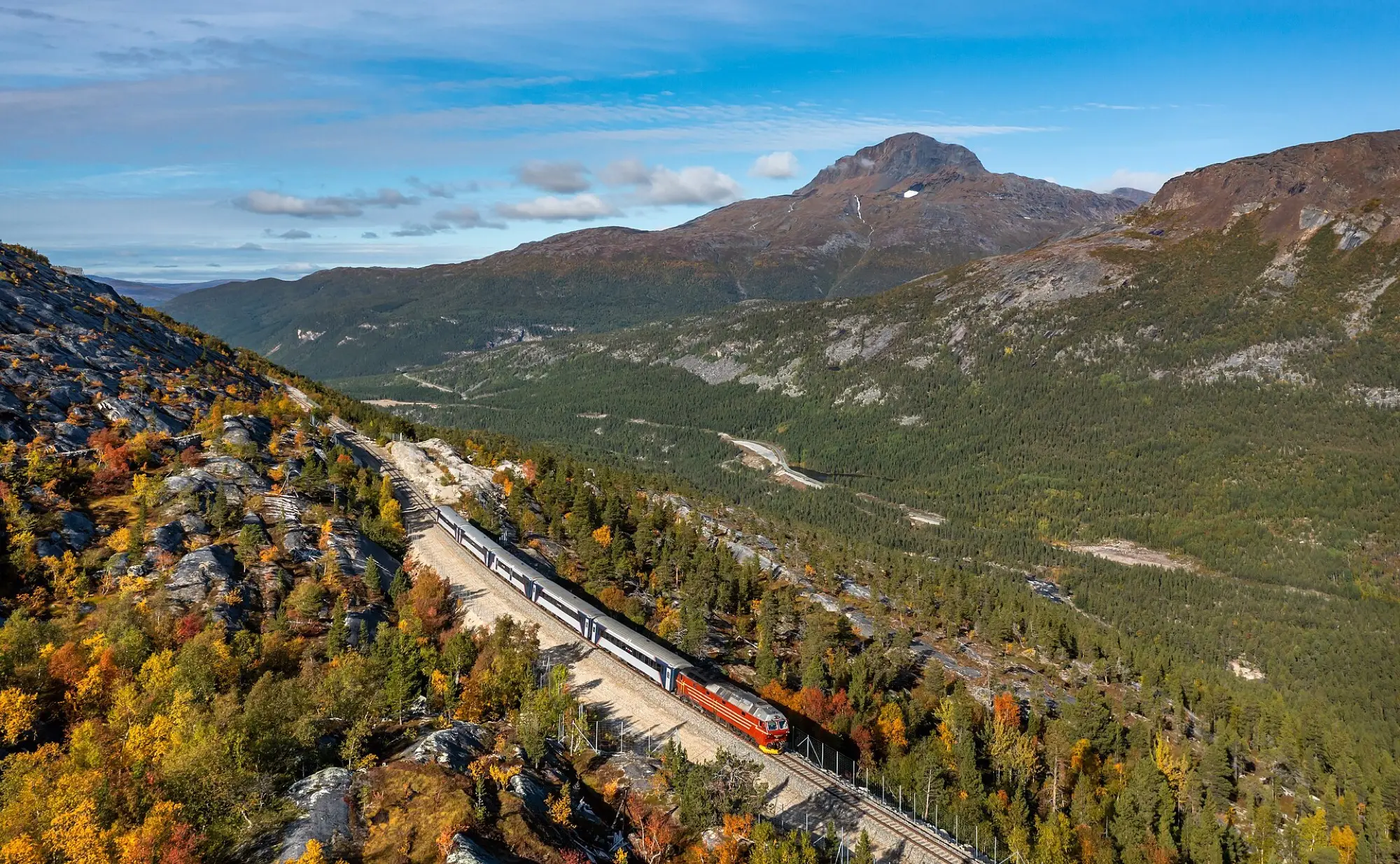

Travelling Norway by train centres on five main scenic routes: the Bergen line between Oslo and Bergen, the Flåm Railway from Myrdal down to Flåm, the Rauma line from Dombås to Åndalsnes, the Dovre line between Oslo and Trondheim, and the Nordland line from Trondheim to Bodø. A sixth route, the Ofoten line, is a separate stretch in the far north that connects Narvik to the Swedish and European rail network via the train between Stockholm and Narvik. Each line has its own operator, travel times, and practical booking rules you need to know before planning your route.
The five lines at a glance
Fjord Tours counts 7 scenic railways in Norway, with more than 3000 km of track between them. From Oslo the network runs in 3 directions; the lines meet at a few fixed hubs, so several can be combined in one journey.
| Line | Route | Length | Journey time | Operator | Season note |
|---|---|---|---|---|---|
| Bergen line | Oslo to Bergen | 471.25 km | 6.5 to 7.5 hours | Vy | all year, book early in summer |
| Flåm Railway | Myrdal to Flåm | 20.2 km | under 1 hour | Vy | all year, 4 departures a day in winter and 9-10 in summer |
| Rauma line | Dombås to Åndalsnes | 114.2 km | about one and a half hours | SJ | can close for landslides |
| Dovre line | Oslo to Trondheim | 548 km | about 6.5 to 7 hours | SJ | night train runs |
| Nordland line | Trondheim to Bodø | 729 km | around ten hours | SJ | night train not before mid-January 2027 |
| Ofoten line | Narvik to the Swedish border | 43 km | not given | SJ (Sweden) | daily train from Stockholm |
Vy runs the services in the west, while SJ operates the Dovre line, the Rauma line, and the Nordland line. Services from Narvik across the Swedish border are run by SJ Sverige. On the Nordland line, SJ states that the night train is not expected to resume before mid-January 2027, because a rebuilt locomotive is still awaiting approval.
1. The Bergen line: crossing the mountain plateau from Oslo to the west coast
The Oslo to Bergen train covers 471.25 km and takes 6.5 to 7.5 hours. It crosses the high mountain plateau, reaching its peak altitude of over 1200 metres at Finse, which is the highest point on the Norwegian rail network. Bane NOR lists this passenger service as line F4, run by Vy.
The Bergen line runs several times a day each way, with day trains and one night train with sleeper cabins. Between Oslo and Bergen you can usually choose standard class or a comfort class, which costs more and gives a bigger seat, more legroom, free coffee and tea, and a quieter car.
The Bergen line runs all year, but it is one of the most popular routes in summer, so book early if you want a window seat. In winter the Bergen line runs a little slower, as the train eases through the most exposed parts of the plateau. The Bergen line and the Flåm Railway meet at Myrdal, about 4.5 to 5 hours from Oslo and around 1.5 hours from Bergen.
2. The Flåm Railway: the steep ride down from Myrdal to the fjord
The Flåm Railway descends 20.2 km from Myrdal down to the fjord at Flåm, with a height drop of 863 metres from 867 metres above sea level. Around 80% of the route is at a 5.5% gradient, taking the train under 1 hour to complete the ride. Vy operates the line, which opened in 1940 and passes through 20 tunnels. In 2024 the Flåm Railway carried nearly 960,000 passengers, most of them in the summer months.
Berekvam is the only place on the single track where trains can pass each other. Seating on the Flåm Railway is free; you cannot book a seat in advance and choose one when you board. Going down from Myrdal, sit on the left for the best of the valley and the bends, including the Rjoandefossen waterfall. With fixed dates, book early, especially for July and August, when departures can sell out.
The train runs all year, with 9-10 departures a day in the summer season (May to September) and 4 a day in the winter season (October to April). The Huldra (a mythical forest spirit) performance at the Kjosfossen waterfall is there only in the summer months. For the short distance, the Flåm Railway costs a little more than most lines, and it connects with regional fjord routes featured in the Norway in a Nutshell itinerary.
3. The Rauma line: down the valley from Dombås to Åndalsnes
At Dombås you change from the Dovre line to the Rauma line. Branching off at Dombås, the Rauma line runs 114.2 km to Åndalsnes and is the only railway in Møre og Romsdal. SJ gives the ride between Dombås and Åndalsnes as about one and a half hours. The whole line was opened by King Haakon in November 1924, and Bane NOR lists it as line R65, run by SJ Norge.
The train passes Trollveggen, which SJ calls Europe's tallest vertical, overhanging rock face. On the way, the line crosses the Kylling Bridge over the Verma waterfall, which has appeared in films including Harry Potter and the Half-Blood Prince. In the sharp bend at the Kylling Bridge you can see your own train from the window. Lonely Planet named the Rauma line the world's most beautiful train journey in 2023.
The line runs through steep, landslide-prone terrain and can be closed for a time; the risk is higher in autumn and early spring, with rain and snowmelt. Check Bane NOR's or SJ's websites for the latest on the line before you go. The Golden Train is a separate return service between Åndalsnes and Bjorli on part of the Rauma line, with more narration about the landscape and the story of the gold transport. Fjord Tours lists the Golden Train trip as 2 hours 40 minutes, available all year.
4. The Dovre line: over the mountains from Oslo to Trondheim
The Dovre line runs 548 km from Oslo to Trondheim in about 6.5 to 7 hours; its highest point is Hjerkinn, 1024 metres above sea level. SJ has run the trains on the Dovre line and the Rauma line since June 2020. About 200 musk oxen live around Dovre, Hjerkinn and Kongsvoll, and you may see some from the train.
Lillehammer and Dombås are the most natural stops on the way. Besides the daily trains, SJ runs one night train between Oslo and Trondheim, where you sleep in a seat or a private sleeping compartment. Premium Pluss, on the Dovre and Nordland lines, is SJ's most comfortable seat, reclining up to 45 degrees.
5. The Nordland line to Bodø, and the Ofoten line from Narvik
The Nordland line connects Trondheim to Bodø over 729 km and takes around ten hours. It is Norway's longest railway line, completed in 1962 after 60 years of building. The Nordland line runs on diesel along its whole length. Its highest point is on Saltfjellet, 680 metres above sea level, where the line crosses the Arctic Circle at 66 degrees 33 minutes north.
Getting off at Lønsdal, less than two hours from Bodø, puts you on Saltfjellet, by the Saltfjellet-Svartisen national park. Tverlandet, two stops before Bodø, is less than 15 minutes from the Saltstraumen tidal current. You can book only part of the Nordland line, for example to Mo i Rana or Fauske, or break the trip with a night in Mosjøen or Mo i Rana. From Bodø, travellers can reach Lofoten by boat or plane. Regarding overnight services, SJ says the Nordland line night train is not expected to resume before mid-January 2027, because a rebuilt locomotive is still awaiting approval; SJ will put Nordland night train tickets on sale as soon as the final start date is confirmed. Those planning to travel onwards from the rail terminus can consult options for travelling past the end of the line towards Tromsø.
The Ofoten line is 43 km long, from Narvik harbour to Bjørnfjell at the Swedish border. The line opened in 1902, built to carry iron ore from Swedish mines to an ice-free Atlantic port, and ore trains still make up most of its traffic. At the border it continues on the Swedish side as the Malmbanan (the iron ore railway), over Kiruna and Boden to Luleå. Bane NOR lists the passenger line from Narvik to Boden, Luleå and Stockholm as F8, run by SJ Sverige. Narvik, the end of the line and Norway's northernmost station, connects to the Swedish and wider European rail network via SJ's daily train between Stockholm Central and Narvik, which arrives the following day. Visit Narvik calls the stretch between Kiruna and Narvik one of the most beautiful train journeys in Europe, with fjords, waterfalls and mountains, and advises booking well ahead in the winter and summer peaks on SJ's Swedish website, sj.se.
Night trains this winter
Overnight rail options are limited this season: the Bergen line and the Dovre line each offer one night train, whereas the Nordland line night service is suspended until at least mid-January 2027, with tickets going on sale once a resumption date is confirmed.
On SJ's night trains you can book your own sleeping compartment whether you travel alone or with a companion; it is charged on top of a Standard ticket. An SJ compartment has two single beds, two water bottles, towels and a sink; the toilet is shared, at the end of the carriage. Up to two adults and two children under 6 can share a compartment, and animals are not allowed in it except service dogs on duty. On Norway's night trains you must reserve a bed or a seat in advance, pass or no pass.
Tickets and fares, and how prices work
Most train fares in Norway work the same way; the cheapest tickets sell first and prices rise as a departure fills, so the earlier you book, the less you usually pay. Vy, Go-Ahead and SJ, the three rail companies a pass covers in Norway, can all be booked through Entur, the national travel planner.
SJ's Standard Non-flexible ticket is its lowest fare; it cannot be changed or refunded, and its price varies with the season and offers. A Standard Flexible ticket can be changed or cancelled up to departure, with a NOK 100 fee for cancelling in the last 24 hours. A reclining seat in Premium Pluss starts at NOK 499 on a non-flexible ticket.
With SJ, discounts are taken off a Standard Flexible ticket:
- Children under 6 travel free with an adult on a Standard ticket, though they need a ticket for a seat.
- Children aged 6 to 17 get 75% off a Standard Flexible ticket.
- Everyone aged 67 or older gets SJ's senior discount, 50% off a Standard Flexible ticket.
- Full-time students under 30 get 50% off a Standard Flexible ticket, and SJ accepts ISIC cards for international students.
Flåm Railway pass-holder fares are detailed in the next section.
Interrail and Eurail passes in Norway
Eurail became Interrail on 9 September 2026; there is now one Interrail Pass for every traveller, wherever they live, and Eurail passes bought before the change stay valid. You cannot buy a One Country Pass for the country you live in. SJ adds that someone living in Norway cannot travel in Norway on an Interrail pass, whatever their citizenship.
Most One Country Passes, the Norway Pass among them, are valid for one month with a set number of travel days, and you must start using a One Country Pass within 11 months of buying it. Age tiers apply as follows:
- Youth Pass: Travellers aged 12 up to and including 27 on the day the trip starts pay 25% less than the adult rate.
- Senior Pass: Travellers from age 60 pay 10% less than the adult rate.
- Child Pass: Children under 4 travel free without a pass; children aged 4 to 11 travel free with a Child Pass, up to two per adult.
With an Interrail pass valid in Norway you pay only the seat reservation fee. Interrail advises always reserving in Norway, because trains often get fully booked. For SJ trains with compulsory seat reservation, pass holders reserve through Entur by choosing the Interrail/Eurail seat reservation traveller, one passport holder per order, and must show the activated pass on board. First-class pass holders need a reservation in the upgraded carriages; it is free but must be booked locally, and on night trains first and second class make no difference.
The Flåm Railway is not covered by rail passes; pass holders get 30% off instead, with Interrail giving an indicative price of NOK 245 from October to December, NOK 260 from January to April, and NOK 315 from May to September. The Veøy bus from Åndalsnes to Molde gives pass holders 50% off, with tickets bought on board.
Combining the lines into one trip, and when to go
From Oslo the network runs in 3 directions; the lines meet at a few fixed hubs, so several can be combined in one journey. To see the fjords in the shortest time, Fjord Tours recommends combining the Bergen line and the Flåm Railway. For a trip from valleys and lakes to mountains, it suggests the Dovre line and the Rauma line.
The Rauma and Nordland lines are quieter than the busy western lines, with fewer people at the windows. Two more lines are worth knowing; the Sørlandet line from Oslo to Stavanger takes around 8 hours, and the Røros line from Hamar to Trondheim about 431 km and around 6 hours.
Deciding when to visit Norway affects crowds and fares. Summer, from June to August, brings the busiest trains; spring and autumn are quieter and often cheaper. May or September often gives the best mix of weather, seats and prices. Winter is low season on most lines. Most longer trains have a bistro car with coffee and hot food, and there is room for luggage by the doors. Mobile coverage can drop out in the mountains and in tunnels.
Winter, snow and closures
Some stretches of the Bergen line have no road connection in winter. The Bergen line is cleared of snow and ice every day, from the west in the morning towards the east in the afternoon. Bane NOR's heaviest snow blowers clear the high mountain sections of the Bergen line and the Nordland line.
On days of extreme winter weather Bane NOR now cuts the number of departures rather than stopping all traffic, a method it is developing with the train companies. In winter the Bergen line runs a little slower, as the train eases through the most exposed parts of the plateau. Because the Rauma line passes through precipitous, slide-prone ground, autumn rains and spring thaw can prompt temporary closures.