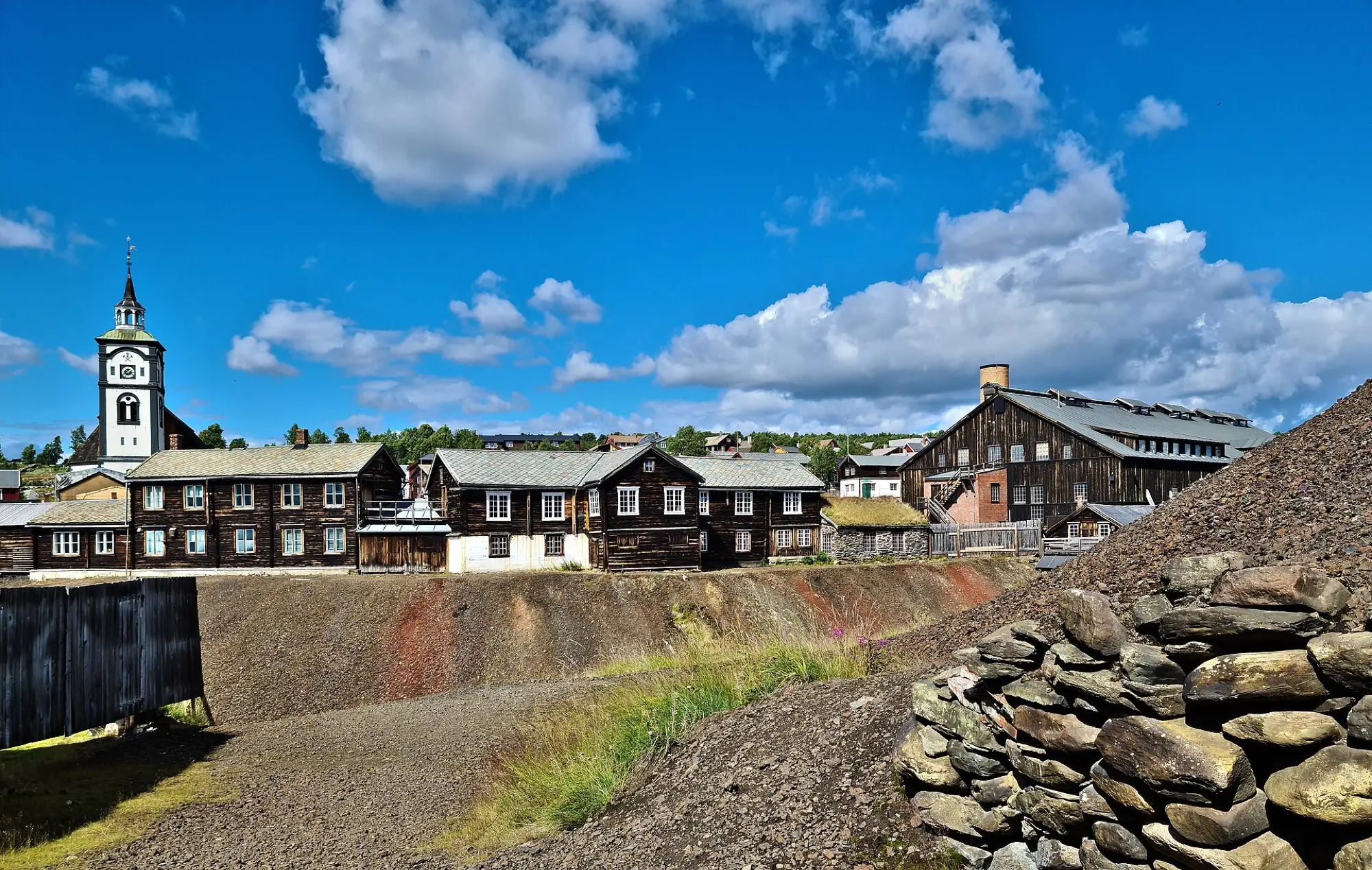

Røros Mining Town and the Circumference is a UNESCO World Heritage site shaped by 333 years of copper mining until 1977. Its two largest gatherings are the Christmas market, held from 3 to 6 December 2026, and the winter fair Rørosmartnan, running from 16 to 20 February 2027. Reaching the town by train from Trondheim takes about 2.5 hours.
The short answer
Copper ore was discovered in the mountains at Røros in 1644, giving rise to an industrial settlement that operated until the mining company went bankrupt in 1977. Today, the town's preserved core and surrounding landscape form a protected heritage area. The annual Røros Christmas market (Julemarked Røros) takes place over four days around the second weekend of Advent, running from 3 to 6 December 2026. The historic winter fair, Rørosmartnan, runs from 16 to 20 February 2027 for its 172nd staging. Rail services run regularly, with three daily departures connecting Røros with both Trondheim (about 2.5 hours) and Oslo or Hamar (about five hours from Oslo with an interchange at Hamar).
What Røros is, and why UNESCO lists it
The UNESCO World Heritage site comprises Røros Mining Town and the Circumference. First inscribed in 1980, the site boundaries were significantly modified and extended in 2010. The designated property encompasses the town alongside its industrial and rural landscapes, Femundshytta (a historical smelter and its district), and the winter transport route.
Trial mining began under Lorentz Lossius in 1644 after the discovery of copper ore. The first smelter was constructed in 1646 beside the Hitterelva river, forming the nucleus around which the settlement expanded. The Circumference was a circle with a radius of four old Norwegian miles (45.2 kilometres) inside which the copper works had first rights to minerals, forest and waterways. Swedish forces destroyed the settlement in 1679, after which it was rebuilt. Today, Røros retains approximately 2,000 wooden one- and two-storey properties and a smelting house, characterised by blackened timber facades.
During its 333 years of activity before bankruptcy in 1977, the enterprise yielded just over 118,000 tonnes of copper, establishing it as one of the largest mining operations in Norway. After the smelter was destroyed by fire in 1953, raw copper concentrate was dispatched to Boliden in Sweden for processing. The modern town has 3,897 inhabitants according to Statistics Norway (2025). The historic urban core remains fully protected with extensive listed architecture while operating as a living town, and more than 20 local Sámi families continue to work in reindeer husbandry.
Smelthytta, the museum on the old smelter
Smelthytta serves as the main exhibition building of the Røros Museum, which was founded in 1930. Smelting ended when the smelter burned in 1953 and closed for good. The last smelter building burned in 1975, and Smelthytta was rebuilt on its ruins in 1988. The facility is open all year, operating every day from 10:00 to 15:00.
Inside, the Copper Works exhibition displays detailed miniature working models that demonstrate historical mining techniques, water pumping mechanisms, and copper smelting processes primarily from 1650 through the 1800s. Smelting operations and ore yards ran 24 hours a day historically, pausing only for a midsummer recess when workers tended their farms. Smelting ceased permanently on site in 1953, and the underground mines ceased operations in 1977.
General admission to Smelthytta is NOK 150 for adults and NOK 130 for students and seniors. Children under 16 accompanied by an adult enter free of charge (not groups). Visitors buying tickets for Smelthytta, the guided town walk, and the Olavsgruva mine tour at the same time receive a 10% discount. For an individual adult, the combined tickets total NOK 530 at standard rates, reduced to NOK 477 with the 10% saving. The museum recommends booking tours in advance online or by telephone. The museum remains closed on 1 January, 1 May, 17 May, and 24 and 25 December.
Olavsgruva, the mine 13 km out of town
Olavsgruva served as the primary production mine for the copper works between 1937 and 1972. It was the final operational mine in the district, yielding 15,720 tons of copper over its working life. The site was preserved and opened to the public in 1979, followed by an official opening of the museum building by King Olav V in 1981.
Guided tours run for just over an hour, leading groups through the historic Nyberget mine and into Olavsgruva. The route reaches 50 metres beneath the surface and extends 500 metres into the bedrock to reach the miners' hall. The subterranean temperature remains at roughly 5 degrees Celsius throughout the year with humid air; appropriate warm clothing and solid footwear are required. All entrants are issued helmets. Children may join the tour (small children must be accompanied by an adult), though baby carriers are not advised. Because the path involves stairs, the underground route cannot accommodate wheelchairs or prams.
Olavsgruva is situated 13 km east of Røros along the Rv 31 road towards Brekken, where a left turn is signposted for the mine. There is no public transport serving Olavsgruva. Tour tickets are NOK 220 for adults and NOK 200 for students and seniors (under 16s free with an adult, not groups). During the summer season, guided tours operate daily in English and Norwegian, and an on-site café is open. The mine forms part of the wider Storwartz mining landscape, an area of about 4.5 square kilometres containing nine notable mines, where heritage markers provide QR codes for self-guided exploration.
The town on foot, and Røros church
Guided walking tours depart from Smelthytta and conclude inside Røros church, running for approximately 1 hour 20 minutes in Norwegian and English. The walk costs NOK 160 for adults and NOK 140 for students and seniors, with the church entry fee covered by the tour ticket.
The street network preserves the layout established during the 1600s, with wooden houses dating from the 1700s and 1800s forming the core justification for the town's initial 1980 World Heritage status. Prominent focal points include the slag heaps surrounding Malmplassen, as well as the preserved buildings along Bergmannsgata and Kjerkgata, the central street.
Røros church, referred to as "the pride of the mining town", was completed in 1784. With seating for 1,600 people, it ranks as one of the largest churches in Norway. For independent visits outside of the guided walk, the church opens on Saturdays from 11:00 to 13:00 between 15 August and 31 December, with individual adult admission priced at NOK 60.
Museum tickets and the winter schedule
The Røros Museum covers three primary visits, with discounts available when booked together. All tours should be booked in advance online or by telephone.
| Visit | Adult | Student or senior | Under 16 with an adult |
|---|---|---|---|
| Smelthytta | NOK 150 | NOK 130 | Free (not groups) |
| Guided town walk | NOK 160 | NOK 140 | Free (not groups) |
| Olavsgruva mine tour | NOK 220 | NOK 200 | Free (not groups) |
Purchasing all three visits in one transaction yields a 10% discount, lowering the adult total from NOK 530 to NOK 477.
Smelthytta remains open daily from 10:00 to 15:00. From 11 September 2026 to 31 May 2027, guided tours follow a regular weekly pattern alongside designated holiday dates.
| Visit | When | Time |
|---|---|---|
| Guided town walk | Thursdays and Saturdays (11 Sept 2026–31 May 2027) | 11:00 |
| Smelthytta tour | Thursdays and Saturdays (11 Sept 2026–31 May 2027) | 13:00 |
| Olavsgruva mine tour | Thursdays and Saturdays (11 Sept 2026–31 May 2027) | 15:00 |
| Smelthytta tour (extra) | 4 December 2026; daily 26–31 December 2026 | 13:00 |
| Olavsgruva mine tour (extra) | 4 December 2026; daily 26–31 December 2026 | 15:00 |
The Christmas market, 3 to 6 December 2026
The annual Røros Christmas market takes place across four days surrounding the second weekend of Advent, running from 3 to 6 December 2026. For a broader perspective on regional festivities across the country, consult our guide to Norway's Christmas markets.
Street stalls along Bergmannsgata trade from 11:00 to 18:00 Thursday to Saturday, and from 11:00 to 16:00 on Sunday. The indoor market hosted in Sangerhuset operates Thursday to Saturday between 11:00 and 18:00. Stalls sell regional food and hot gløgg (spiced mulled wine). Visitors can hire a kick-sled from the local tourist office, which serves as standard winter transport for residents. Horse-drawn sleigh rides must be booked in advance with Røros Kjørelag. The tourist board says many scenes of the Netflix series Home for Christmas were filmed in Røros.
On 3-6 December 2026 a train leaves Trondheim S at 09:34 every day and reaches Røros at 12:10. Return services back to Trondheim depart Røros at 15:44 on Thursday and Friday, 16:28 on Saturday, and 16:10 on Sunday, providing visitors with over four hours in town before departure. The market street sits a short walk from the railway station. In addition, a heritage steel-carriage train (Stålvogntoget) makes a return trip from Hamar to the market on Thursday 3 December and Saturday 5 December, picking up passengers at Elverum and Koppang. Extra museum tours at Smelthytta (13:00) and Olavsgruva (15:00) run on 4 December during the event.
Rørosmartnan, 16 to 20 February 2027
Rørosmartnan is an annual winter fair established under royal decree in 1853, which mandated that trading begin on the penultimate Tuesday of February. The 172nd market will run from Tuesday 16 February to Saturday 20 February 2027. Commercial exchange has underpinned the gathering since its first official holding in 1854.
Trading stalls in the town centre and indoors at Martnashallen at Verket Røros open on Tuesday from 12:00 to 17:00, and Wednesday through Saturday from 10:00 to 17:00. Entrance to Martnashallen is free. Around 250 commercial exhibitors set up across the town, primarily along the two main thoroughfares, attracting roughly 70,000 visitors a year. The official opening commences on Tuesday at 12 o'clock, marked by the arrival of over eighty horse-drawn transport sledges that travel across the mountains for nearly a fortnight to uphold historical trade caravan routes.
The town's courtyards host traditional trading, working draft horses in stables, open-hearth coffee preparation, and folk fiddlers. While numerous cultural performances during the fair are free of charge, most tickets are sold at the door, with advance sales for bigger concerts and hour-long sleigh rides. For transit, regional bus service 440 (operated by AtB) links Trondheim with Røros daily, and the local airport is located a 4-minute drive from the town centre.
Winter in Røros, and the cold
Røros holds the cold record for southern Norway, minus 50.6 °C, measured on 13 January 1914, according to Store norske leksikon. The tourist board notes that residents generally regard minus 15 °C as merely "half" cold, only considering conditions intensely cold when the thermometer nears minus 30 °C. The high plateau air remains dry, which makes sub-zero temperatures less biting than on the humid coastline provided appropriate wool clothing is worn. Readers exploring seasonal itineraries across the country can read more about planning in Norway in winter.
The regional plateau sits between 600 and 800 metres above sea level, with surrounding mountain summits reaching up to 1,600 metres; Røros railway station itself lies at an altitude of 628 metres. Røros has more than 200 kilometres of prepared ski tracks; trail status is on skisporet.no. Skiers head out as soon as the first snow falls in November, and even in May the mountains normally offer good off-trail skiing.
Residents across all age brackets rely on the kick-sled for daily transport throughout the snowy months. Popular organised activities include dog sledding excursions and horse-drawn sledge journeys along the historic streets. Within walking distance of the town centre, the South Sámi enterprise Rørosrein provides meals featuring local reindeer meat inside a koia (traditional Sámi tent).
Røros in summer
At Olavsgruva, guided tours run daily in both English and Norwegian throughout the summer season, accompanied by an open café. The tourist board jokes that over 20 degrees counts as a heatwave by local standards, and Olavsgruva stays at refrigerator temperature all year.
Doktortjønna, the museum's outdoor activity park located an easy walk from the town centre, is currently closed for the season. In the summer months, it offers pedal boats, canoes, and a timber raft on the water. Domestic livestock reside at the park throughout summer, with public animal feeding sessions conducted daily at 11 am and 2 pm.
The surrounding uplands feature two major protected wilderness areas: Femundsmarka National Park, established in 1971 and covering 573 km² between Lake Femunden and the Swedish border, and Forollhogna National Park, designated in 2001 and spanning 1,062 km². In summer you can sail on Femunden, Norway's third-largest lake. The mountain village of Vingelen, comprising 30 farms on a south-facing hillside, is one of the few summer farming areas still in use, with animals grazing in summer.
Getting to Røros
Scheduled rail travel is managed by operator SJ Nord on the Røros line, with bookings handled centrally through Entur. Travellers planning complex train itineraries can reference Norway by train for route options. The railway opened in 1877, after which trains took over much of the ore and supply transport from horse-drawn sledges. The full rail route from Trondheim to Hamar extends 431 km, requiring roughly 6 hours as it runs alongside the Glomma river and skirts Femundsmarka National Park. On normal weekdays, timetables offer six departures from Røros south to Hamar and three north to Trondheim. Services connecting Oslo and Trondheim with Røros run three times daily; journeys from Trondheim take about 2.5 hours, while travel from Oslo requires around five hours including an interchange at Hamar. Those spending time in Trondheim before travelling south can consult our guide to Nidaros Cathedral.
Daily regional buses run to and from Trondheim, including AtB bus route 440. For air travel, Røros Airport sits a 4-minute drive from the town centre. Danish Air Transport operates scheduled flights linking Røros directly with Oslo Airport Gardermoen, flying every day except Saturday with a flight duration of 50 minutes.
For road travel, Statens vegvesen's route planner charts the journey from Trondheim along the E6, Rørosveien, and Malmvegen without requiring any ferry crossings. The distance measures 157,196 metres (about one hundred and fifty-seven kilometres), requiring an estimated driving time of 139 minutes, about two hours and twenty minutes, before stops and winter delays. The tourist board notes that driving via the Rv30 takes about 2 hours. A scenic alternate route follows the Fv705 mountain road from Stjørdal, taking about a 2 1/2 hour drive from Værnes, though its unpaved gravel section between Stugudal and Ålen remains open in summer only.
Driving from Oslo, the Statens vegvesen routing follows the E6 and Rv3 without car ferries, covering 382,167 metres (about three hundred and eighty kilometres). The navigation engine calculates 295 minutes behind the wheel, representing just under five hours of transit. The tourist board similarly estimates the road trip at about 5 hours from Oslo via Elverum.