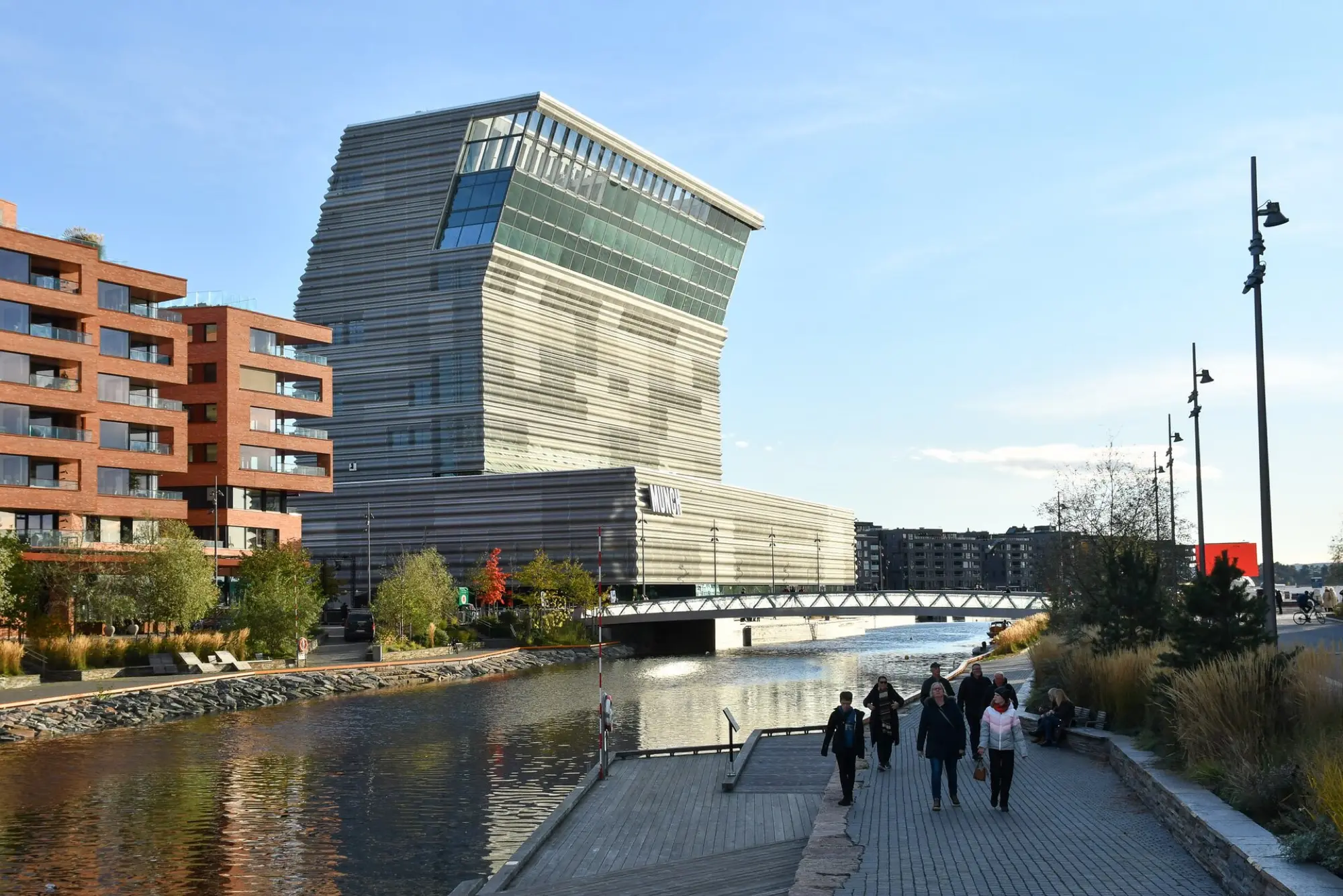

Two separate museums in Oslo hold versions of The Scream (Skrik), and they show different artworks. MUNCH in Bjørvika displays one of its three versions on floor 4 at any given time, rotating between a painting, a crayon drawing and a print during the day. The National Museum holds the famous 1893 painting in its dedicated Munch room, while the privately owned 1895 pastel is not in either public collection.
Where to see The Scream in Oslo
The famous 1893 painting that most people picture is at the National Museum, on display in room 060 in the Edvard Munch part of its collection exhibition. MUNCH in Bjørvika always shows one of its own three versions, a painting, a crayon drawing or a print, in turns during the day, so you see a version of The Scream but cannot choose which one. The privately owned 1895 pastel is in neither museum. The Scream exists in two painted versions; it is now widely agreed that the National Museum's was painted in 1893 and MUNCH's no earlier than 1910.
Which version is where
Store norske leksikon counts five versions; besides the two paintings and the 1895 lithograph there is a crayon version from 1893 at MUNCH and a pastel from 1895 in private hands. The National Museum's painting is tempera and crayon on cardboard, 91 cm high and 73.5 cm wide. The landscape in The Scream is the Oslo fjord seen from Ekeberg hill, with two men walking in the background on the left.
The MUNCH collection holds eight finished versions of The Scream, one painting in tempera and oil on cardboard, one crayon drawing on cardboard and six lithographs, plus sketches, studies and texts. MUNCH dates its painting "1910?", its lithograph 1895 and its crayon drawing 1893. MUNCH's curator writes that Munch made four Scream versions as paintings and drawings, two in tempera and two drawings, and that about 30 impressions of the lithograph are estimated to exist, six of them at the museum, one hand-coloured by Munch. The 1895 pastel is privately owned; when it sold in 2012 for USD 107 million it was the highest sum ever paid for an artwork at auction.
| Version | Year | Medium | Where it is |
|---|---|---|---|
| Painting | 1893 | Tempera and crayon on cardboard | National Museum |
| Crayon drawing | 1893 | Crayon on cardboard | MUNCH (in rotation) |
| Lithograph | 1895 | MUNCH (six impressions, in rotation) | |
| Pastel | 1895 | Pastel | Private owner |
| Painting | 1910? | Tempera and oil on cardboard | MUNCH (in rotation) |
Why the versions at MUNCH take turns
Munch made every version of The Scream on cardboard or paper, which is more fragile than oil on canvas, so light exposure has to be limited; the museum has researched how much light each version can take per day. None of the versions can be shown all the time, so MUNCH shows them in rotation during the day, either the painting, the drawing or the print.
The Scream is shown in the collection exhibition Edvard Munch Infinite on floor 4. Infinite presents 130 works from Munch's career. Infinite is a collection display, not a permanent exhibition; works are exchanged several times a year because of loans, conservation, reframing or curatorial changes. The drawings and prints in Infinite are sensitive to light and are replaced at intervals of six, twelve and eighteen months.
MUNCH tickets and prices
You can review how museum entry fits into your overall budget in our guide on is Norway expensive.
| Ticket type | Price |
|---|---|
| Adult | NOK 220 |
| Under 25 | NOK 100 |
| Child (aged 0–17) | Free |
| Companion (with valid companion certificate) | Free |
| Art student (with valid student ID) | Free |
The ticket page lists adult, under 25, child 0-17, member and companion tickets, with companions free with a valid companion certificate; it lists no separate student ticket. Art students with a student ID (art, design, art history, museology, conservation) and Oslo Pass holders can collect free tickets on arrival, subject to capacity; this covers standard admission to the exhibitions only, not events.
Entry is by timed ticket; MUNCH recommends pre-booking to be guaranteed entry at the time and date you want. Tickets are also sold at the museum, but the line is sometimes long and entry at the time you want is not guaranteed. Entrance tickets are non-refundable. A ticket gives access to all the exhibitions, and you may stay in them as long as you wish. If you leave the exhibition area, for lunch for example, space to go back in is not guaranteed because each time slot has limited capacity. The audio guide is free and runs on your own device.
Opening hours, holidays and the free Wednesday evening
MUNCH is open every day, with longer hours from Wednesday to Saturday.
| Day | Opening hours |
|---|---|
| Sunday to Tuesday | 10–18 |
| Wednesday to Saturday | 10–21 |
Entry is free on the first Wednesday of each month from 18:00 to 21:00, drop-in with tickets collected at the museum, except in July, August and September.
MUNCH's exceptions to its normal hours include 10-14 on 24 and 31 December and 10-18 on 25 and 26 December and on 1 January. VisitOSLO lists MUNCH as open 10-18 on Wednesday 23 December 2026. For Christmas and New Year hours across the city, see Oslo in December 2026. MUNCH is closed on 1 May.
MUNCH with the Oslo Pass
The Oslo Pass includes free entry to over 30 museums and attractions, MUNCH and the National Museum among them. An adult Oslo Pass costs NOK 580 for 24 hours, NOK 845 for 48 hours and NOK 995 for 72 hours. You can read full details on whether the card works for your itinerary in our Oslo Pass guide.
Oslo Pass holders cannot pre-order free MUNCH tickets; tickets are reserved for pass holders in each time slot and are given out on site. MUNCH is the only museum on the Oslo Pass with on-site timeslots, every 15 minutes, and pass holders do not need to pre-book. If a slot's Oslo Pass tickets are gone when you arrive, you wait for the next slot that has some, typically 15-30 minutes. VisitOSLO marks the National Museum as included in the Oslo Pass.
What is on the 13 floors
MUNCH has 13 floors, 11 galleries and 4,500 square metres of gallery space, with over 200 works by Munch on permanent display. At 26,313 square metres MUNCH is one of the world's largest museums devoted to a single artist, and it has five collection exhibitions built around works such as The Scream, Madonna and The Sun (Solen). The building in Bjørvika opened in 2021. The tower is sixty metres tall, clad in recycled, perforated aluminium panels, with a leaning top section. It was designed by Juan Herreros and Jens Richter of the Spanish practice Estudio Herreros; its foundation stone was laid in autumn 2016.
- Floor 1 has the lobby, the shop, the cloakrooms, the café and escalators and lifts up to the exhibitions.
- Floor 4 holds Edvard Munch Infinite, with motifs such as The Scream and Madonna and less-known major works.
- Floor 6 holds Edvard Munch Monumental, his largest paintings in a double-height room, versions of the paintings he made for the University of Oslo's Ceremonial Hall.
- Floor 7 holds Edvard Munch Shadows, an interactive reconstruction of Ekely, the villa outside Oslo where Munch spent his last 30 years, which was demolished in 1960.
- Floor 11 holds Edvard Munch Horizons, Munch shown with the European and Norwegian artists of his time.
A glass lift from the café goes to the restaurant on floor 12 and the bar on floor 13.
The café, the restaurant and the rooftop bar
The café, restaurant and bar are run by Muma, the company behind Oslo places such as Taco Republica and Mangelsgården.
- MUNCH Kafé: Ground floor. Has its own sourdough bakery, takes no reservations and has indoor and outdoor seating. Open 10-17 Monday to Friday and 10-18 at weekends, and follows the museum's hours on public holidays.
- MUNCH Restaurant: Floor 12. Open 17-23 on Monday, 12-15:30 and 17-23 on Tuesday and Wednesday, 12-15:30 and 17-00 Thursday to Saturday. Closed on Sunday.
- MUNCH Bar: Floor 13 (top floor). Serves drinks and finger food, with views over Oslo and a rooftop terrace. Open 12-23 on Monday, 12-00 Tuesday to Saturday and 12-18 on Sunday. To reach the bar you take the glass lift by the café.
The 1893 painting at the National Museum
VisitOSLO calls the National Museum the largest art museum in the Nordic countries. The National Museum is at Brynjulf Bulls plass 3. The Scream (1893) and Madonna (1894) hang in the Munch room (room 060) in the Edvard Munch part of its collection exhibition.
From 1 September to 22 December 2026 VisitOSLO lists the National Museum's hours for Tuesday to Sunday only, 10:00-20:00 on Tuesday and Wednesday and 10:00-17:00 Thursday to Sunday. For Christmas week VisitOSLO lists the National Museum open 10:00-17:00 on 23, 27 and 28 December 2026 and 10:00-20:00 on 29 and 30 December.
The National Museum's painting was first shown in Berlin in the year it was painted, under the title Verzweiflung (Despair). Olaf Schou bought the painting in 1910 and gave it straight to the museum. A faint pencil inscription at the top left reads "can only be painted by a madman!"; a 2020 study with an infrared camera and handwriting analysis confirmed that Munch wrote it himself. The National Museum's painting was stolen in 1994 and returned the same year.
Getting there, bags and house rules
MUNCH is at Edvard Munchs plass 1 in Bjørvika, next door to the Oslo Opera House. It is a 10-minute walk from Oslo Central Station (Oslo S). For travel from the airport to Oslo Central Station, see Oslo airport to city center. The closest public transport stops are Bjørvika for tram and bus, and Munch Bjørvika for the boat. There is bicycle parking outside, and the nearest city bike (bysykkel) stops are Sukkerbiten, Rostockgata and Bjørvika. There is no parking outside the museum; the closest car parks are at Sørenga, Oslo Central Station, Havnelageret, Rådhusgata and Strandgata.
Lockers in the lobby cloakroom take hand luggage up to 55 x 40 x 23 cm; the museum cannot store larger luggage. The following items cannot be taken into the exhibition halls:
- Backpacks and trolley cases
- Handbags larger than 40 x 35 x 10 cm
- Liquids and sharp items
- Umbrellas
- Food and drink
- Shoes with spikes
Strollers cannot go into the exhibition halls; they are parked outside the main entrance, and the museum lends baby carriers. Photography is welcome, but not with flash inside the exhibition halls.
How the collection came to Oslo, and the 2004 robbery
Four years before he died on 23 January 1944, Munch left his whole estate to the City of Oslo, including more than 28,000 artworks. MUNCH holds the world's largest collection of Munch's work. The first Munch Museum opened at Tøyen in May 1963, 100 years after Munch's birth.
On 22 August 2004 two masked gunmen took The Scream and Madonna from the museum at Tøyen. Oslo police announced on 31 August 2006 that both paintings had been recovered.