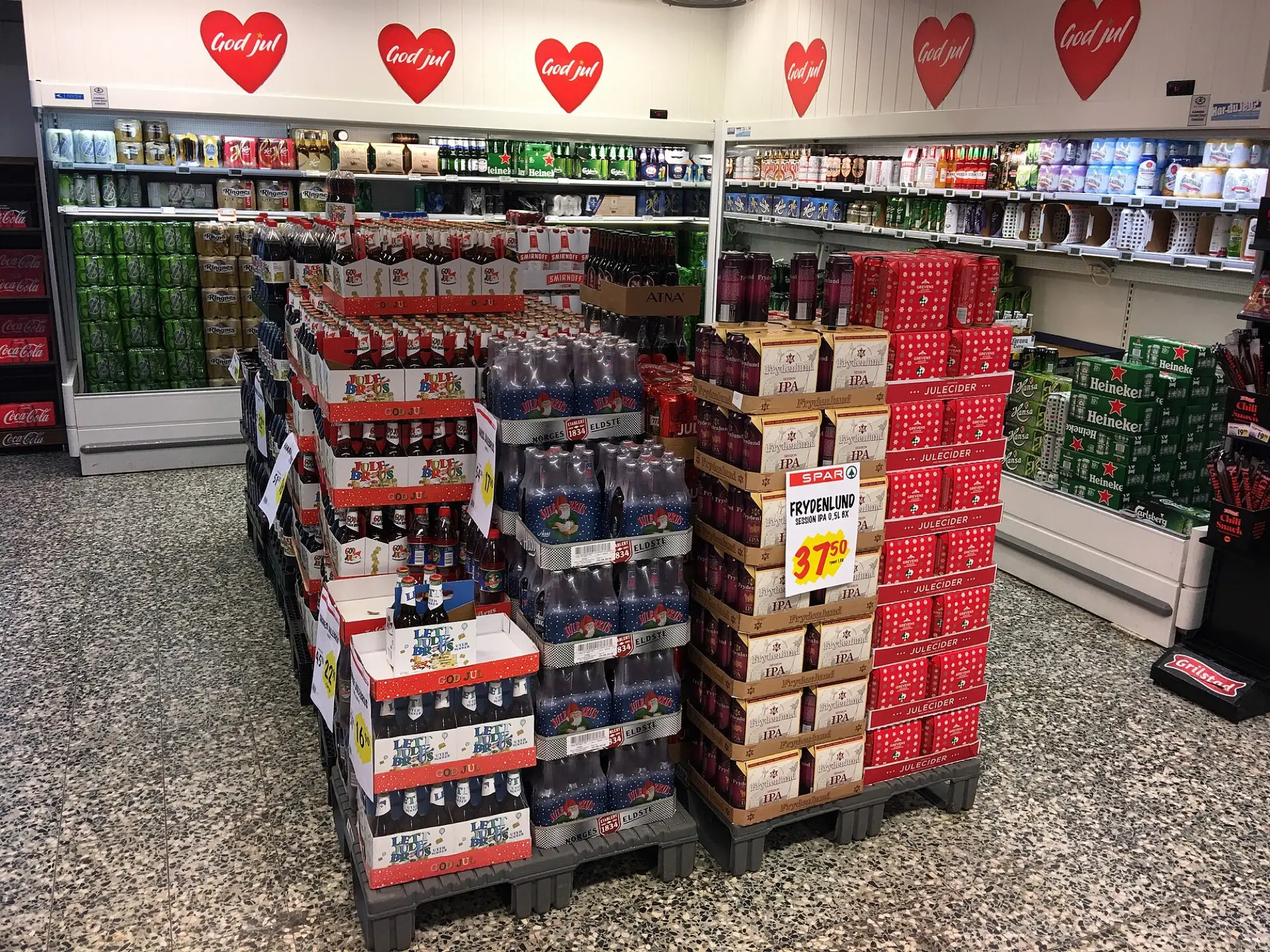

Norway's essential drinks to try are aquavit (akevitt), coffee, juleøl, julebrus, gløgg, beer from Mack and the craft breweries, Solo, and cider from Hardanger. Where you buy each depends on its alcohol strength: drinks up to 4.7% sit in ordinary supermarkets, while anything stronger must come from the state-run monopoly shops or licensed bars.
1. Aquavit (akevitt): the spirit Linie sends across the equator
Aquavit is a spiced spirit made primarily across Scandinavia, flavoured with caraway, dill, or both. Unlike Danish and Swedish variants, which generally rely on grain, Norwegian aquavit is mostly distilled from potatoes. Aquavit cannot be under 37.5% alcohol, and most bottles contain between 37.5% and 43%. Vinmonopolet held an exclusive monopoly on producing aquavit until 2005. Since the monopoly ended in 2005 around 40 distilleries have been set up (2025 figure). Vinmonopolet now lists well over 400 aquavits, of which more than 380 are Norwegian.
The most prominent label is Linie. According to Linie's own account, the method was discovered in 1805 when the Lysholm family shipped potato spirit to the East Indies and noticed its quality had improved upon return. However, Store norske leksikon notes that the story of an 1805 voyage to Jakarta has been disproved. Instead, Jørgen B. Lysholm commercialised line aquavit in the 1840s, with the first documented shipment leaving in 1842 aboard the schooner Nordstjernen.
Today, every cask of Linie is carried as deck cargo for four months, crossing the equator twice. The shipping firm Wilh. Wilhelmsen took on the transport contract when Vinmonopolet was formed in 1922; Wallenius Wilhelmsen still carries the spirit in deck containers today. The flagship Linie Original matures for 16 months in former sherry casks, including four months spent at sea, and is bottled at 41.5%. Caraway leads the botanical blend alongside star anise. The reverse of each label specifies the ship and the dates when that batch crossed the equator. Linie recommends drinking it at room temperature from a tulip-shaped glass. When this page was checked, a 70 cl bottle of Lysholm Linie (41.5%) cost NOK 489.90 at Vinmonopolet in its basic range.
At the table, rakfisk (fermented trout) is commonly eaten alongside aquavit and beer as part of traditional Norwegian food. To protect the drink's heritage, "norsk akevitt" became a protected national designation on 1 March 2011 and gained an EU Protected Geographical Indication (PGI) on 6 February 2020. To carry the label, the spirit must be made in Norway from potato spirit containing at least 95% Norwegian potatoes. It must also mature in oak casks for at least six months for casks smaller than 1,000 litres, or at least 12 months for casks above that size. Matmerk administers these protected designations in Norway, approved by the Norwegian Food Safety Authority (Mattilsynet).
2. Coffee: four cups a day, mostly black
Norway ranks near the very top of global coffee consumption per person, second only to Finland. In a 2026 survey by Norsk Kaffeinformasjon and Ipsos covering 1,203 respondents, 69% of adults reported drinking coffee daily. Average daily intake reaches 4.3 cups, consumed primarily at home, work, or school. Black coffee is the default choice for 72% of drinkers, and the electric filter machine remains the standard tool, found with 66% of coffee drinkers.
Serving coffee remains a customary greeting for guests and the standard provision in workplace meetings. It is regularly paired with traditional baked goods: soft griddle flatbreads (lefse) are often topped with butter, sugar, cinnamon, or sliced brunost (whey-based brown cheese). Norwegians often eat waffles, usually with jam and sour cream or with butter and brunost.
3. Juleøl: Christmas beer, in a shop strength and a stronger one
Juleøl is beer brewed specifically for the festive period, continuing a Norwegian custom rooted in the Viking era. King Olav Tryggvason established a legal obligation for every grain farmer to brew Christmas beer, and the Norsk Folkemuseum considers it the country's oldest Christmas custom, historically begun around 8 December. Traditional brews are rich, dark, and strong, typically running between 7% and 10% alcohol.
There are no rules for how juleøl should taste; only the label must look like Christmas. Classic breweries established before 2000 tend to brew dark lagers, whereas the newer breweries go for dark ales. The season is active in late November. Supermarkets sell low-strength versions capped at 4.7%, such as Mack's 4.5% juleøl, a dark brew with distinct sweetness and bitter notes. Mack also produces a fuller 6.5% edition with elevated sweetness and fruit character, which among shops only Vinmonopolet may sell.
Vinmonopolet introduced more than 250 kinds of juleøl on 4 November 2026. Every branch tailors its shelves to local interest, and bottles can be ordered online. For example, Nøgne Ø God Jul, an 8.5% Christmas beer from Grimstad, cost NOK 74.90 for a 50 cl bottle when this page was checked. The monopoly's seasonal release also included alcohol-free dark juleøl. For broader festive dining customs, consult our guide to Christmas in Norway.
4. Julebrus: the red Christmas soda, in shops from mid-October
Julebrus is a seasonal soda made exclusively in Norway. In most iterations it is bright red and tastes predominantly of raspberry. The soft drink arrives on supermarket shelves in mid-October. Product diversity is broad: 2024 saw more than 70 distinct varieties on sale.
Mack's julebrus, red and tasting of raspberry, has long traditions. In western Norway, Lerum produces both standard and sugar-free varieties. Lerum julebrus is in the shops in western Norway and you can ask for it in any Meny, Spar or Joker.
5. Gløgg: mulled wine at Vinmonopolet, a juice version in the supermarket
Gløgg is a hot drink, usually of red wine and/or spirits, with sugar, almonds and raisins, spiced with cinnamon, cloves and orange peel. It comes with or without alcohol and is often served with gingerbread or saffron buns (lussekatter). Gløgg became a Christmas tradition in Sweden only in the late 1800s and came to Norway from there.
Wine and spirit versions are sold at Vinmonopolet. When this page was checked, Herregårdsgløgg (a 12.5% spiced red wine made by Arcus in Nittedal) cost NOK 159.90 for 75 cl. A stronger spirit-based alternative, Atlungstad Julegløgg from Stange (blended with Norwegian potato spirit and red wine at 15%), cost NOK 249.90 for 50 cl.
Supermarkets sell juice-based gløgg such as Lerum julegløgg, made from apple juice (60%) and blackcurrant juice (15%) with sugar and spice, which is mixed one part gløgg to two parts water. You can find Lerum's gløgg at Kiwi, Spar, Eurospar, Meny, and Bunnpris. At the Trondheim Christmas market the lavvo restaurant serves local beers, cocoa and gløgg. Vinmonopolet's November launches also include alcohol-free gløgg.
6. Beer: Mack from Tromsø and the craft brewers
Nine in ten litres of beer sold in Norway is shop strength, between 3.8% and 4.7%. Strong beers exceeding 4.7% made up only about two per cent of all beer sales in 2025.
Mack, which calls itself the world's northernmost brewery, was founded in Tromsø in 1877. Still independent and family-owned, Mack moved main production to Nordkjosbotn (70 km away), but retains its historic city site with a brewpub, beer shop, and microbrewery. Its portfolio covers over 90 beverages, including Mack Pilsner at 4.5%. Walk-in tours at the historic Storgata 4 facility run Monday to Friday at 15:30 and Saturday at 14:30. In 2026, the 60-minute tour costs NOK 250 per person, which includes one tasting glass. In the Mack quarter is Ølhallen, Tromsø's oldest pub, open since 1928 with 72 Norwegian beers pouring on tap; both are central stops among things to do in Tromsø.
Norway's domestic brewing scene has expanded significantly over the past 15 years, with beer now produced at more than 150 locations nationwide. Nøgne Ø was among Norway's first craft beer producers, starting inside a Grimstad garage in 2002; it now produces around 20 regular beers alongside 25 to 30 new releases each year. Lervig operates as an independent craft brewery in Stavanger exporting to more than 30 countries. The company operates Lervig Local in Stavanger's Ledaal park, where a dedicated 500-litre brewing system produces specialty batches available only on site and at select venues.
7. Solo: the orange soda from 1934
Solo is a Norwegian orange-flavoured soft drink launched in 1934 from a Swedish recipe, first made by Tønsberg Bryggeri. In 1940, Nora Fabrikker acquired the rights, turning Solo into the country's first nationally distributed soft-drink brand. In 2023 Ringnes owned 91.15% of the Solo company. Solo long held the title of Norway's top-selling soft drink, though volume sales have since fallen behind Coca-Cola and Pepsi-Cola. Carbonated soft drinks (brus) form the single largest beverage category in the country, reaching 568.7 million litres in 2025 and representing over half of all drinks sold.
8. Cider from Hardanger: a protected name, dry to sweet
Sider frå Hardanger carries a protected geographical status. Only cider produced within the Hardanger region using apples from the region can bear the name. The regulation, enacted by Mattilsynet on 17 April 2009, established Hardanger cider as Norway's first alcoholic product with geographical protection. To qualify, apple growing, pressing, fermenting, and storing must all take place inside seven regional municipalities: Eidfjord, Granvin, Jondal, Kvam, Odda, Ulvik, and Ullensvang. A similar regional protection also exists for cider from Sogn.
More than 20 approved producers make cider across the district. Ciders range in taste from dry to medium or sweet, and span three statutory strength classes from 3% up to 12% alcohol. Vinmonopolet's shops have their own shelves of cider from Hardanger, and supermarkets also sell cider of guaranteed Hardanger origin.
Ulvik hosts Norway's only dedicated fruit and cider route, linking three farms: Ulvik Frukt & Cideri, Syse Gard, and Hardanger Saft- og Siderfabrikk. All three lie within walking distance of Ulvik village centre and run dedicated farm shops selling directly to visitors. The farms hold two seasonal events: Siderslepp in May to present the new ciders, and Fruktslepp in October marking the harvest. For the rest of the fjord, see our Hardangerfjord guide.
Supermarket or Vinmonopolet
Norway divides all alcohol sales at 4.7% alcohol by volume. Ordinary supermarkets and grocery stores can sell beer and cider at or below 4.7% under licences granted by local municipalities. Everything stronger, including wine, strong beer, and all spirits, must be bought from the state-owned retail monopoly, Vinmonopolet, or served in restaurants and bars. For opening hours, age limits, and required ID, see our Vinmonopolet guide. No retail shops, whether supermarkets or Vinmonopolet outlets, sell alcohol on Sundays.