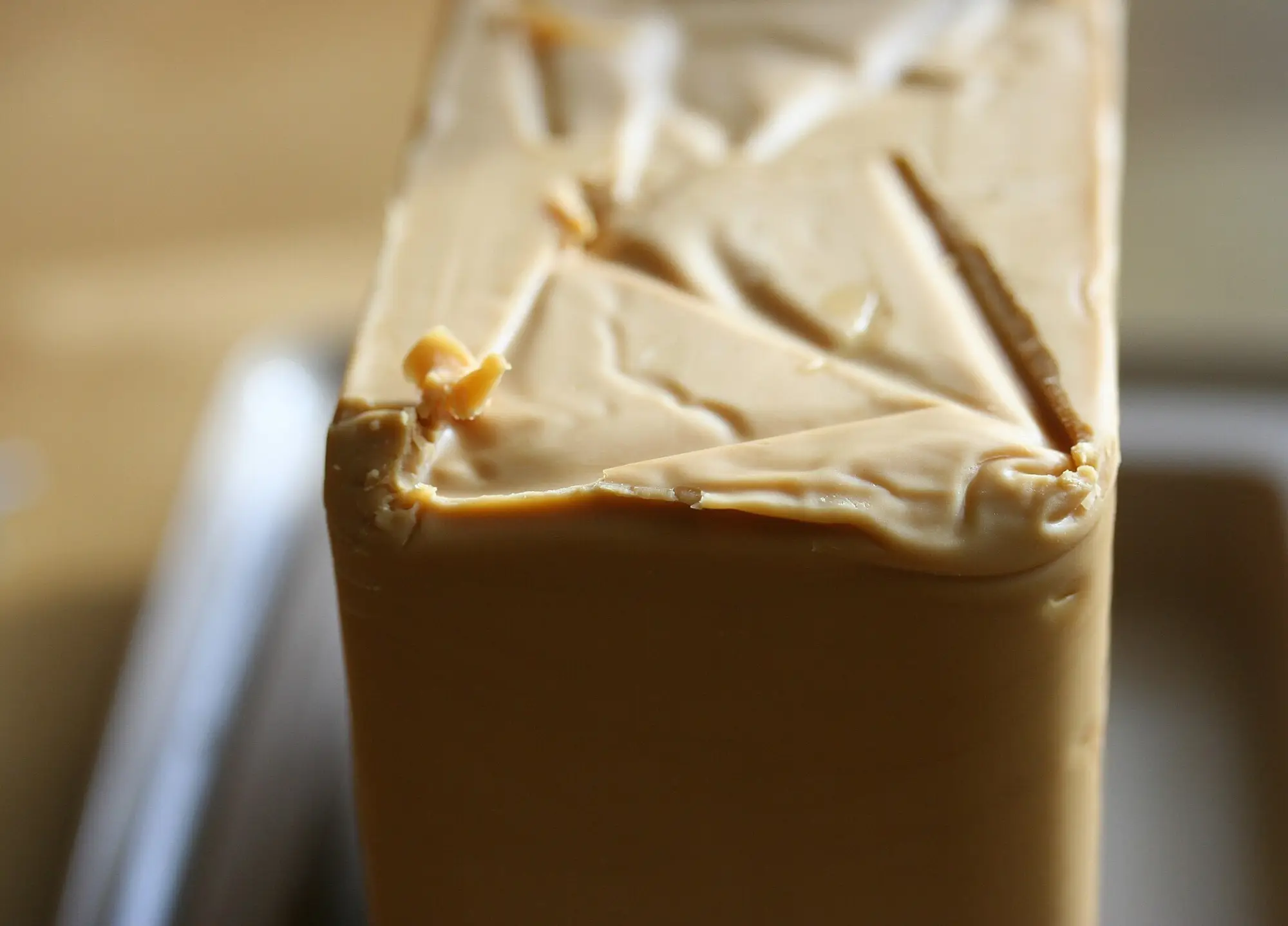

Brunost is a traditional Norwegian sandwich topping made from boiled-down whey whose natural milk sugar caramelises into a sweet, reddish-brown mass. Gudbrandsdalsost is the most popular variety on supermarket shelves today. It is cut into thin slices with a cheese slicer and eaten on bread, crispbread and waffles.
What brunost is, and why it is not strictly a cheese
Brunost (brown cheese) is a traditional Norwegian topping made from boiled-down whey. In Gudbrandsdalen it is often called raudost (red cheese). Mysost (whey cheese), brunost and raudost are different names for the same product, named brown cheese for its colour.
By the World Health Organization and Food and Agriculture Organization definitions, brunost is not a true cheese. A true cheese is made solely from the curd with the whey separated off; brunost is made from the by-product of that cheesemaking. Whey contains milk sugar, known as lactose. As the whey boils and the water evaporates, the milk sugar caramelises into a reddish-brown mass. Almost half of the dry matter in brown cheese is milk sugar. TINE notes that many people assume brunost contains added sugar, but it does not; the natural milk sugar gives it the sweet taste. Because caramelised milk sugar makes the product behave more like caramel than cheese, foreigners tasting it for the first time usually react to the taste.
Norwegians cut brunost with a cheese slicer and eat it as an everyday topping on bread, crispbread, potato lefse (flatbread), and sveler (thick griddle cakes), as well as on freshly made waffles. It is one of the classic flavours of Norwegian food.
The kinds on the shelf: Gudbrandsdalsost, ekte geitost, fløtemysost and prim
When you approach the dairy counter in Norway, you will see several distinct varieties:
- Gudbrandsdalsost: The most popular Norwegian brown cheese, named after the valley of Gudbrandsdalen where it was first produced. It is made from cow's whey, milk, cream and some goat's milk. Its fat content is 35% of dry matter (often labelled G35). TINE describes its flavour as round, full, sweetish and caramel-like, with the goat's milk providing depth without an overwhelming goat flavour.
- Ekte geitost: Meaning "real goat cheese", this product is made from goat's whey with goat's milk and cream added.
- Fløtemysost: Meaning "cream whey cheese", this type is made from cow's whey, cow's milk and cream.
- Prim: A spreadable, light golden-brown dairy product. The main dividing line between prim and brown cheese is water content: prim contains more than 30% water and is spreadable, whereas sliceable brown cheeses hold less than 25% water. Prim has a sweet, mild caramel taste and is sweeter than brunost because sugar is added.
Det Norske Akademis ordbok defines blended goat cheese (blandingsost) as one made with at least 1 litre of goat's milk per kilo of finished cheese. A food researcher at OsloMet explains that goat's milk gives brown cheese a sharper, more acidic and aromatic character, while cow's milk produces milder and sweeter brown cheeses. Fat content varies with the amount of milk and cream added, ranging from 35% of dry matter in Gudbrandsdalsost down to about seven per cent in lean mysost.
In recent years several brown cheeses have been sold under their own names, such as the light Misvær, the dark and sweet fløtemysost Innherred, the dark Heidal, and the strong stølsost. At Christmas, dairies sell formost, which is standard Gudbrandsdalsost with a decorated surface.
Gjetost, geitost and the other names
The dictionary Det Norske Akademis ordbok files gjetost under geitost and quotes it from Sigrid Undset in 1918 ("hvetekake med gjetost", wheat cake with gjetost). The dictionary defines geitost as cheese made from goat's whey, milk and cream, refers to brunost, and notes that in everyday speech it is also used for cheese made from a blend of cow's and goat's milk.
According to Store norske leksikon, brunost is the most common Norwegian name today, though mysost describes the raw material best. Oslo City Hall, the tall square brick building with two towers, was nicknamed "geitosten" from its first day.
How brunost is made
Cheesemaking begins by adding rennet to lukewarm milk. The curds coagulate and the whey is strained off, then fresh milk and cream are added to the whey to set the fat content.
In dairies today, 90% of the water is removed through vacuum evaporation. The mixture is then boiled until the dry matter reaches roughly 75%. The brown colour comes in the last 15 minutes of boiling, especially as the mass nears 100 °C. A dark cheese tastes stronger than a light one but can easily taste burnt.
Whey used to be boiled in iron pots, which made brunost a good source of iron. Dairies later added iron to the cheese instead, but that was banned from 2001.
Traditional methods remain in use on small farms. In Undredal on the Sognefjord, a little whole goat's milk and cow's cream is added to fresh whey, which is cooked for 8 to 10 hours, then cooled, kneaded and pressed into square wooden moulds. After a day it is ready to eat.
Anne Hov, Solbråsetra and how Gudbrandsdalsost began
Brown whey products are mentioned in sources going back to the 1400s, but modern Gudbrandsdalsost dates to the nineteenth century. Store norske leksikon names the dairymaid Anne Solbrå (born 1846, later married Hov), who in the 1860s developed a new, fattier primost known as the "Gudbrandsdal fat cheese". TINE dates brunost as it is known today to 1863 at Solbråsetra in Gudbrandsdalen, where Anne Hov tried blending cream into the whey mixture instead of goat's milk because the farm owner would not keep goats.
Years later, married and on her own farm, Anne Hov perfected the recipe by adding some goat's milk as well as cream, and it spread quickly to neighbouring farms. In 1908, thirteen dairies started production to her recipe, which was the origin of today's Gudbrandsdalsost. In 1933, Anne Hov received the King's Medal of Merit in silver for the part her cheese had played in keeping other businesses in Gudbrandsdalen going.
TINE could have saved costs by moving brown cheese production out of its dairy in Lom and Skjåk, but after more than 51,000 Norwegians backed keeping it, the board decided to keep it there. Lom and Skjåk municipalities started Gudbrandsdalsost Day (Gudbrandsdalsostens dag) as a yearly event on 17 March, first marked in 2021 to mark ten years since that decision.
The cheese slicer, a Norwegian invention made for brown cheese
TINE says most Norwegians eat brown cheese on their sandwiches, cut into thin slices with a cheese slicer (ostehøvel), which it calls another Norwegian invention. Thor Bjørklund, a furniture maker in Lillehammer, was inspired by the carpenter's plane. Bjørklund filed his patent application in February 1925, and the patent was granted in November 1926. Bjørklund said that by 1927 his firm was already making 40,000 cheese slicers.
The dairies' sales body feared that thin slices would make Norwegians eat less cheese, and bags were hung up around the country reading "throw your cheese slicers here". The patent ran out in 1942, leaving others free to make cheese slicers. More than 50 million Bjørklund cheese slicers have been made, and since 2009 they have been made in Ringebu, in Gudbrandsdalen, by Gudbrandsdal Industrier.
How Norwegians eat it
According to figures OsloMet cites from melk.no, 20% of Norwegians say they eat brunost daily, and 45% weekly. The oldest eat the most and the youngest the least. In addition, 51% say they nearly always have brunost in the fridge, and 72% say they like the taste.
Brunost is used today on bread, crispbread, waffles and lefse, and potato lefse with butter and brunost is common in eastern Norway. Norwegian waffles are usually served with jam and sour cream, or with butter and brunost. A little brunost is often added to game sauce to bring out the flavour, and it goes into the sauce served with raspeballer (potato dumplings). There are also brunost ice cream, panna cotta, sweets and sauces, and TINE notes it is used in brownies or sauces.
In South Korea, where brunost has a cult following, it is usually grated rather than sliced, over ice cream, into coffee and even over pizza.
What brunost costs in a Norwegian supermarket
To plan what you will spend on everyday groceries, check out our guide on whether Norway is expensive. The following shelf prices were read in November at the online grocer Oda:
- TINE Gudbrandsdalsost Original G35 (500 g): NOK 56.40 (NOK 112.80 a kilo)
- TINE Gudbrandsdalsost Original G35 (1 kg): NOK 115.40
- TINE Gudbrandsdalsost Original G35 (ready-sliced, 130 g): NOK 22.60 (NOK 173.85 a kilo)
- TINE Fløtemysost (500 g): NOK 62.90 (NOK 125.80 a kilo)
- TINE Geitost FG33 (500 g): NOK 106.60 (NOK 213.20 a kilo)
- Synnøve Finden Gudbrandsdalsost (480 g): NOK 43.90 (NOK 91.46 a kilo)
- TINE Prim Original (8% fat, 300 g): NOK 34.10
Two 500 g blocks of Gudbrandsdalsost (NOK 112.80) cost NOK 2.60 less than one 1 kg block (NOK 115.40). Ready-sliced Gudbrandsdalsost costs NOK 173.85 a kilo compared to NOK 112.80 a kilo for the 500 g block. TINE Geitost FG33 is the dearest of the brown cheeses listed.
Per 100 g, TINE Gudbrandsdalsost G35 has:
- Energy: 441 kcal
- Fat: 28 g
- Sugars: 30 g
- Protein: 10 g
- Ingredients: whey, goat's milk, cream and milk.
Where to taste it at the source
If you plan to tour western Norway by public transport, check our guide to visiting the Norwegian fjords without a car or explore itineraries on Norway in a Nutshell. Here are places where brunost is made or can be tasted:
- Undredal: A small village on the fjord between Flåm and Gudvangen, about a 10-minute drive from Flåm, best known for white and brown goat cheese. Undredalsbui, the village shop, sells white and brown goat cheese, goat sausages, souvenirs and groceries. The village is home to Eldhuset, a visitor centre featuring exhibitions on cheesemaking and how the cheese matures. Fjordsafari Norway runs daily RIB boat trips from Flåm to Undredal for cheese tasting and local history. Undredal Stølsysteri was the first goat cheese dairy in Norway with full authorisation to make and sell white and brown goat cheese throughout Europe. Slow Food notes that in 2003 it became Norway's first authorised producer of raw goat's milk cheeses, and it remains one of the few cooperatives still making geitost with raw milk. After local food safety authorities demanded pasteurisation in 1991, Undredal's goat farmers founded Norsk Gardsost, an association of small-scale cheesemakers that grew to more than 100 members across Norway by 1997.
- Solbråsetra: Situated at Gålå in Gudbrandsdalen, the summer farm where Gudbrandsdalsost began still keeps the tradition alive. TINE says guests can meet the dairymaid and taste freshly made Gudbrandsdalsost there.
- Herdalssetra: A summer mountain farm in Norddal inside a World Heritage area that has run for 300 years and keeps several hundred goats. Guests can see how white and brown cheeses were traditionally made.
- Stordalen gardsbruk: A farm in Telemark whose brown cheese made with raw goat's milk won silver at the cheese world championships in 2018 and was described as the world's best brown cheese.
- Storsteinnes: Situated in Troms, this site makes Norgold, Norway's northernmost brown cheese.
The brunost tunnel fire of 2013
On the evening of 17 January 2013, a lorry trailer carrying 21.5 tonnes of fløtemysost, geitost and brunost on 33 pallets caught fire inside the Brattli tunnel in Tysfjord.
The cheese burned very well because of its fat. Uncovered PE foam in the tunnel walls gave off toxic gases, so the fire service let the fire burn out, which took five days. Nobody was hurt. Repairing the damage cost NOK 8.2 million, and the safety upgrades a further NOK 20 million, NOK 28 million in all.
Keeping it and taking it home
Oda lists Gudbrandsdalsost as a chilled product to be kept between 0 and 4 degrees. Brown cheeses keep very well; at 1-5 °C they last about four months, and at -8 °C a year, but freezing colder than that spoils the texture because the water freezes.
Before taking brunost home, check the customs rules of your destination country:
- United Kingdom: The UK government says that, because of animal disease outbreaks, you cannot bring cheese, milk or other dairy products into Great Britain from the EU, Switzerland, Norway, Iceland and some other countries for personal use.
- United States: U.S. Customs and Border Protection says travellers may bring bakery items and certain cheeses into the United States. Failing to declare agricultural items at a US port of entry carries a civil penalty of $300 for a first offence and $500 for a second.