
Ten souvenirs to buy in Norway are a wool sweater or a Røros tweed blanket, brunost (brown cheese), a cheese slicer, Freia chocolate and Kvikk Lunsj, aquavit, Hadeland glass, Porsgrund porcelain, rosemaling, a carved wooden troll, and Sámi duodji (handicraft). Prices are the makers' or shops' own listed prices when checked, and prices change over time.
1. A wool sweater or a Røros tweed blanket: buy it from the maker
Devold listed the Original Islender, in 100% Norwegian wool and 860 g in size L, at NOK 1,999. Oleana listed the Rosemaling cardigan at 5,990 NOK. Each Oleana product page says it is produced at the company's own factory in Norway. Patterns, makers and shops are on our page about Norwegian sweaters. You can also look at Norwegian outdoor clothing brands for other layers. Norsk Flid Husfliden sells Røros Tweed blankets, which it describes as Norwegian wool with 100% Norwegian production.
2. Brunost: the brown cheese, if your customs allow it
Brunost is Norwegian brown cheese; read our guide to brunost for the full story. Gudbrandsdalsost is the most popular of the Norwegian brown cheeses; it has a sweet, caramel-like taste, its fat content is 35% of dry matter, and it is named after Gudbrandsdalen, where it was first made. At the online grocer Oda, a 500 g block of TINE Gudbrandsdalsost Original G35 cost NOK 56.40 (NOK 112.80 a kilo).
Brown cheeses keep very well. At 1-5 °C they last about four months, and at -8 °C a year, but freezing colder than that spoils the texture because the water freezes. Customs is the rule of the country you fly home to, not Norway's. The UK government says that, because of animal disease outbreaks, you cannot bring cheese, milk or other dairy products into Great Britain from Norway for personal use. US Customs and Border Protection says travellers may bring bakery items and certain cheeses into the United States.
3. Cheese slicer (ostehøvel): a Norwegian patent, still made in Ringebu
The cheese slicer (ostehøvel) was invented by Thor Bjørklund, a furniture maker in Lillehammer, inspired by the carpenter's plane. Bjørklund filed his patent application in February 1925 and the patent was granted in November 1926. Bjørklund's cheese slicers have been made in more than 50 million copies, and since 2009 they have been made in Ringebu, in Gudbrandsdalen, by Gudbrandsdal Industrier.
Norsk Flid Husfliden listed the Bjørklund1925 "Norway" cheese slicer, with "Norway" engraved on its birch handle and Thor Bjørklund's original patent mark on the blade, at kr 349; it is made in Norway, in the village of Ringebu, and comes in a box. Norsk Flid Husfliden's web shop does not send goods abroad, so a visitor buys in one of its shops.
4. Freia milk chocolate and Kvikk Lunsj: buy them at Freia's own shop
Freia began making finer eating chocolate in 1904 and in 1906 bought from Switzerland the method for making milk chocolate, the start of Freia Melkesjokolade. Norwegian cows on summer pasture have been part of the Freia Melkesjokolade wrapper since 1926. Kvikk Lunsj, Freia's chocolate-covered wafer bar, was launched in 1937, then with dark chocolate.
Freiabutikken, Freia's own chocolate shop, is at Karl Johans gate 31 in central Oslo; it moved into the newly built Grand Hotel in 1913. Freiabutikken opens Monday to Friday 10.00-18.00 and Saturday 10.00-16.00, and is closed on Sunday. The shop sells Twist and other sweets loose by weight, and the 2 kg versions of Melkesjokolade, Firkløver and Kvikk Lunsj are sold only there. The Freia factory at Rodeløkka in Oslo has Freialand, a visitor centre on the history of chocolate, and tours of the Freia hall decorated with 12 paintings by Edvard Munch.
5. Aquavit (akevitt): Linie, the one that crosses the equator
Aquavit (akevitt) is a spiced spirit made mainly in Scandinavia, from neutral spirit flavoured with a spice distillate in which caraway and/or dill must be the main spice. In Norway aquavit is mostly made from potato spirit, while Danish and Swedish aquavit is usually made from grain spirit. "Norsk akevitt" has been a protected name since 1 March 2011: it must be made from Norwegian potato spirit of at least 95% Norwegian potatoes and matured in oak casks for at least six months.
Linie aquavit has been sent on a long sea voyage that crosses the equator ("the line") twice; it is still shipped there and back, now in about four months. Jørgen B. Lysholm is credited with commercialising Linie aquavit in the 1840s. Vinmonopolet listed Lysholm Linie, a Norwegian aquavit of 41.5% aged 16 months in cask, at kr 489.90 for 70 cl, in its basic range. To see opening hours and rules, visit our guide to Vinmonopolet, and read about other options among Norwegian drinks. For alcohol allowances, see the customs section below.
6. Hadeland glass: a mouth-blown dram glass or a Norgesglasset jar
Hadeland Glassverk at Glassverksveien 9, 3520 Jevnaker, calls itself Norway's oldest craft business, a living museum since 1762, and operates as a visitor centre with shops, places to eat and activities; opening hours vary through the year. In the glassworks hall (Glasshytta) you can watch glass being blown, Monday to Friday 10-15. Hadeland says watching the glassblowing is free for everyone. From May and through the summer a Vy bus runs direct from Oslo to Hadeland Glassverk. From 21 November to 20 December the shops, including the factory outlet and the glass shop, open Monday to Sunday 10-18.
Hadeland's Tangen dram glass, designed by Willy Johansson and launched in 1958, is mouth-blown and handmade at Hadeland Glassverk, made for dram and aquavit, and must be washed by hand. Hadeland listed the clear 5 cl Tangen dram glass at kr 499. Norgesglasset, the glass preserving jar, went into production at Hadeland Glassverk in 1902 as an everyday product for keeping fruit, berries and vegetables through the year. Hadeland listed a 37 cl Norgesglasset storage jar with a plastic lid at kr 129.
7. Porsgrund porcelain: check which pieces are still made in Porsgrunn
Porsgrunds Porselænsfabrik was founded in 1885. Porsgrund says several of its series, not all, are still made at its factory in Porsgrunn. Bogstad Strå, one of Porsgrund's oldest dinnerware series, has its pattern painted by hand, and has been made since production started in 1887. Porsgrund's Christmas nisse (farm elf) dinnerware, with farm elves on skis, sledges and skates, has been made since 1902 and is often handed down in families.
Porsgrund's factory outlet is at Porselensveien 6, 3920 Porsgrunn, and sells first-quality pieces and seconds from the factory. The outlet opens Monday to Friday 09.00-19.00, Saturday 09.00-18.00 and Sunday 12.00-16.00. At the outlet you can watch the painters hand-paint the straw pattern (stråmønster). The outlet also stocks other brands, Hadeland Glassverk and Norgesglasset among them.
8. Rosemaling: the folk painting, and what the souvenir version lacks
Rosemaling (rose painting) is decorative painting rooted in Norwegian folk art, done mainly in the countryside in the 1700s and 1800s by craftsmen outside the guilds. The typical rosemaling developed above all in Hallingdal and Telemark, and the style differs from district to district. Typical motifs are acanthus scrolls, rocailles, drinking verses and flowers of many kinds. At first the technique was used mostly on chests and ale bowls. The word rosemaling became common in Norwegian around 1890 and was often used by the craft movement.
Store norske leksikon says much rosemaling in the 1900s was made for the craft shops (husfliden) and sold as souvenirs, and that it lacks the liveliness and ease of the older painters. Oleana also makes a Rosemaling cardigan. You can also look for crafts at Christmas markets in Norway.
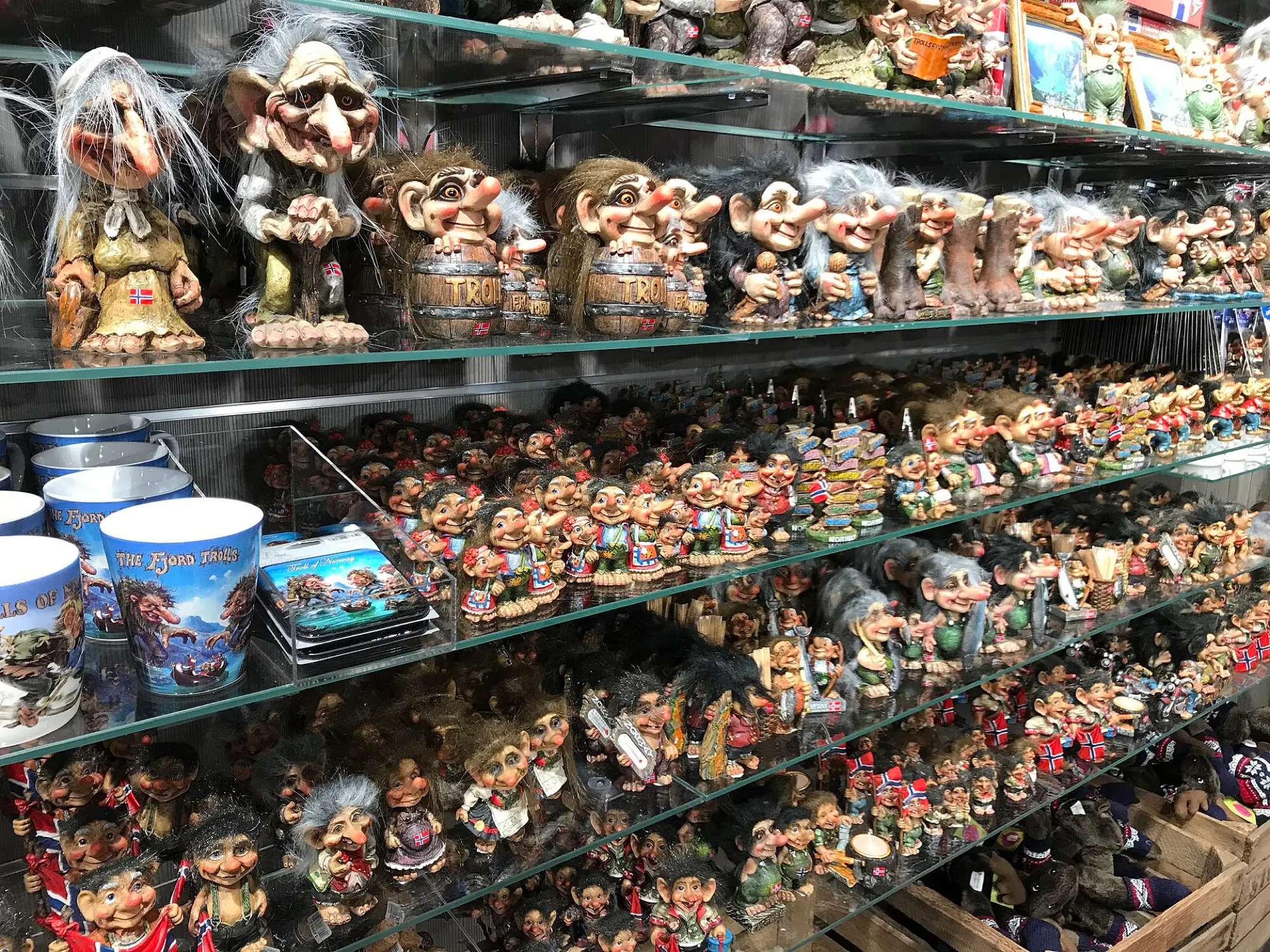
9. A carved wooden troll: Henning's workshop on Toten
Henning Engelsen began carving wood in 1947 and founded the firm Henning; his figures show wildlife, mythology and folklore. Mesterstuen, at Tømmerholsvegen 116, 2849 Kapp, on Toten, is the shop for the Engelsen family's carvings, with figures of people, animals, angels, birds, tusser (goblins) and trolls carved in wood. Mesterstuen listed the carved troll king (Trollkonge), 16 cm high, at kr 750, and the small Sopptusse figure, 9 cm high, at kr 300.
10. Sámi duodji: look for the Sámi Duodji label
The Sámi Duodji trademark tells the buyer a product is genuine Sámi handicraft made by a Sámi duojár (handicrafter), following traditional materials, techniques, forms and uses. A second mark, Sámi Made, means a product is made by a Sámi person or a Sámi-owned company; both marks are owned by the Sámi people and managed by the Saami Council. In Norway the Sámi Duodji mark is licensed through Duodjeinstituhtta. Read our overview of Sámi culture in Norway for more context.
Two northern stops feature Sámi craftwork:
- Sápmi Park in Karasjok: Run by Scandic, it presents Sámi culture and history through the Magical Theatre, reindeer feeding, joik, lasso throwing, Sámi crafts and a souvenir shop with its own silversmith; most of the activities run in the summer months.
- Juhls' Silver Gallery in Kautokeino: Set in a building on the hill above Kautokeino, it shows traditional Sámi silver alongside modern silver design, and is the life's work of Frank and Regine Juhls.
Norsk Flid Husfliden, the craft shops in Bergen, Trondheim and Tromsø
Norsk Flid Husfliden sells Røros Tweed blankets and the Bjørklund1925 cheese slicer mentioned above. Because Norsk Flid Husfliden's web shop does not send goods abroad, a visitor buys in one of its shops:
- Bergen: Vågsallmenningen 3, with its own sewing workshop for bunads upstairs. Opens Monday to Friday 09-17, Thursday 09-19 and Saturday 09-15.
- Trondheim: Kjøpmannsgata 42. Opens Monday to Friday 10-18 and Saturday 10-16.
- Tromsø: Sjøgata 4.
What your own country lets you bring home
Customs rules are set by the country you enter. In the UK, personal allowance rules apply to any goods you have bought overseas and bring in, wherever you bought them. If you go over a UK allowance, you pay tax and duty on all the goods in that category, and goods may be seized if you break the rules. The UK government says that, because of animal disease outbreaks, you cannot bring cheese, milk or other dairy products into Great Britain from the EU, Switzerland, Norway, Iceland and some other countries for personal use. Chocolate and confectionery, unless made with a lot of unprocessed dairy ingredients, can be brought into Great Britain from any country without restriction.
US Customs and Border Protection says travellers may bring bakery items and certain cheeses into the United States. Failing to declare agricultural items at a US port of entry carries a civil penalty of $300 for a first offence and $500 for a second. For the United States, the laws of the state where you first arrive also govern how much alcohol you may bring and whether you need a licence, so check that state's rules before you leave.
Getting the VAT back when you leave
Skatteetaten (the Norwegian Tax Administration) says VAT is charged as normal on goods sold in Norway to people living abroad, but the seller may, on conditions, refund it when the goods leave as luggage. The export is proved either with form RD-0032 stamped by Customs, or through a private VAT refund company.
With a refund company, the shop gives you a dated refund cheque, and when you leave you hand it to the company, which pays you. Skatteetaten says the amount the company pays is somewhat lower than the VAT charged, because the difference covers the company's costs and profit.
Eligibility rules depend on where you live:
- Residents outside Denmark, Finland and Sweden: The goods must leave Norway with you within one month of delivery, and each invoice must be at least NOK 250 excluding VAT.
- Residents of Denmark, Finland and Sweden: Each item must cost at least NOK 1,000 excluding VAT, and the refund depends on the goods being declared and taxed in the buyer's home country.