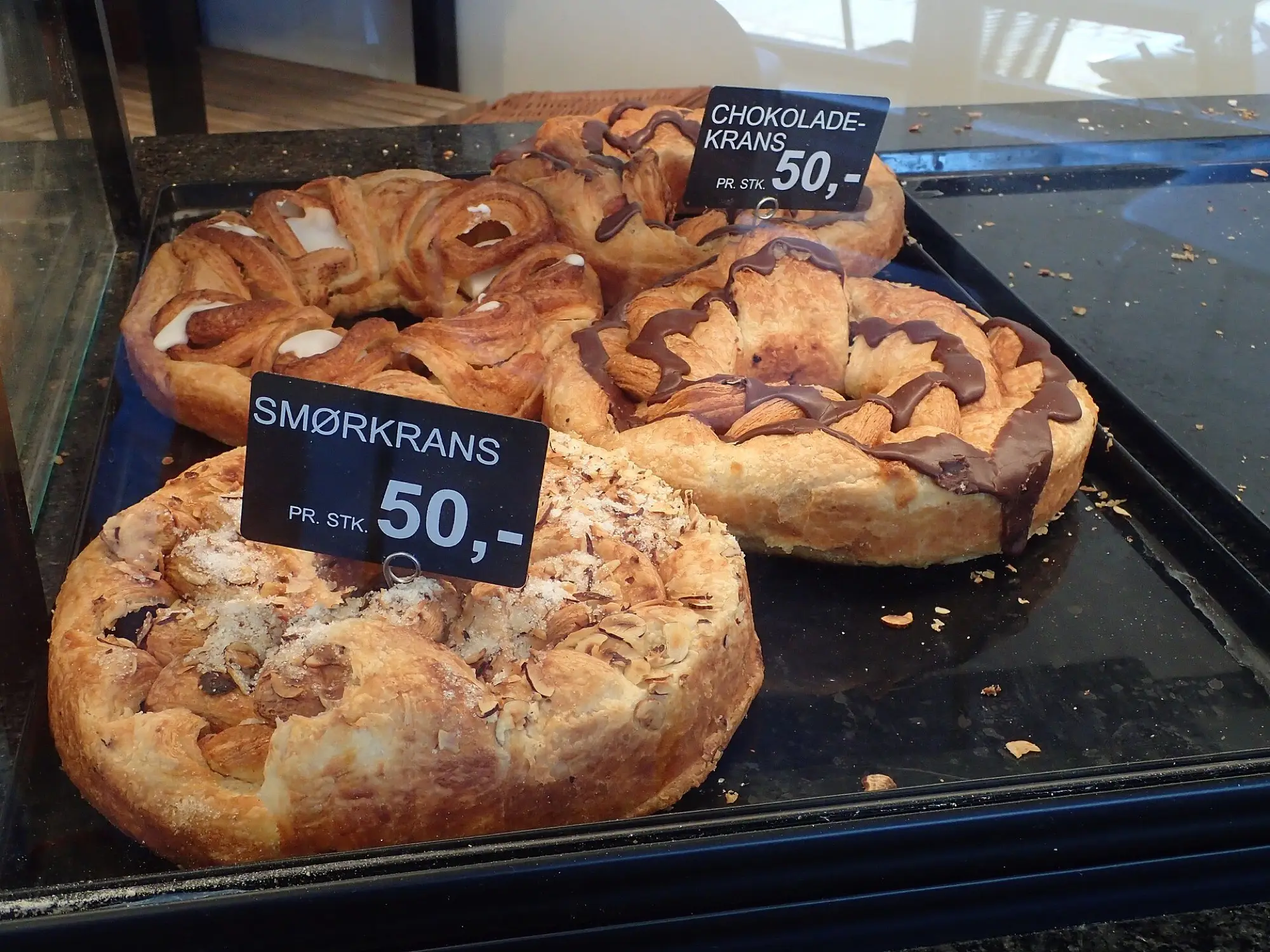

Danes call their pastry wienerbrød (Viennese bread). The ten on this page are wienerbrød, spandauer, kanelsnegl, onsdagssnegl, tebirkes, frøsnapper, kringle, fastelavnsbolle, hindbærsnitte and Napoleonshat. This page covers six Copenhagen bakeries: Hart, Andersen & Maillard, Juno, Lille, Meyers and Sankt Peders.
1. Wienerbrød: the Danish pastry Danes call Vienna bread
According to VisitDenmark, Danes call their pastries wienerbrød, Viennese bread, because the inspiration came from a trip a Danish baker took to Vienna in the 19th century. The organisation's food guide notes that wienerbrød was first made in Denmark in the 1840s by Austrian bakers.
Den Store Danske dates the first Viennese bakery in Denmark to the 1840s on Købmagergade in Copenhagen, opened by the confectioner Niels Christian Albeck after a stay in Austria, with three journeymen from the pastry's homeland. Wienerbrød was also served at the breakfast table of King Christian VIII and Queen Caroline Amalie.
Den Store Danske explains that wienerbrød covers kringles, sticks, wreaths, spandauers, horns and snails, all made from the same yeast dough, so only the filling, decoration and shape decide a pastry's name. In Vienna the same pastry is called Kopenhagener Gebäck or Dänischer Plunder, and abroad it is known as Danish pastry. Den Store Danske suggests wienerbrød became part of the Sunday breakfast table because bakers used to put a free piece in the bag when you bought your morning roll. For more on how baked goods fit into the country's wider food culture, see our guide to traditional Danish food.
2. Spandauer: the round one with custard in the middle
VisitDenmark describes the spandauer as a pastry with a dab of custard cream in the middle, the one most visitors know as a Danish pastry.
Den Store Danske defines a spandauer as a round piece of wienerbrød with custard or jam in the middle, named after the Spandau district of Berlin.
3. Kanelsnegl: the cinnamon snail
Den Store Danske defines a snegl (snail) as a kind of wienerbrød made from slices of a roll of yeast dough rolled around remonce, often spiced with cinnamon and topped with icing. Meyers' own tebirkes recipe makes its remonce from 100 g marzipan, 100 g sugar and 100 g butter. VisitDenmark's tip is to ask for a kanelsnegl (cinnamon snail) at Danish bakeries.
VisitCopenhagen singles out the cinnamon rolls called kanelsnurrer, made with Valrhona chocolate, at Meyers Bageri on Jægersborggade. VisitCopenhagen says Lille Bakery on Refshaleøen bakes everything from berliners to sourdough bread to cinnamon rolls.
4. Onsdagssnegl: the Wednesday snail at Sankt Peders
VisitDenmark says there is a special pastry just for Wednesdays, the onsdagssnegl, baked by Sankt Peders Bageri, which it calls the oldest bakery in Copenhagen.
VisitCopenhagen says Sankt Peders Bageri's cinnamon rolls, the onsdagssnegle (Wednesday snails), are so popular that the bakery sells no less than 4000 of them every Wednesday.
5. Tebirkes: the poppy-seed morning pastry
VisitDenmark describes the tebirkes as a pastry with remonce in the middle and poppy seeds all over the top. Den Store Danske defines tebirkes as small morning pastries of wienerbrød dough sprinkled with birkes, usually with remonce inside; in Jutland and on Funen they are called københavnerbirkes.
Until the mid-1960s tebirkes were baked without remonce; the encyclopedia retells the story of a baker near Copenhagen with remonce to spare who filled a whole tray, after which demand was so great that within weeks all tebirkes were baked with remonce.
Birkes are dried poppy seeds; Denmark is one of the only countries to use the word, which comes from the Hebrew berakot, because Jewish bakers in 1700s Copenhagen spread their tradition of sprinkling them on the sabbath bread.
6. Frøsnapper: the seed snapper twist
VisitDenmark's tip also names the frøsnapper (seed snapper) as a pastry to ask for at Danish bakeries. DR, the Danish public broadcaster, calls the frøsnapper a bakery classic; its recipe, a version filled with cream cheese, cuts the dough into strips, brushes them with egg, sprinkles sesame on one side and poppy seeds on the other, and twists them once or twice.
7. Kringle: the twisted bakers' sign
Den Store Danske describes a kringle as a long stick of dough whose ends are twisted around each other and laid up to the middle; made with different doughs it becomes a wienerbrødskringle among others, and since the Middle Ages it has been the bakers' guild symbol and hung as the sign outside bakeries.
VisitCopenhagen says Sankt Peders Bageri offers everything from buttery kringle to bread and cinnamon rolls. For the rest of the day, see things to do in Copenhagen.
8. Fastelavnsbolle: the cream bun before Lent
VisitDenmark says Denmark celebrates Fastelavn seven weeks before Easter with cream-filled buns, fastelavnsboller, sold everywhere in bakeries and supermarkets. You can read more about the seasonal calendar in our guide to Danish traditions.
Den Store Danske says Fastelavn buns have been eaten in the days before Lent since at least the 1500s and that these days they go on sale as early as mid-January; the versions of wienerbrød dough with custard, whipped cream or jam are 1900s inventions. Since the 2010s, gourmet bakeries have sold the bun in ever new flavours such as liquorice, pistachio and sea buckthorn.
9. Hindbærsnitte: the raspberry slice
VisitDenmark describes hindbærsnitte as a buttery biscuit with raspberry filling and icing. Den Store Danske explains that a snitte is a piece cut from something larger, and that a hindbærsnitte is a dry cake cut from a long cake bar.
Juno the Bakery lists hindbærsnitter among its seasonal favourites sold only at the bakery.
10. Napoleonshat: the chocolate-dipped hat
Den Store Danske describes a Napoleonshat as a triangular cake shaped like a hat, a parcel of shortcrust pastry filled with macaroon paste of finely ground almonds, sugar and egg white, with its base dipped in dark chocolate after baking.
Where to buy them: six Copenhagen bakeries
VisitDenmark's list of where to buy the best pastries in Denmark names Hart, Andersen & Maillard and Flere Fugle in Copenhagen, Jumbo in Aarhus, Vesterports Bageri on Funen and Tir Bakery in North Zealand. The six are spread over Frederiksberg, Nørrebro, Østerbro, Refshaleøen and the Latin Quarter; see our guide to Copenhagen neighbourhoods.
Richard Hart was the baker at Noma before opening Hart; its first bakery is at Gl. Kongevej 109 in Frederiksberg, and VisitCopenhagen counts ten Hart bakeries in Copenhagen, selling sourdough bread, croissants, cardamom rolls and pastries.
Andersen & Maillard is a café, coffee roastery and bakery in a former bank at Nørrebrogade 62, with baking by the pastry chef Milton Abel, formerly of Noma and Amass; it also has locations at Antwerpengade 10 in Nordhavn and Ny Østergade 15 in the city centre.
Juno the Bakery in Østerbro opened in 2017; its founder Emil Glaser, a former Noma cook who grew up with cardamom rolls in Sweden, made them part of the range, and VisitCopenhagen sends you there for one of the city's best cardamom rolls. Juno is at Århusgade 48 in Østerbro and opens Tuesday to Saturday 07:30 to 18:00 and Sunday 07:30 to 16:00; it is closed on Mondays.
Lille is at Refshalevej 213b and opens Wednesday to Sunday 08:00 to 17:00; it is closed on Mondays and Tuesdays. Lille closes from 21 December 2026 for a long winter break and reopens on 20 January 2027 at 08:00.
Meyers Bageri on Jægersborggade 9 was opened by the chef Claus Meyer with a baker and a confectioner; it opens early, sells organic bread and cakes, and has room for only five people inside. Meyers' own site lists three bakeries, at Classensgade 33 in Østerbro, Amagerbrogade 48 on Amager and Jægersborggade 9 in Nørrebro, its first, and says it bakes only with organic flour.
Sankt Peders Bageri is at Sankt Peders Stræde 29 in the Latin Quarter; VisitCopenhagen says it can lay claim to being Copenhagen's oldest bakery, in a protected building with nine bar stools.
| Bakery | Area | Address | Opening hours |
|---|---|---|---|
| Hart | Frederiksberg | Gl. Kongevej 109 | Not stated |
| Andersen & Maillard | Nørrebro | Nørrebrogade 62 | Not stated |
| Andersen & Maillard | Nordhavn | Antwerpengade 10 | Not stated |
| Andersen & Maillard | city centre | Ny Østergade 15 | Not stated |
| Juno the Bakery | Østerbro | Århusgade 48 | Tuesday to Saturday 07:30 to 18:00, Sunday 07:30 to 16:00 (closed Mondays) |
| Lille Bakery | Refshaleøen | Refshalevej 213b | Wednesday to Sunday 08:00 to 17:00 (closed Mondays and Tuesdays; closed 21 December 2026 to 20 January 2027) |
| Meyers Bageri | Nørrebro | Jægersborggade 9 | Opens early |
| Meyers Bageri | Østerbro | Classensgade 33 | Not stated |
| Meyers Bageri | Amager | Amagerbrogade 48 | Not stated |
| Sankt Peders Bageri | Latin Quarter | Sankt Peders Stræde 29 | Not stated |