
Danish traditions through the year: the jump into the new year after the monarch's speech, Fastelavn, Easter (gækkebrev and påskefrokost), Store Bededag and its warm hveder, candles in the window on 4 May, Constitution Day on 5 June, Valdemarsdag and the flag on 15 June, Sankt Hans on 23 June, J-dag, Mortensaften on 10 November, Advent and Lucia, and Christmas Eve.
1. New Year's Eve, 31 December: the monarch's speech and the jump
The King gives his New Year address every year on 31 December at 6 pm, broadcast live on television and radio from Frederik VIII's Palace. On 1 January 1941 Christian X gave the first New Year speech broadcast on radio. Later in the evening, as denmark.dk notes, champagne and kransekage (baked marzipan cookies) are served while everyone waits for the clock on Copenhagen City Hall to strike twelve, and many people then go outside to set off fireworks. According to VisitDenmark, Danes stand on chairs just before midnight and jump into the new year as the clock strikes 12, since forgetting is said to bring bad luck for the whole year.
2. Fastelavn, February or early March: the cat out of the barrel
The National Museum says Fastelavn dates from Catholic times, as a feast before the 40 days of fasting before Easter, and survived the Reformation of 1536. The word comes from German fastelabend (the evening before the fast). Fastelavn Sunday is the Sunday seven weeks before Easter Day, so it always falls between 1 February and 7 March. By the National Museum's table, Fastelavn Sunday was 15 February in 2026 and is 7 February in 2027.
VisitDenmark says children dress up in costumes at Fastelavn and hit a cat out of a barrel, like a piñata. Queen Christine's accounts for 1508 may be the first trace of barrel-beating in Denmark. A live cat was kept in the barrel until the 1800s, and the custom is also known in western Skåne, Holland and England. The barrel once held a black cat, but these days it holds sweets and is decorated with a cut-out cat. The child who breaks open the barrel becomes the cat queen or cat king of the festival. Today's fastelavnsboller come from the habit of feasting before the fast, and can be made of Danish pastry dough filled with whipped cream and custard, or of yeast dough with vanilla custard.
3. Easter: gækkebrev and påskefrokost
VisitDenmark says the gækkebrev is a tradition dating back to the 18th century. Young Danes fold and cut patterns into paper, write a short poem inside and sign it with one dot for each letter of their name. If the recipient guesses the sender, the recipient is owed an Easter egg; if not, the recipient owes the sender one.
VisitDenmark says the påskefrokost (the Easter lunch) is held with family and friends on Easter Sunday, lasts a full afternoon and is built on rye bread with eggs, fried fish, herring, cheese and liver paste, with snaps alongside. You can learn more about these dishes in our guide to traditional Danish food. VisitDenmark says the breweries release their påskebryg (Easter beer) in the run-up to Easter.
4. Store Bededag, the fourth Friday after Easter: warm hveder
Store Bededag came from a royal ordinance of 27 March 1686, introduced thanks to Hans Bagger, Bishop of Roskilde. The National Museum says Store Bededag fell every year on the fourth Friday after Easter, but in 2023 the Folketing voted to abolish it as a public holiday from 1 January 2024.
The National Museum says it is still a Copenhagen tradition to walk on the ramparts and to eat warm hvedeknopper on the evening before Store Bededag. Eating warm hveder (wheat buns) on the evening before Store Bededag has been known since the middle of the 1800s; bakers could not bake in the early morning hours of the holiday, so the buns were baked the evening before.
5. 4 May: candles in the window
The Royal Danish Library says that when Germany occupied Denmark on 9 April 1940, Danes had to black out their windows and limit outdoor lighting. When the message of liberation came on the radio on the evening of 4 May, people tore down the blackout curtains. A few years after the war, when candles could be bought again, people began putting candles in the windowsill on the evening of 4 May; the Royal Danish Library says almost half of Danes still do it.
6. 5 June: Constitution Day
The National Museum says Frederik VII signed the Constitution of 5 June 1849, Denmark's first free constitution. denmark.dk calls Constitution Day, 5 June, a partial holiday; a few businesses close for part of the day, most stay open, and Denmark generally holds no parades or festivities for it.
7. 15 June, Valdemarsdag: the flag that fell from the sky
By legend, during a battle on 15 June 1219 in present-day Estonia, with King Valdemar's Danes on the defensive, a red banner with a white cross fell from the sky, the Danes won, and Denmark got its flag. Since 1913 the flag and its legend have been celebrated every year on 15 June, Valdemarsdag, and the flag is raised across the country.
denmark.dk says the crusade happened but the falling flag has no basis in reality; the flag became Danish around the middle of the 14th century, which makes it one of the world's oldest national flags in continuous use, and the legend was first written down by historians in the early 16th century. The flag's name, Dannebrog, probably means "the cloth of the Danes". Up to 1854 Dannebrog was the flag of the king and the navy only, and private persons have been allowed to use it since 1854.
8. 23 June: Sankt Hans
The National Museum says 24 June is Sankthansdag and the evening before, 23 June, is celebrated as Sankt Hans aften, a midsummer festival. Olaus Magnus described the bonfires, dancing and singing in his chronicle of 1555; Sankt Hans day itself was abolished as a holiday in 1770, but people went on celebrating the evening.
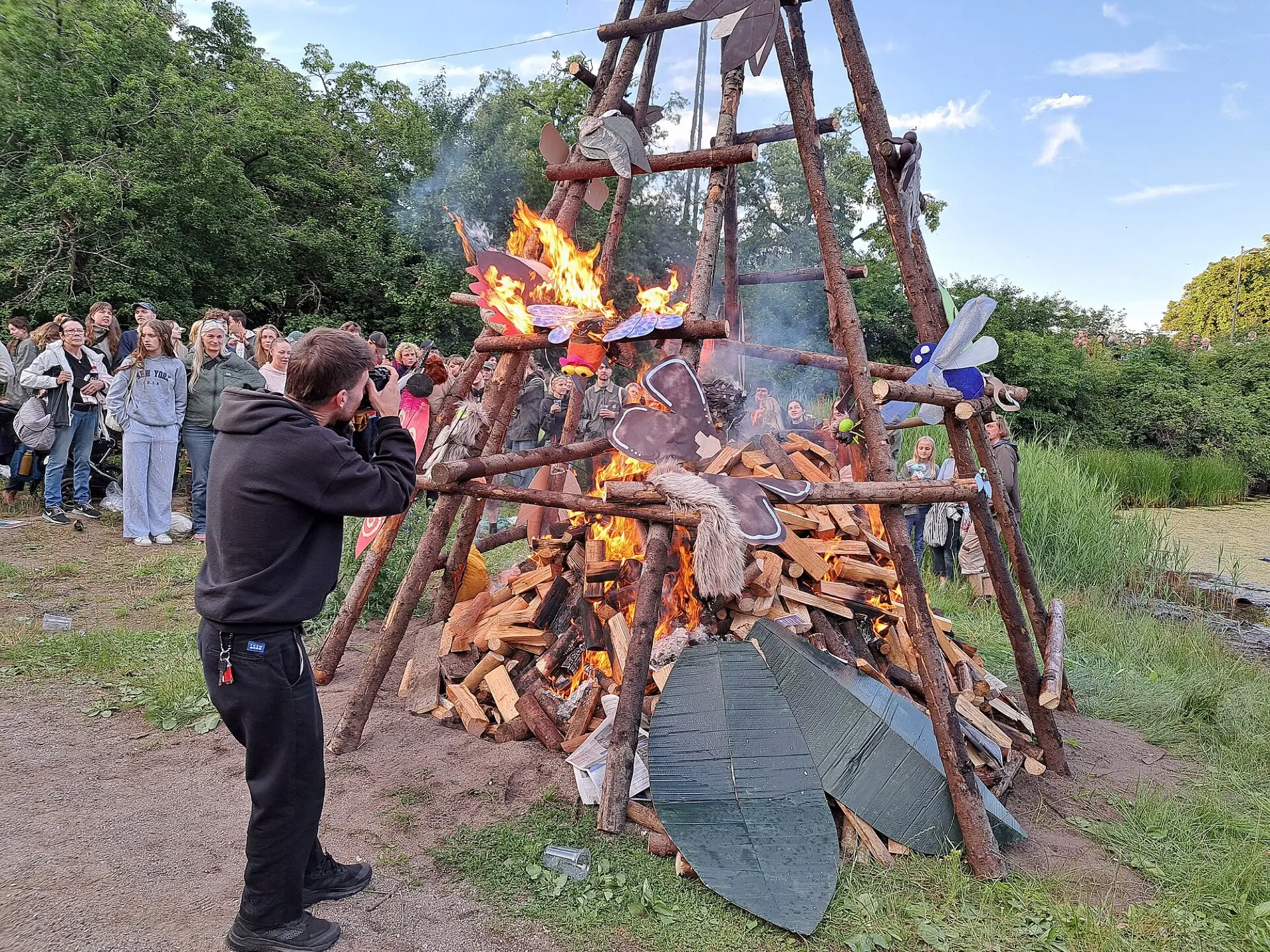
denmark.dk says Sankt Hans is usually a dinner at home followed by a walk to a community bonfire, often by the beach, in a park or by a lake, with speeches and the song Midsommervisen, written by Holger Drachmann in 1885. VisitDenmark says a doll witch is put on the bonfire, and a firework makes her "scream". The National Museum says the witch on top of the bonfire is fairly new; the first witch figures appeared at the end of the 1800s in larger East Jutland towns, at first on Valborg eve, and one of the first Sankt Hans fires with both Midsommervisen and a witch was among the Jelling seminary students around 1900.
9. J-dag, the first Friday of November
VisitDenmark says J-dag, short for julebrygsdag (Christmas brew day), was introduced by the Tuborg brewery in 1990 to launch its Christmas beer. It falls on the first Friday of November every year, starts at 8:59 pm and is celebrated in bars and pubs across the country.
10. Mortensaften, 10 November: roast duck
VisitDenmark says Danes mark Mortensaften (Saint Martin's Eve) on 10 November with roast goose, or more often roast duck, potatoes and gravy, after the story of Martin hiding among geese to avoid being made a bishop.
11. Advent and Lucia, 13 December
VisitDenmark says the advent calendar candle counts down the days to Christmas Eve, and Lucia processions on 13 December can be seen all over the country. Lucia, dressed in white with a crown of candles, leads a procession of girls in white on 13 December, and children take part in the parade at school or locally. The National Museum says the Lucia procession is a fairly new custom in Denmark, brought from Sweden, which took off in the years just after the occupation.
12. Christmas Eve, 24 December
VisitDenmark says Denmark celebrates Christmas on 24 December, Christmas Eve, with a long dinner in the evening and presents opened afterwards, often late into the night. The dinner is roast pork and duck with potatoes, red cabbage and gravy, followed by risalamande with one whole almond hidden in it; whoever finds it gets a prize or an extra present. Families dance round the Christmas tree holding hands and singing before the presents are opened. You can read more about these customs in our guide to Christmas in Denmark.
Birthdays: the flag, the cake, cinnamon and pepper
denmark.dk says one of the most popular uses of the flag is to decorate birthday cakes and buns with small paper flags, as a symbol of happiness. No laws, only guidelines, regulate the use of the most common version of the Danish flag. VisitDenmark says that at school or at work it is the birthday person who brings sweets or cake. According to VisitDenmark, a Dane who is single on their 25th birthday is covered in cinnamon by friends, and one still single and unmarried at 30 gets the same treatment with black pepper.
Public holidays and what closes
VisitDenmark says Good Friday, Easter Sunday and Easter Monday are public holidays, when some attractions, restaurants and supermarkets close, and that many Danes go to a summer house over Easter. denmark.dk says 1 May, International Workers' Day, is a partial holiday when people in the trade union movement may have the day off but most businesses are open. Whitsunday and Pentecost are days off work when many shops are closed, with few special traditions; most Danes use them to go to their summer houses. denmark.dk says most shops and restaurants in Denmark are closed on 24, 25 and 26 December.