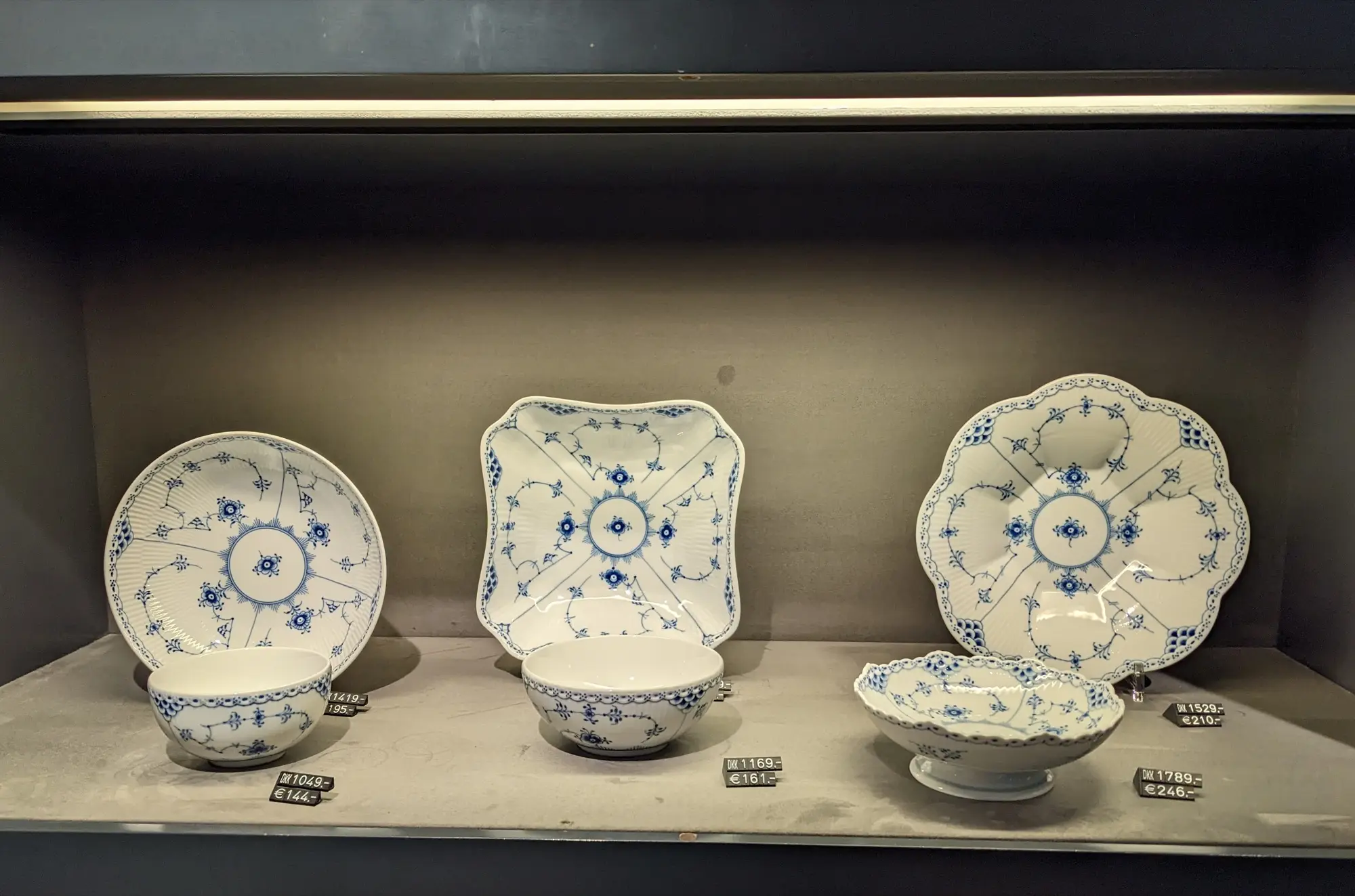

VisitDenmark says Danish design makes good souvenirs. The classic items include Royal Copenhagen porcelain, Georg Jensen silver, Kay Bojesen's wooden monkey, PH lamps, Bang & Olufsen and LEGO, bought on Strøget, at Illums Bolighus, Magasin, or museum shops. Visitors living outside the EU can claim back VAT on purchases over DKK 300 as Customs sets out.
Royal Copenhagen porcelain
Royal Copenhagen was founded in 1775 and was originally named the Royal Porcelain Factory. VisitDenmark notes that Royal Copenhagen is famous for its distinctive blue and white porcelain. VisitCopenhagen states that the company has worked with deep respect for the history and traditions of craftsmanship, but never without renewal.
The Royal Copenhagen flagship store stands on Strøget in Copenhagen. For discounted items, its historic factory in Frederiksberg houses a factory outlet shop, according to VisitDenmark.
Georg Jensen silver and jewellery
In 1904 a Danish silversmith set up his first silversmithy, which became the Georg Jensen company; it grew out of Art Nouveau into a luxury lifestyle brand. The Georg Jensen flagship store is next to Royal Copenhagen's and sells jewellery and silverware such as cutlery, vases and pitchers. VisitCopenhagen calls Georg Jensen a Danish design house renowned for artistic boldness, craftsmanship and collaborations with artists and designers.
The Georg Jensen Outlet at Søndre Fasanvej 9 in Frederiksberg sells only Georg Jensen design. It stocks first-grade goods at heavily reduced prices and remains open all year.
Kay Bojesen's monkey and Danish homeware
VisitDenmark says that in most Danish living rooms you will find a wooden Kay Bojesen monkey hanging from a shelf. Kay Bojesen (1886 to 1958) was a Danish silversmith and designer whose training years were with Georg Jensen (1906-10), according to Den Store Danske.
VisitDenmark also names vases from Kähler and Lyngby Porcelæn and pillows by Normann Copenhagen as typical in Danish homes. VisitCopenhagen says Vipp is world-famous for its pedal bin, with a store and showroom in central Copenhagen.
Lamps and furniture: PH, Klint, Fritz Hansen and Hay
VisitDenmark says Poul Henningsen (PH) is the name in Danish lamps, and that his PH5 and Artichoke lamps are popular although designed as far back as the 1950s. Kaare Klint, whom VisitDenmark calls the father of modern Danish furniture design, made his first piece of furniture in 1914 and also designed shades for his brother's lighting company, Le Klint.
VisitDenmark names Arne Jacobsen, Hans J. Wegner, Finn Juhl, Poul Kjærholm and Børge Mogensen as the mid-century Danish Modern designers, whose legacy continues in companies like Hay and BoConcept. VisitCopenhagen reports that Fritz Hansen has stood for quality Danish design since 1872, with a store on Valkendorfsgade.
Hay makes contemporary furniture and design products, and VisitCopenhagen lists Hay House among its interior design stores. Klassik in Copenhagen is a specialist shop for used Danish furniture classics, with more than 20 years in modern Danish furniture design, VisitCopenhagen says.
Bang & Olufsen and LEGO
Bang & Olufsen was founded in 1925, and its motto was and remains ærlig musikgengivelse (honest music reproduction), VisitDenmark says. VisitDenmark suggests visiting the Bang & Olufsen museum and the home of LEGO in Jutland. For visitors heading to the area, see the guide to Legoland Billund.
Food to take home
VisitDenmark says food makes a great souvenir, but advises you to check your luggage weight limit if you plan to take a lot of rugbrød (rye bread) home. For traditional ideas to add to your list, consult the guides to Danish food and Danish drinks.
Torvehallerne, Copenhagen's marketplace, has fresh food stalls, an oyster bar, a French cheese shop and smørrebrød (open-faced sandwich) stands. In Østerbro, Leckerbaer sells gourmet cookies made by the chefs Jakob Mogensen and Gabi Bär Mogensen, VisitDenmark says.
Museum shops
VisitDenmark suggests starting a shopping trip in a museum shop, naming Louisiana's design, art and lifestyle shop, the Danish Architecture Center, ARKEN and Glyptoteket's books. The National Museum of Denmark's shop sells coffee table books on Danish history and jewellery inspired by Viking art, according to VisitDenmark. VisitDenmark also recommends the gift shop of the newly refurbished Design Museum Danmark.
Where to shop: Strøget, Illums Bolighus and the side streets
VisitDenmark says Danish design items make excellent souvenirs, and Copenhagen has flagship stores of big design brands such as Georg Jensen and Royal Copenhagen. VisitCopenhagen calls Illums Bolighus the must-visit interior store, with its flagship on Amagertorv presenting Danish, Scandinavian and international design including porcelain, silver, glassware, ceramics and furniture. VisitDenmark calls Strøget Europe's longest shopping street, through the centre of Copenhagen, with international brands such as LEGO and H&M and the Harrods of Danish design, Illums Bolighus.
VisitDenmark's tip is to check the side streets off Strøget, especially Strædet, which runs parallel to it, for boutiques and vintage shops. For boutiques and vintage, VisitDenmark also suggests exploring specific Copenhagen neighbourhoods: Blågårdsgade, Jægersborggade and Elmegade in Nørrebro, as well as Istedgade and Værnedamsvej in Vesterbro. The big department stores Illums Bolighus and Magasin have a wide range of Danish design, VisitDenmark says.
Claiming back VAT if you live outside the EU
The Danish Customs Agency explains that a tourist living outside the EU can get a VAT refund on goods bought during a stay in Denmark, if they come on holiday from outside the EU and go back when it ends. Anyone whose official address is in Denmark or another EU country, or who has studied or worked in the EU, for example as an au pair, cannot get a VAT refund.
The goods must be worth more than DKK 300, and you must take them with you when you leave Denmark. The goods must leave the EU before the end of the third month after the month of purchase; bought on 4 March, they must leave Denmark before the end of June. Danish VAT normally corresponds to 20% of the sales price, or 25% of a price quoted without VAT. For Norway and the Åland Islands the threshold is DKK 1,200, under special rules.
Shops are not obliged to help with a VAT refund, so if the shop will not assist, you cannot get one. The process requires three steps:
- Obtain an invoice from the shop with your passport shown.
- Obtain a customs stamp on leaving the EU.
- Send the stamped invoice back to the shop, which refunds the VAT.
The stamp can be obtained no earlier than four hours before leaving Denmark, and you must show your passport, ticket, proof of non-EU residence and the goods. From small airports such as Aarhus and Aalborg you may have to go to a customs office away from the airport, so check its opening hours in advance.