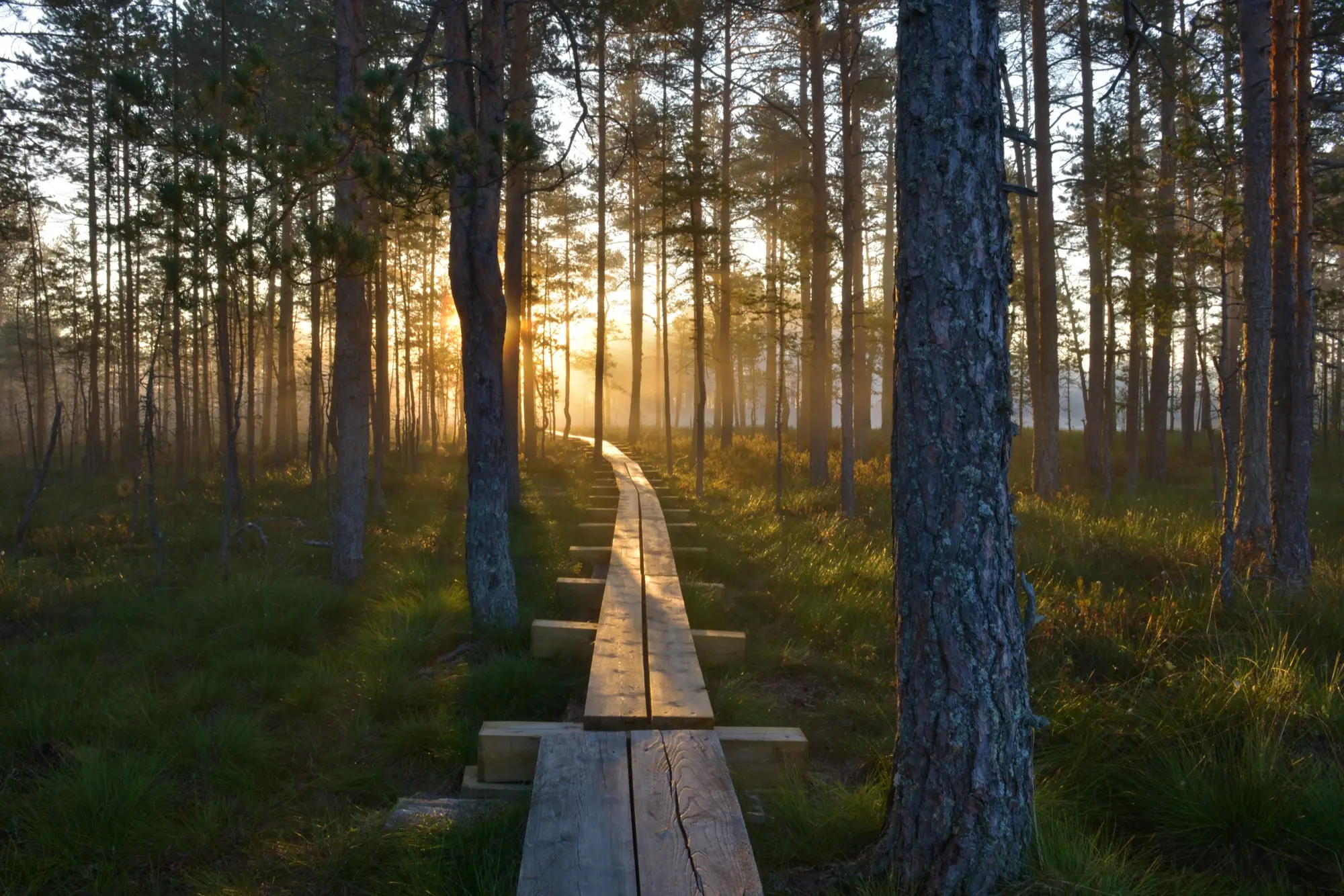

Estonia's landscape offers quick transitions between raised peat bogs and historic coastal resorts. The country's six prominent bog walks are Viru, Kakerdaja, Männikjärve, Soomaa, Riisa and Tolkuse, while its leading spa towns are Pärnu, Kuressaare, Haapsalu, Narva-Jõesuu, Otepää and Tallinn. Viru Bog is the closest to the capital, situated 52 km from Tallinn.
1. Viru Bog, Lahemaa: 3.5 km of boardwalk, 52 km from Tallinn
To reach the Viru bog trail in Lahemaa National Park, RMK (Riigimetsa Majandamise Keskus, the State Forest Management Centre) says to drive 52 km from Tallinn on the Tallinn-Narva road (E20), turn left towards Loksa, and park on the right. The trail starts directly from the car park. You can also view options for day trips from Tallinn to combine this walk with other rural stops.
The trail through Viru Bog is 3.5 km long and marked in white and green on the trees. If you walk it as a circle back along the bog-side dunes, the route is 5.5 km. The boardwalk leads past classic peat landscapes, heather and open bog pools.
Wheelchairs and prams can reach the observation tower by a ramp. The 1.3 km path from the car park to the tower is passable by wheelchair with an assistant; beyond the tower, the boardwalk narrows. Up to 25 people may be on the tower's top floor at the same time, and climbing the tower during thunderstorms is forbidden. Despite all the surrounding water, the bog is highly flammable, so RMK asks visitors to walk only on the boardwalk. Cycling on the boardwalk is prohibited.
2. Kakerdaja bog: 4 km of boardwalk off the Jäneda–Perila road
RMK gives the way into Kakerdaja bog from the Jäneda–Perila road rather than from Tallinn: turn left 13 km from Jäneda (signposted Kakerdaja) and drive 1.8 km along the gravel road to the campfire-site sign.
The Kakerdaja nature trail is 7 km in total and includes 4 km of boardwalk through Kakerdaja bog. The Kalajärve section loops around the small and large Kalajärv lakes past the Noku campfire site.
Kakerdaja is one of the largest bogs in Kõrvemaa, covering about 1,000 hectares, with Lake Kakerdaja sitting in the middle. In spring and autumn, thousands of waterfowl stop in its bog pools. In 2020, reflectors were fitted along the 3.4 km Kalajärve part of the trail, and carrying a torch is recommended if you walk late in the day.
3. Männikjärve bog, Endla: a 7.3 km trail 143 km from Tallinn
The Männikjärve bog trail starts at Tooma in the Endla Nature Reserve, 143 km from Tallinn (136 km along the Piibe road) and 72 km from Tartu.
The Männikjärve bog study trail is 7.3 km, starts and ends at Tooma, takes about 2 hours, and has 1.3 km of boardwalk with blue trail marks painted on the trees. Mire research in Estonia began at Tooma village in 1910, and meteorological observations have been made there continuously since 1950.
From the 7-metre observation tower, you see the whole 210-hectare Männikjärv bog, which contains more than 120 bog pools. During high-water periods, some sections of the trail can be impassable. Campfires and camping along the trail are prohibited.
4. Soomaa National Park: the fifth season and bog-shoe hikes
Visit Estonia states that Soomaa National Park is easily reached on a day trip from Pärnu or Viljandi. Buses run between Pärnu and Soomaa, but in the mornings and afternoons only. There is no grocery shop inside Soomaa; the nearest shop is located in Tori.
Established in 1993, Soomaa sits on the border of Pärnu and Viljandi counties and is Estonia's second largest national park, with wetlands making up as much as half of its 39,884 hectares. Floods can cover up to 17,500 hectares of the park. This spring high water is known as the fifth season, when visitors can take a canoe through forests and fields to places that are normally unreachable on foot. Checking the best time to visit Estonia helps align a visit with these seasonal water changes. The fifth season usually arrives at the end of March or the beginning of April, though the rivers can overflow whenever there is heavy rain or an early thaw. Visit Estonia advises calling the visitor centre before planning a trip.
During the fifth season, some roads and hiking trails may be under water; monitor soomaa.com, RMK's Soomaa pages, or the Soomaa visitor centre for current water levels. For off-trail exploration, guided bog-shoe hikes operated by soomaa.com equip each participant with a pair of bog shoes (räätsad) and an accompanying local guide. These hikes last 2 to 5 hours, the price depends on group size, and no hikes run during the spring bird-nesting period. In addition, Soomaa's dugout canoe (haabjas) building tradition was added by UNESCO to its intangible cultural heritage list in 2021. RMK's Soomaa visitor centre at Kõrtsi-Tõramaa features a permanent exhibition about travelling Soomaa by dugout canoe, open to all from 19 January 2026; from 31 August to 31 May, the centre opens Tuesday to Saturday between 10.00 and 16.00.
5. Riisa bog, Soomaa: 4.8 km with a tower and 8 rest sites
RMK gives no distance from Tallinn for the Riisa study trail. Coming from the Tallinn-Pärnu road, drive to Tori, take the road into the national park, follow the Jõesuu road for 6 km, and turn right onto the Kõpu-Jõesuu road, from where it is 6 km to the trail entrance.
The Riisa study trail runs for 4.8 km through the open bog and the damp forests alongside the Navesti river. It features 8 recreation sites and an observation tower looking across the bogscape.
The boardwalk was renovated in 2013 and is fully accessible by wheelchair or pram as far as the first bog pool, 1,220 metres into the route.
6. Tolkuse bog: a 2.2 km boardwalk loop 162 km from Tallinn
To reach the Rannametsa-Tolkuse trail in the Luitemaa Nature Reserve, RMK instructs drivers to travel 162 km on the Tallinn-Pärnu-Ikla road directly to the car park. If arriving by public transport, take a Pärnu-Ikla bus service to the Luite stop and walk about 100 m along the Riga road towards Riga to find the start of the trail.
The 2.2 km trail forms a complete circular loop covered entirely by boardwalk, which was rebuilt alongside its observation tower in June 2023. The path crosses pine-covered sand dunes to the tower on Tornimäe, offering views over Pärnu Bay on one side and Tolkuse bog on the other, before descending to the bog's largest pool.
The initial stretch leading from the car park directly to the bog pool is suitable for wheelchairs and pushchairs.
7. Pärnu: Estonia's top spa resort, mud baths since 1838
Pärnu is reached by bus and car, sitting about a 90-minute drive from Tallinn. Buses run between the Tallinn and Pärnu bus stations every 30 minutes to 1 hour, and the Port of Tallinn is about 130 km from Pärnu.
Visit Estonia identifies Pärnu as Estonia's top spa resort destination, recognised for wooden resort architecture, a long sandy beach and historical sanatoriums. Pärnu's first mud bath opened in 1838, and the town joined the official list of imperial Russian resorts in 1890. Today, it belongs to the union of European historic spa cities, an association of more than 50 cities and regions across 16 countries. The Hedon boutique spa operates inside the town's historic mud bath building. Estonian spas draw heavily on local natural ingredients, including mineral-rich mud, juniper, natural spring water and peat, with Pärnu offering seawater and mud treatments continuously since the 19th century.
8. Kuressaare, Saaremaa: Spa-remaa, 211 km of road plus a ferry
Reaching Kuressaare by car involves driving 135 km from Tallinn to the ferry port at Virtsu, which takes about 1 hour 45 minutes. From Kuivastu harbour on the island of Muhu, it is 76 km, or about 50 minutes, to Kuressaare. That requires 211 km of total driving from Tallinn, in addition to the ferry crossing. By public transport, direct buses from Tallinn to Kuressaare take around 4 hours. A scheduled flight from Tallinn takes about half an hour; Kuressaare airport is located 3 km from the town centre. Visit Saaremaa has also announced that Finnair will launch a daily Helsinki-Kuressaare route in summer 2027, providing a 40-minute flight with fares from €70, though this service is only announced and not yet operating.
Saaremaa is colloquially referred to as Spa-remaa because of its density of spa hotels. Kuressaare, the island's largest town, contains large spa complexes alongside several boutique properties, resulting in one spa place for every 10 inhabitants. According to Visit Saaremaa, mud with medicinal properties was discovered at Kihelkonna on Saaremaa, where a medical spa opened in 1824. Kuressaare subsequently expanded into a resort destination, continuing its therapeutic bathing traditions to the present day.
9. Haapsalu: the oldest resort town, under two hours away
Haapsalu is located less than two hours from Tallinn and works easily as a day trip by car or coach.
Visit Estonia calls Haapsalu Estonia's oldest resort town, now housing two spa hotels. The country's mud-therapy tradition began here after a local doctor, Carl Abraham Hunnius, arrived in Haapsalu in 1820. He observed local residents treating physical ailments with mud gathered from the bay and went on to open the first mud spa in 1825. Cultural visitors soon followed, including Pyotr Tchaikovsky, who spent the summer of 1867 in the resort. Today, Haapsalu's Paralepa beach is nicknamed the chocolate coast because locals continue to apply its dark mud directly for joint pain.
10. Narva-Jõesuu: the Riviera of the North, spas since 1876
Narva-Jõesuu lies about 13 km north of Narva. Narva itself is reached from Tallinn by train, taking about two hours and 20 minutes.
Narva-Jõesuu's first dedicated spa facility opened in 1876, quickly earning the settlement the title Riviera of the North among Russian nobility. Ida-Virumaa's regional tourism authority notes that Narva-Jõesuu has been an officially recognised resort town since the 1920s. The town is built alongside a coastal pine forest and remains known for its modern spa centres offering both relaxing wellness breaks and targeted healing treatments.
11. Otepää: the winter-sports town with Pühajärve Spa
No official road distance from Tallinn is stated for Otepää. The town serves as Estonia's principal destination for winter sports and features outdoor routes during the warmer months, including a 12 km walking circuit around Lake Pühajärv.
On the outskirts of town, the Pühajärve Spa & Holiday Resort hotel provides a wide range of treatments for health-oriented and leisure holidays. South Estonia is also the heartland of the UNESCO-recognised smoke sauna tradition; near Otepää, visitors can access two authentic smoke saunas, Toidupada and the sauna at Kevvai guesthouse.
12. Tallinn spa hotels: no day trip needed
For treatments without leaving the capital, travellers staying in the city can review things to do in Tallinn alongside several central wellness properties. The four-star Kalev Spa hotel features an indoor water park equipped with slides, while Tallink Spa includes five saunas and four swimming pools.
Just outside the administrative boundary, Tallinn Viimsi Spa is situated 12 km from the city centre. The complex incorporates an extensive sauna centre as well as the Atlantis H2O water park, which is Estonia's largest interactive water park and includes eight slides.
The Võromaa smoke sauna on the UNESCO list
In 2014, the smoke sauna tradition in Võromaa was inscribed on UNESCO's Representative List of the Intangible Cultural Heritage of Humanity after a five-year application process. UNESCO listed the living cultural tradition itself, rather than individual sauna buildings.
The tradition comprises bathing customs, the crafting of bath whisks (vihad), the manual building and repairing of saunas, and the smoking of meat inside the room. A smoke sauna (suitsusaun) has no chimney; wood smoke circulates freely throughout the interior while the stones heat up. The structure is heated for six to eight hours, after which the fire is allowed to die down and the lingering smoke is vented outside before bathers enter.
This practice remains predominantly a family custom, observed on Saturdays as well as prior to major seasonal festivals or significant family events, with neighbouring households taking turns to host. For visitors seeking to experience the process, Visit Estonia lists authentic sessions held in a traditional old Võromaa smoke sauna at Mooska farm.
Distances from Tallinn at a glance
| Destination | Distance or route from Tallinn | What to do |
|---|---|---|
| Viru Bog | 52 km | Walk 3.5 km or 5.5 km trails, climb the observation tower |
| Kakerdaja bog | Turn off Jäneda-Perila road 13 km from Jäneda, drive 1.8 km | Walk 7 km trail with 4 km boardwalk, observe waterfowl |
| Männikjärve bog | 143 km (136 km via Piibe road) | Walk 7.3 km trail, view bog pools from 7 m observation tower |
| Soomaa National Park | Day trip from Pärnu or Viljandi (distance not stated) | Canoe flooded forests in the fifth season, take guided bog-shoe hikes |
| Riisa bog | Via Tori, 6 km on Jõesuu road, then 6 km on Kõpu-Jõesuu road | Walk 4.8 km trail, access first bog pool by wheelchair or pram |
| Tolkuse bog | 162 km | Walk 2.2 km circular boardwalk, climb Tornimäe observation tower |
| Pärnu | 130 km to Port of Tallinn (90-minute drive) | Mud baths, seawater treatments, visit sandy resort beach |
| Kuressaare | 211 km driving plus ferry | Visit medical and boutique spas, tour island resort town |
| Haapsalu | Under 2 hours (kilometres not stated) | Mud therapy, visit two spa hotels, walk Paralepa beach |
| Narva-Jõesuu | 13 km north of Narva (Narva is 2 h 20 min by train) | Spa treatments, walk along pine forest coast |
| Otepää | Not stated | Spa holiday at Pühajärve, 12 km lake walk, smoke saunas |
| Tallinn | In city (Viimsi Spa is 12 km from city centre) | Hotel spa pools, saunas, Atlantis H2O water park slides |