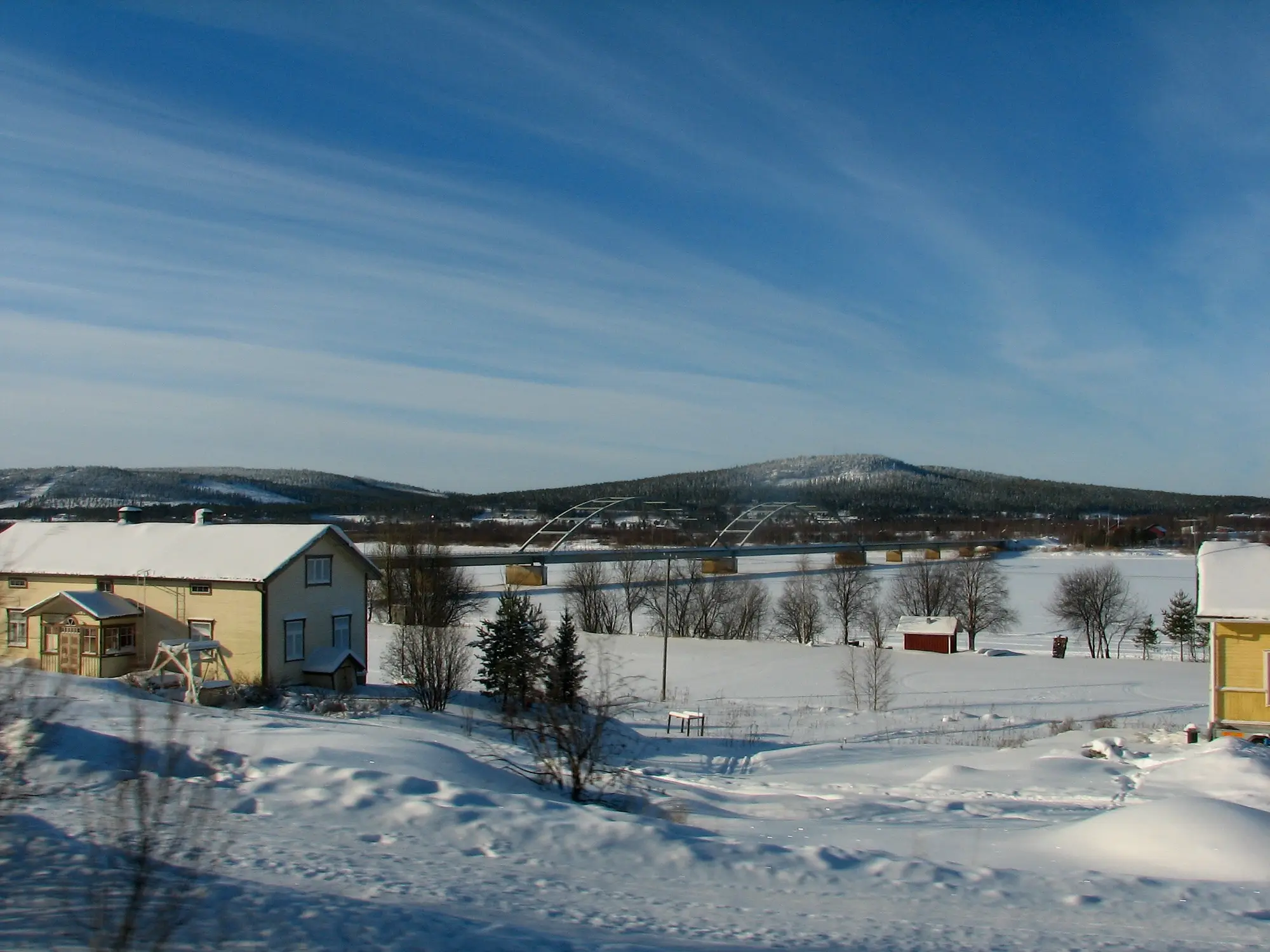

Finnish Lapland is the Santa Claus Village and resort side, with Rovaniemi reached by daily Finnair flights and VR's night train, and Levi, Ylläs and Saariselkä further north. Swedish Lapland is Kiruna, the Icehotel and Abisko, where the case for the aurora is clear skies. Choose Finland for Santa, ski resorts and a choice of bases on one road north; choose Sweden for the Icehotel, Abisko's dry skies, Kungsleden and Sámi reindeer experiences, as both get dark enough from September to March or April.
Getting there: Rovaniemi or Kiruna
To reach Finnish Lapland, you can fly into Rovaniemi Airport, which sits 3 km from Santa Claus Village. Finnair operates daily flights between Helsinki and Rovaniemi throughout the year. On the rails, VR operates double-decker night services known as the Santa Claus Express, or the Santa train. The Santa Claus Express runs from Helsinki or Turku and goes to Rovaniemi, Kolari or Kemijärvi. A private cabin on the Helsinki–Rovaniemi night train starts from €59, and the price covers the whole cabin.
For Swedish Lapland, you can travel via Kiruna. Kiruna Lappland states that SAS and Norwegian both fly Stockholm Arlanda to Kiruna all year round, a flight of around 90 minutes. For ground transport, SJ's night train runs between Stockholm and Narvik, so you can sleep part of the way to Kiruna. On this service, you choose a seat, a sleeping car berth or, in first class, your own compartment with shower and toilet.
Where to base yourself
Rovaniemi at 66.50°N on the Arctic Circle is the easiest Lapland city to reach. Streetlamps mean walking to the riverbank behind Arktikum, climbing Ounasvaara or driving out of town for darker sky. You can explore town details in the practical guide to Rovaniemi. North of Rovaniemi, darker skies and higher fells sit at Pyhä (87 km away), Ylläs (133 km away), Levi (150 km away), and Saariselkä and Inari up the Arctic highway. Levi at about 68°N sits well inside the quiet-night auroral oval, and Ylläs lies 36 km west under the same western Lapland sky. Saariselkä and Ivalo sit 128 km north-east of Levi along the road towards Inari, where darker village edges and open fells reduce town glare.
Kiruna is Sweden's northernmost town, about 145 km north of the Arctic Circle. LKAB says its Kiruna mine is today the world's largest underground iron ore mine. On 19 and 20 August 2025 Kiruna Church, which weighs 672.4 tonnes and is 40 metres wide, was moved in one piece to a site between the cemetery and the new city centre. Jukkasjärvi is a small village 15 km outside the Kiruna city centre, with about 800 inhabitants. Abisko National Park was established in 1909, one of the first in Sweden. The Aurora Sky Station sits at around 900 metres on Mount Njullá (Nuolja), just south of Abisko and Lake Torneträsk, below a summit of about 1,160 metres. More ideas appear in the overview of Swedish Lapland.
Northern lights: the odds each side gives
Each region presents distinct auroral claims. According to Finnish Meteorological Institute statistics on clear dark nights, northern lights appear three nights out of four in northern Lapland (the Kilpisjärvi and Utsjoki area), every second night in central Lapland around Sodankylä, and about one night per month in Helsinki. The Finnish Meteorological Institute names February to March and September to October as the best months to see the northern lights, and 9 p.m. to 1 a.m. local time as the best nightly window. Saariselkä, Ivalo and Inari are far enough north that even a quiet geomagnetic night is often enough to see the aurora, as outlined in the overview of northern lights in Finland.
Across the border, the Swedish Lapland Visitors Board says more or less active northern lights can be caught around Abisko every night from October until the end of March, and that there the question is not auroral activity but clear skies. The board also notes the best time is between September and late March, though the lights have been seen as early as late August, and the best hours seem to be between 9 pm and 2 am. STF says the Abisko area is often called "the blue hole" because the sky there is frequently clear even when it is cloudy in surrounding areas. An SMHI blog post on the 1991-2020 normals names Abisko for the lowest normal annual precipitation, 347.2 mm, and says Abisko, in a precipitation shadow for most wind directions, has long been known as a very dry place. For Kiruna, Kiruna Lappland says the town has plenty of darkness and is far enough north that even minimal solar activity is enough to see the lights, so the weather is the most unreliable factor. You can check viewing details for northern lights in Sweden.
How dark it gets, computed on this site
Every darkness figure here comes directly from site calculations:
- In Rovaniemi astronomical darkness starts on 8 September and ends on 2 April, reaching 13h 10m on 21 December, as shown on the Rovaniemi daylight record.
- In Levi astronomical darkness returns on 12 September and runs until 30 March, reaching 13h 20m on 21 December while the sun does not rise, recorded on the Levi aurora tracker.
- In Saariselkä the aurora-dark season opens on 13 September and closes on 28 March, reaching 13h 24m on 21 December.
- Computed on this site for the 2026-27 season on the Kiruna aurora page, Kiruna has 2h 42m of astronomical darkness on 15 September, 12h 48m on 1 December, 13h 16m on 15 December and 5h 40m on 15 March, and none on 1 September or 1 April.
- Computed on this site for the 2026-27 season on the Abisko aurora log, Abisko has no astronomical darkness on 1 September; 2h 12m on 15 September; 12h 50m on 1 December; 13h 20m on 15 December; 5h 28m on 15 March; and none again by 1 April.
Rovaniemi does not get polar night: atmospheric refraction lifts the sun above the horizon even on 21 December, when the sun rises at 11:08 and sets at 13:22 for 2h 14m of daylight. In summer, Rovaniemi has 30 days of continuous midnight sun from 6 June to 5 July, with 24h 00m of daylight on the summer solstice.
Santa Claus Village or the Icehotel
Finland provides dedicated family installations. Santa Claus Village is open every day of the year and charges no entrance fee. Admission to meet Santa at the Santa Claus Office is free every day of the year, and visitors are under no obligation to buy the official photographs.
Sweden offers original ice architecture. Icehotel began in 1989, when its founder Yngve Bergqvist opened Arctic Hall, an art gallery built from ice and snow, in Jukkasjärvi. Each winter the Torne River freezes, and its ice is harvested and made into the hotel's art and architecture, which takes a new form every year. Icehotel 365, a permanent building cooled by solar power, keeps a steady minus five degrees, so the ice art can be seen all year, even in summer. Icehotel is open every day, all year round, and it is cash free.
Sámi culture and the wilderness
The Sámi are one of the world's indigenous peoples, and their traditions and culture are still very much alive.
In Finland, Inari stands on Lake Inari, also called the Sámi Sea, the third largest and second deepest lake in Finland, with some 3,318 islands. Siida in Inari village is 40 km from Ivalo, 50 km from Ivalo Airport, 75 km from Saariselkä and 328 km from the nearest station, Rovaniemi.
In Sweden, there are eight Sámi communities in Kiruna; a Sámi community is an economic association whose members work with reindeer herding. Nutti Sámi Siida is a Sámi tourism company in Jukkasjärvi that runs nature and culture experiences based on Sámi culture and has lodging close to reindeer. For wilderness hiking, Kungsleden, the King's Trail, runs just over 450 km between Abisko and Hemavan, and the Swedish Tourist Association (STF) set it up in the early 20th century. The northern section, Abisko to Nikkaluokta, is 107 km in 7 stages, and can be done in 5 days.