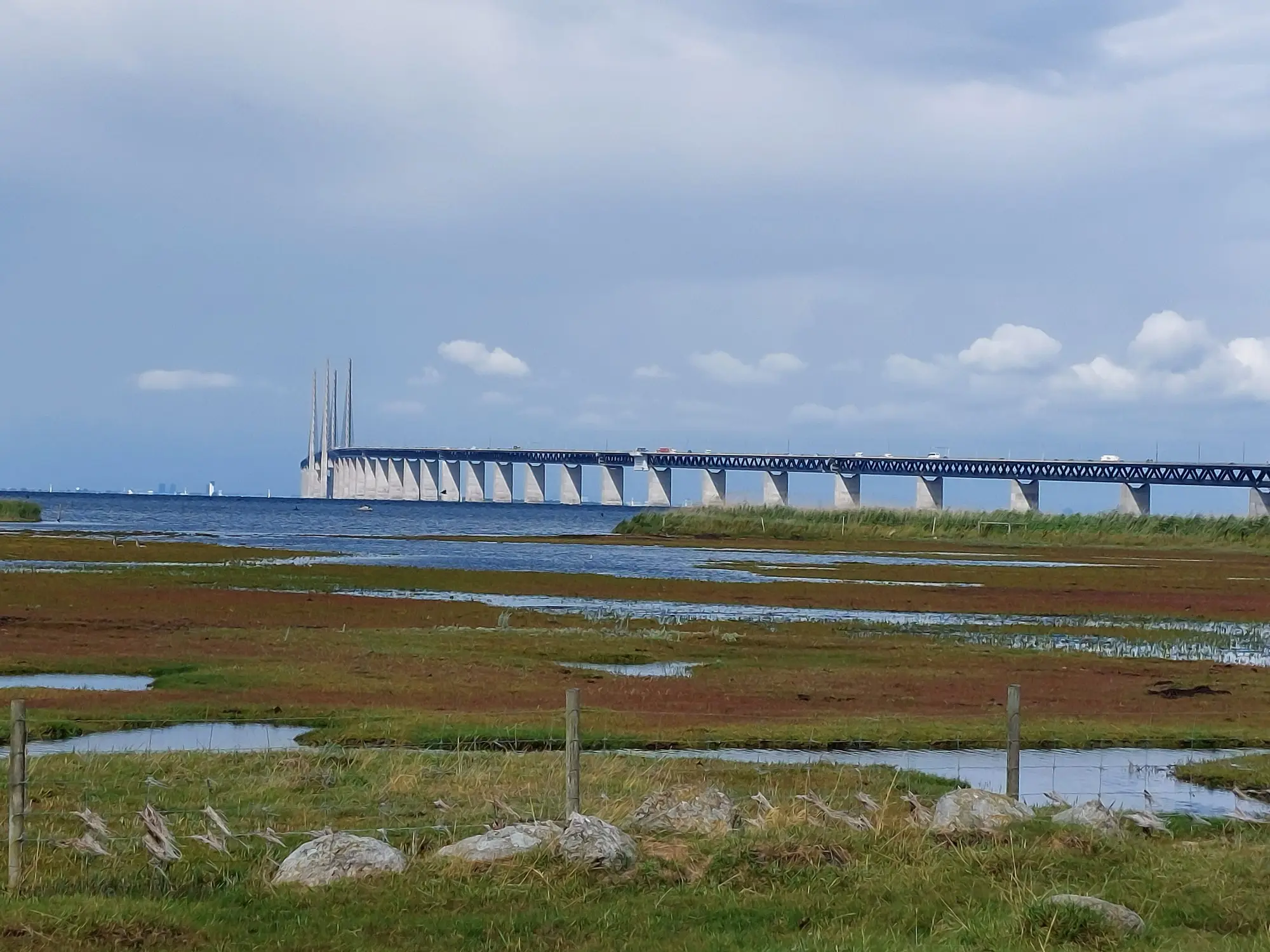

Denmark is dearer (Eurostat's 2025 price level 139.7, the EU's highest, against Sweden's 121.0) and milder in winter. Sweden is far bigger, almost 1,600 km from south to north, with 31 national parks, the midnight sun and the northern lights in Lapland. The two meet across the Öresund (the sound separating Denmark and Sweden), 20 minutes apart by ferry at Helsingborg.
| Feature | Sweden | Denmark |
|---|---|---|
| Price level index (Eurostat 2025, EU = 100) | 121.0 | 139.7 |
| January mean temperature | -1.0 °C (Stockholm observatory hill) | 1.6 °C (Denmark as a whole) |
| July mean temperature | 18.7 °C (Stockholm observatory hill) | 16.9 °C (Denmark as a whole) |
| Winter solstice daylight (capital) | 6h 06m (Stockholm) | 7h 02m (Copenhagen) |
| Midnight sun | Abisko, 24 May to 18 July | - |
Sweden or Denmark, in short
Choosing between Sweden and Denmark comes down to scale, landscape, and budget. Eurostat's 2025 price level index for household final consumption expenditure puts Iceland at 173.5, Switzerland at 171.3, Denmark at 139.7, the United States at 133.3, Norway at 128.6, the United Kingdom at 123.3, Sweden at 121.0, and Finland at 120.8. In Eurostat's 2025 comparison, published in June 2026, Denmark had the highest price level for consumer goods and services in the EU, 40% above the EU average.
Geographically, Sweden stretches almost 1,600 km from south to north, has 31 national parks, and almost 70 per cent of it is forest. Denmark is compact and low-lying, visible across the water from southern Sweden, where the ferry to Helsingør takes 20 minutes and runs frequently. If you are debating urban hubs specifically, compare Copenhagen vs Stockholm to see how their city centres contrast.
Cost
Everyday expenses differ noticeably between the two countries. When considering whether Sweden is expensive, Eurostat figures show it sits significantly below Danish rates. The 2025 price level index for household final consumption expenditure ranks Denmark at 139.7 and Sweden at 121.0. For context across other peer nations, Iceland reached 173.5, Switzerland 171.3, the United States 133.3, Norway 128.6, the United Kingdom 123.3, and Finland 120.8.
Dining out and overnight stays show a similar gap. For restaurants and accommodation services in 2025, Eurostat's price level index was 139.7 for Norway and 123.4 for Sweden, measured against an EU average of 100. Denmark had the highest price level for consumer goods and services in the EU overall in the 2025 figures, running 40% above the EU average.
Local transport fares reflect these national pricing structures:
- In Copenhagen, the cheapest adult single ticket covers 2 zones, costs DKK 24, and remains valid for 1 hour 15 minutes.
- In Stockholm, an adult SL (Storstockholms Lokaltrafik, the regional transport authority) single ticket costs SEK 43 and is valid for 75 minutes.
Weather
Comparing the recorded figures, DMI's preliminary 1991-2020 values for Denmark as a whole give January:
- A mean temperature of 1.6 °C
- An average daily high of 3.6 °C
- An average daily low of -0.7 °C
- 65.3 mm of precipitation and 15.3 frost days
- 50 hours of sunshine based on DMI's 1981-2010 normal
For July, DMI's preliminary 1991-2020 figures for Denmark as a whole report:
- A mean temperature of 16.9 °C
- An average daily high of 21.2 °C
- An average daily low of 12.7 °C
- 65.8 mm of precipitation and 0 frost days
- 217 hours of sunshine under the 1981-2010 normal
In Sweden, SMHI reports station figures across the country. In the south, SMHI's normal monthly mean temperatures for 1991-2020 at Malmö (station Malmö A) are 1.2 °C in January, 1.2 °C in February, 3.3 °C in March, 7.7 °C in April, 12.3 °C in May, 15.7 °C in June, 18.2 °C in July, 17.9 °C in August, 14.2 °C in September, 9.5 °C in October, 5.5 °C in November, and 2.6 °C in December, with an annual mean of 9.1 °C.
Further north at the Stockholm observatory hill, SMHI's 1991-2020 normal monthly mean temperatures run -1.0 °C in January, -1.0 °C in February, 1.6 °C in March, 6.3 °C in April, 11.4 °C in May, 15.7 °C in June, 18.7 °C in July, 17.7 °C in August, 13.1 °C in September, 7.7 °C in October, 3.6 °C in November, and 0.6 °C in December, giving 7.9 °C for the year.
At Kiruna airport in Swedish Lapland, SMHI records monthly means of -11.3 °C in January, -11.2 °C in February, -7.3 °C in March, -1.7 °C in April, 4.2 °C in May, 9.9 °C in June, 13.2 °C in July, 11.1 °C in August, 6.0 °C in September, -0.9 °C in October, -6.8 °C in November, and -9.4 °C in December, producing an annual mean of -0.3 °C.
Light
Daylight varies by latitude, particularly in midwinter. On the winter solstice on 21 December, sunrise in Copenhagen is at 08:37 and sunset is at 15:38, providing 7h 02m of daylight. You can check detailed figures for Copenhagen's daylight across other months of the year.
On the same date in Sweden's capital, the sun rises at 08:43 and sets at 14:48, yielding 6h 06m of daylight. That gives Copenhagen more than an hour of daylight longer than Stockholm in midwinter; see Stockholm's daylight for full seasonal tables.
Further north in Swedish Lapland, the daylight changes completely:
- In Abisko, the midnight sun lasts 56 days, from 24 May to 18 July.
- In Kiruna, the nights are dark enough for the aurora from 12 September to 30 March.
Denmark does not reach high enough latitudes to experience the midnight sun or regular aurora displays.
Nature and space
Sweden offers immense wilderness and expansive public land. The country stretches almost 1,600 km from south to north, contains 31 national parks, and almost 70 per cent of its landmass is forest. Hikers can use over 400 marked hiking trails, extending from short day walks to long-distance routes, with many easy to reach by public transport. When planning an itinerary across these outdoor areas, look at the best places to visit in Sweden for regional trail networks.
Water is just as central as forest. The Stockholm archipelago, Sweden's largest archipelago, encompasses over 30,000 islands across more than 650 square miles, starting just 20 minutes from the city centre. Denmark has no matching scale of vast boreal forests, mountain trekking routes, or archipelagos of this size.
Doing both
Because the two countries sit directly beside one another, you do not have to pick only one. At the narrowest point of the sound, Denmark is visible across the water from Sweden, a border area often described as "two countries, one destination". In the south, you can explore Helsingborg and the ferry to Helsingør, where the crossing takes 20 minutes and runs frequently.
If you want to travel between both capitals, the Copenhagen to Stockholm train provides a direct rail link. You board one of the many Øresund commuter trains across the sound to Malmö Central, where you change to the high-speed X2000 service. That train reaches Stockholm Central in just under 5 hours. According to DSB, the Danish national railway operator, there are normally more than 10 departures a day in each direction between Copenhagen Central and Stockholm.