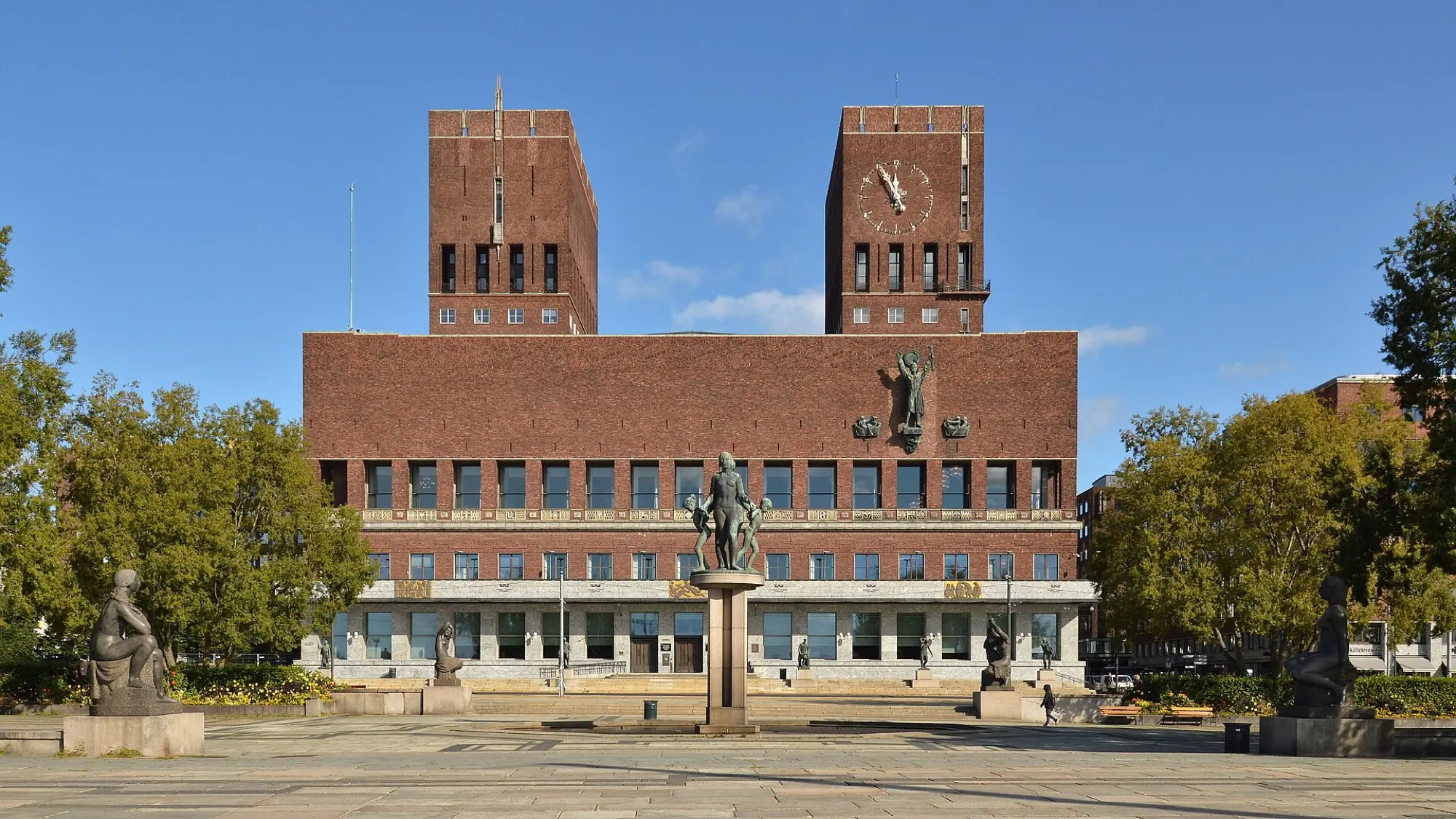

Oslo City Hall is free to enter and open Monday to Saturday from 09:00 to 16:00 except on listed days. The Royal Palace can be seen inside only on the summer tours, which ran from 20 June to 16 August in 2026. The park around it is open all year except the Queen's Park, while the Queen Sonja Art Stable hosts its own exhibitions.
City Hall and the Royal Palace at a glance
Oslo City Hall opened in 1950 and is open to everyone as the seat of the city council and administration. VisitOSLO lists Oslo City Hall among the museums and sights that cost nothing to enjoy, alongside other things to do in Oslo. The Royal Palace stands at the end of Karl Johans gate; its address is Slottsplassen 1.
In 2026 the palace was open to the public every day from 10.00 to 17.00, from 20 June to 16 August. The 2026 tour season is over; the tours return in summer 2027, and details of the 2027 season will come from the royal house. The Palace Park is open to the public all year, apart from the part called the Queen's Park (Dronningparken). This fenced south-west part of the Palace Park is normally open to the public only from 18 May to 1 October. In the palace's old stables, the Queen Sonja Art Stable shows changing exhibitions of art and objects from the Royal Collections; you can also see the stable hall restored as it was in King Haakon and Queen Maud's time and the old tack room.
| Place | When | Price |
|---|---|---|
| City Hall | Monday to Saturday 09:00 to 16:00 | free |
| City Hall summer tours | 30 June to 27 August, Tuesdays, Thursdays, Saturdays at 12:00 pm and 2:00 pm | free |
| City Hall private tours | Monday to Friday 10:00 to 16:00, Monday to Friday 16:00 to 19:00, Saturday and Sunday 09:00 to 16:00 | Monday to Friday 10:00 to 16:00: NOK 2 509; Monday to Friday 16:00 to 19:00: NOK 3 126; Saturday and Sunday 09:00 to 16:00: NOK 3 126 |
| Palace summer tours | Every day 10.00 to 17.00, 20 June to 16 August (2026) | NOK 230 for adults, NOK 110 for students and children aged 6-17 (2026) |
| Queen Sonja Art Stable | 26, 27, 28 and 29 November and 3 December (11:00 to 17:00); 4, 5 and 6 December (hours vary) | check the ticket page |
| Palace Park | Open all year | - |
| Queen's Park | 18 May to 1 October | - |
Visiting City Hall - hours, the security check and closed days
City Hall is open to tourists and other visitors Monday to Saturday from 09:00 to 16:00, and closed on Sundays. Some rooms may be unavailable during your visit. According to the City of Oslo opening hours, every visitor goes through a security check where queues may occur, so allow some waiting time.
For the rest of 2026, City Hall is closed to visitors on 3 December, from 12:00 on 4 December, on 5 December, from 7 to 11 December, on 24, 25 and 26 December and on 31 December. The list is updated continuously and days may be added at short notice. City Hall has already listed closed days for 2027, among them 1 January, 17 May, 9 to 19 September and 6 to 11 December, so check the list before a visit. Details on winter closures across the capital are also tracked in our guide to Oslo in December 2026: dates, hours and closures.
From the courtyard there is step-free access by an outdoor lift at the west tower and by ramps. From the harbour side there is step-free access by a ramp. Accessible toilets are in the main cloakroom on level 1U and in the meeting centre on level 2U.
Guided tours of City Hall
In summer City Hall runs free guided tours on history, art and architecture. The dates given are 30 June to 27 August, on Tuesdays, Thursdays and Saturdays at 12:00 pm and 2:00 pm. These free tours meet in the Great Hall, take up to 30 people, are in Norwegian and English and last 45 minutes. You cannot reserve a place in advance, and the City recommends arriving well ahead because of the security check. On some days City Hall is closed for events and no guided tours take place. These visits feature among our free things to do in Oslo.
All year, groups can book a private guided tour of about 45 minutes in Norwegian, English or German, through a booking form on the City's site. A private tour takes up to 30 people; larger groups are split, with extra guides booked. Private tour prices are per group of up to 30 people: Monday to Friday NOK 2 509 from 10:00 to 16:00 and NOK 3 126 from 16:00 to 19:00, and NOK 3 126 on Saturday and Sunday from 09:00 to 16:00. Changes or cancellations must reach City Hall three business days before the visit for a refund; later than that, the full fee is charged.
The Great Hall and the murals
The Great Hall (rådhushallen) is the core of the building and opens towards the fjord along its length. The hall is 31 metres wide, 39 metres long and almost 21 metres high; with the lower part included it covers more than 1 400 square metres. Its walls carry two large frescoes and a painting showing people from the main trades and the nation's heroes. The nation more than the city is the focus, since Oslo City Hall was meant to be the whole country's city hall.
Henrik Sørensen's large decoration on the end wall of the Great Hall, "Folket i arbeid og fest" (the people at work and celebration), is 24 by 12 metres, painted in oil on wooden panels. The architects Arnstein Arneberg and Magnus Poulsson had a clear idea of what the building should represent, and artists such as Henrik Sørensen, Alf Rolfsen, Else Poulsson and Per Krohg helped carry it out. Other artists who made major contributions include Axel Revold, Willi Midelfart, Aage Storstein, Anne Grimdalen, Nils Flakstad, Joseph Grimeland, Dagfin Werenskiold and others. The reception hall has wall paintings by Alf Rolfsen, and the Munch room holds a painting by Edvard Munch. You can get married in the Munch room.
The building, its towers, clocks and carillon
City Hall was designed by the architects Arnstein Arneberg and Magnus Poulsson and opened in 1950. An ideas competition for a new city hall in Pipervika was held in 1916, then a design competition in 1917-1918 that Arneberg and Poulsson won. The foundation stone was laid in 1931, but the Second World War delayed the work and the building was not ready to move into until 1947. Copenhagen's city hall was finished in 1905, Stockholm's in 1923 and Oslo's in 1950. In 1999 an expert jury in the newspaper VG named Oslo City Hall the Norwegian building of the century.
Because of the terrain, the east tower is two metres taller than the west tower and reaches 66 metres from the ground. Above the main entrance on the city side stands the sculpture Oslopiken, with a raised arm. On the harbour side, two large sculptures stand on the brick facade: St Hallvard facing south and Harald Hardråde facing west. On the courtyard facade an astronomical clock shows the time, sidereal time, the date, the phases of the moon and solar and lunar eclipses, while the large clock on the south side of the east tower is 8.60 metres across.
The carillon on the roof of the east tower has 49 bells that can be played by hand or automatically, and was restored in 1999. The City Hall tower is home to the largest carillon in the Nordic countries. The bells play every hour from 7 a.m. to midnight, everything from classical pieces to pop. The largest bell weighs 4,000 kilograms and the smallest 14 kilograms. The carillonneur plays live concerts every Sunday at 3 p.m. in June, July and August, and at 11:00 a.m. on the first Saturday of each month the rest of the year.
Why City Hall shuts for the Nobel ceremony on 10 December
The Nobel Peace Prize has been presented in Oslo City Hall since 1990, every December, in the Great Hall. The prize is awarded on the anniversary of Alfred Nobel's death, 10 December, a tradition since 1901. The 2026 Nobel Peace Prize is awarded to Navanethem "Navi" Pillay for her efforts to promote peace and international law. At most the Great Hall seats 1300 people on chairs; it is also used for the children's 17 May celebration and for anniversaries and concerts.
The formal ceremony in City Hall gathers members of the royal family, the government, parliament and diplomats among close to 1000 guests. The laureate receives the medal and diploma and gives the Nobel lecture. The ceremony starts at 13:00 CET and lasts 1.5 hours; NRK broadcasts it live, with the English speeches subtitled in Norwegian. The ceremony is not open to the public, but on 10 December 2026 from 12:00 to 13:30 the Nobel Peace Center, across the street from City Hall, shows it live on a large screen outside the centre. For the rest of 2026, City Hall's list of closed days includes 7 to 11 December, the days around the ceremony on 10 December.
The Royal Palace in a few dates
In 1822 the Storting granted money to build a palace in Oslo; King Karl Johan was set on the present site at the top of the Bellevue height. The architect was the Danish-Norwegian Hans Ditlev Franciscus Linstow. The foundation stone was laid in 1825, and political and economic problems made the building take many years. The palace was finished in 1848 and first used by King Oscar I. It has three wings of three storeys in a classicist style, with a facade of rendered brick. On the terrace in front stands Brynjulf Bergslien's equestrian statue of Karl Johan, unveiled in 1875.
Only after 1905 did the palace become a permanent royal residence. King Haakon VII lived there throughout his reign except during the Second World War. King Haakon VII died at the palace in 1957. During the German occupation, Vidkun Quisling used the palace as an office from 1942. King Olav V lived at the palace throughout his reign (1957-1991), while King Harald V and Queen Sonja moved in only in 2001.
A new king in 2026
Harald V was King of Norway from 1991 to 2026, the first Norwegian monarch born in Norway since 1380. King Harald V was born on 21 February 1937 and died in Oslo on 28 August 2026. Haakon VIII is King of Norway; he became king when his father, Harald V, died on 28 August 2026, and he is married to Queen Mette-Marit.
King Harald V rests in the Royal Mausoleum at Akershus Fortress, in a double sarcophagus of greenish olivine stone from Volda designed by Snøhetta.
Summer tours of the Royal Palace
According to a report by the magazine Klikk on 6 July 2026, the palace has held tours for two months every summer since 2002, except during the coronavirus pandemic; the record is 51 000 visitors, in 2019. In 2026 the palace was open to the public every day from 10.00 to 17.00, from 20 June to 16 August, during the peak season of activities covered in our guide to Oslo in summer. Check the royal court's site for the 2027 details.
Everyone who visits the palace follows a guided tour. Tours leave every 20 minutes through the opening hours every day of the season, and a tour lasts an hour. The 2026 tour began in the Ministers' Salon and the Council of State room, then went through the White Salon, the Bernadotte Salon, the upper vestibule, the Great Hall (Store festsal) and the Great Dining Room. The 2026 ticket prices were NOK 230 for adults and NOK 110 for students and children aged 6-17. Tickets could be bought at the entrance behind the palace, but it paid to get them in advance. In summer 2026 the palace tour ticket also gave entry to the Queen Sonja Art Stable in the Palace Park. The 2026 tour season is over; the tours return in summer 2027, and details of the 2027 season will come from the royal house.
Inside the old royal stables, the Queen Sonja Art Stable
The stable building in the Queen's Park was built in 1848 and extended in 1911, to plans by the palace steward Hjalmar Welhaven. Queen Sonja opened the gallery, Dronning Sonja KunstStall, in the stable building on her 80th birthday, 4 July 2017. The Queen Sonja Art Stable, in the palace's old stables, shows changing exhibitions of art and objects from the Royal Collections; you can also see the stable hall restored as it was in King Haakon and Queen Maud's time and the old tack room.
The 2026 exhibition, "Tråder i tid" (Threads in time, from the national tapestries to the King's tapestry), shows Norwegian tapestry weaving from the 1890s to the years of peace after the Second World War, some of it on public view for the first time. The open days left on the ticket page are 26, 27, 28 and 29 November and 3, 4, 5 and 6 December 2026, Thursday to Sunday. VisitOSLO lists the Art Stable open 11:00 to 17:00 on 26, 27, 28 and 29 November and 3 December. Opening hours vary through the season, and the stable refers visitors to the royal house's website for current times.
There is a set introduction to the exhibition on every open day at no extra cost, usually at 13.00 on weekdays and at 12.00 and 14.00 on Saturdays and Sundays, though this can vary. Private group tours can be arranged within normal opening hours; the price is 3 000 for a group of up to 30 people. The Art Stable is accessible to wheelchair users: a gentle ramp leads to the entrance, the whole exhibition is on one floor, and wheelchairs can be borrowed. Photography is allowed in the exhibitions.
The Palace Park and the King's Guard
The Palace Park is open to the public all year, apart from the part called the Queen's Park. The Queen's Park (Dronningparken), the fenced south-west part of the Palace Park, is normally open to the public only from 18 May to 1 October. The Palace Park covers about 225 decares, which is about 22.5 hectares. The park took its final form from 1838 under the Danish-born gardener Martin Mortensen, in the English romantic style with lawns under large trees and small ponds with fountains; most of the old trees date from his time. The park has Ada Madssen's statue of Queen Maud (1959) and Gustav Vigeland's statues of Niels Henrik Abel (1908) and Camilla Collett (1911), as well as the guard house of His Majesty the King's Guard. In snowy seasons ski tracks are prepared in the Palace Park.
The King's Guard keeps watch around the clock at the royal residences, the Royal Palace and Skaugum. The guard at the palace is kept in the Guard's parade uniform, with weapons; despite the ceremony, the soldiers are on a military assignment to protect the royal family. The changing of the guard at the palace is one of Oslo's well-known sights, taking place every day at 1.30 pm. The Guard's watch at Akershus Fortress ended in 2019.
From April to September, His Majesty the King's Guard and two military bands march guard parades through central Oslo with the incoming and outgoing guard of the Royal Palace; in 2026 they left Akershus Fortress at about 13:15, with mounted police in front. New in 2026, the parade left from Kontraskjæret and went up Akersgata, past Egertorget and along Karl Johan to the Palace Square; parades ran on set weekdays, not every day. Parades are cancelled in bad weather and can be cancelled at short notice; the bands post updates on social media, including @forsvaretsmusikk on Instagram. Because of court mourning, the remaining guard parades of 2026 were cancelled.
Getting there
City Hall is at Rådhusplassen 1. The Nobel Peace Center on the City Hall square is 100 metres from the Aker brygge tram stop (line 12) and 700 metres from Nationaltheatret station. A three-day Oslo itinerary takes in City Hall on day 1.
The Royal Palace stands at the end of Karl Johans gate; its address is Slottsplassen 1. The Art Stable is at Parkveien 50; it is easiest to come on foot, the nearest metro station is Nationaltheatret, and the nearest bus and tram stop is Solli plass. There is no parking right by the Art Stable.