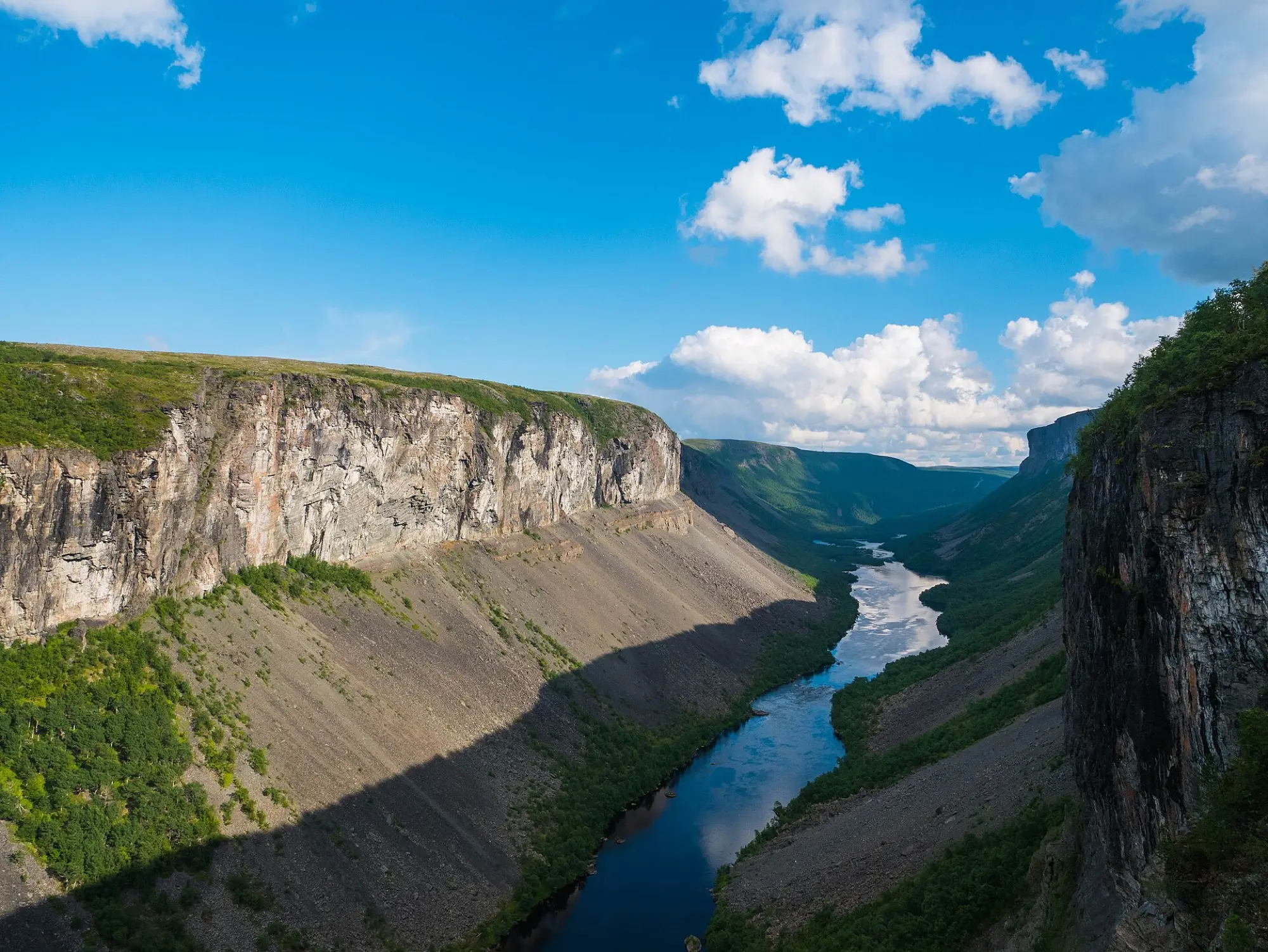

Alta, the largest town in Finnmark, offers distinct daytime activities across winter and summer, including the UNESCO rock art, the Northern Lights Cathedral, Sorrisniva Igloo Hotel, Alta Canyon, Holmen Husky dog sledding, Finnmarksløpet, Komsafjellet, the Halde observatory trail, Kåfjord's war and mining sites, and riverboat trips on the Alta river. Night-time sightings are covered separately on the Alta northern lights guide.
| Item | Season | Adult price | Distance or time from Alta |
|---|---|---|---|
| Rock art at Alta Museum | Open all year (outdoor carvings snow-free only) | NOK 175 (summer 2026) / NOK 115 (winter 2026) | About 5 km west of the centre |
| Northern Lights Cathedral | Open all year | not stated | Centre of Alta |
| Sorrisniva Igloo Hotel | 20 December to 31 March | NOK 395 (2026/2027 season) | About 20 km from Alta |
| Alta Canyon (Sautso) | car tours May to October; riverboat in summer | set by the operator | About an hour's drive to dam; 13 km hike or riverboat |
| Holmen Husky | Tours September to April | set by the operator | 15 minutes from Alta airport |
| Finnmarksløpet | 5 to 13 March 2027 | free to watch | Starts in central Alta |
| Komsa | not stated | free | In Alta, between Bukta and Bossekop |
| Halde | Summer and autumn (cabin open all year) | not stated | trail starts in Kåfjord, 400 metres north of Kåfjord church |
| Kåfjord: Tirpitz Museum & copper trail | Museum: 15 June to 31 August; Trail: not stated | not stated | Short drive from the centre, across Kåfjordbrua |
| Alta river | Riverboats: June to August; Fishing: from 1 June | set by the operator | Along the Alta river |
1. The rock art at Alta Museum: World Heritage since 1985
The World Heritage Rock Art Centre - Alta Museum preserves prehistoric carvings and paintings situated at Hjemmeluft, about 5 km west of the centre of Alta. Alta Museum states that the town contains northern Europe's largest concentration of rock art made by hunter-gatherers, produced between 7,000 and 2,000 years ago. UNESCO inscribed the Rock Art of Alta on the World Heritage List in 1985, encompassing thousands of carvings and paintings across 45 sites in five areas at the head of the Alta fjord. Hjemmeluft is the largest of these areas and the only one open to the public.
The museum building remains open all year, but the outdoor carvings can only be visited during the snow- and ice-free part of the year. When winter arrives, the museum judges conditions daily and may close the outdoor pathways at short notice if ice forms; staff inform visitors at the ticket desk whether the outdoor paths are open that day. When the paths are closed, visitors view seven original carved rocks displayed in the indoor exhibition. Visit Alta notes the indoor galleries also present Sami and Kven culture, the Alta case, northern lights research, and salmon fishing, and records that it is the only museum on the Norwegian mainland to receive the European Museum of the Year award. Paths outside cover a short walk of 1.2 km or a longer walk of 3 km, taking 1-2 hours according to Visit Alta. Audio guides cost NOK 50 and come in Norwegian, English, German, French, Spanish, and Italian.
Alta Museum's admission rates for 2026 set adult admission at NOK 175 in summer (1 May to 30 September) and NOK 115 in winter (2 January to 30 April and 1 October to 30 December). Children aged 7-16 pay NOK 50 in summer and NOK 40 in winter; children aged 0-6 enter free. In 2026, the museum operates from 19 September to 31 December on Monday to Friday 9-15 and Saturday and Sunday 11-16 (closed 24, 25, and 31 December). In 2027, hours run Monday to Friday 9-15 and Saturday and Sunday 11-16 from 2 January to 16 May; every day 9-17 from 18 May to 31 May; every day 9-19 from 1 June to 22 August; and every day 9-17 from 23 August to 19 September. The museum advises that winter, May, or September provide quieter visits, though cruise groups visit occasionally. Drivers follow signs off the E6 to free on-site parking. The Alta Museum bus stop is 150 metres from the entrance, extending to 250 metres in winter due to snow paths.
2. The Northern Lights Cathedral: a 2013 church at the end of the main street
The Northern Lights Cathedral, known locally as Alta church, stands at Markedsgata 30 at the end of the pedestrian street in central Alta. Designed by architect Kolbjørn Jensen of Link Signatur in Stavanger and consecrated on 10 February 2013, its curving forms draw inspiration from the aurora borealis. Inside, decorations by Danish artist Peter Brandes feature a gold-plated bronze figure of Christ. The church seats 350 people, expanding to approximately 500 when joined with the congregation hall.
From 2 January to 30 April and 1 October to 31 December, the cathedral opens Monday to Friday, 11 am to 1 pm. From 2 May to 19 June and 21 August to 30 September, opening hours run Monday to Friday 10 am to 2 pm. From 20 June to 20 August, it opens Monday to Saturday 9 am to 3 pm and Sundays 1 pm to 3 pm.
3. Sorrisniva Igloo Hotel: a NOK 395 visit from 20 December
Sorrisniva Igloo Hotel is a temporary structure rebuilt every winter along the banks of the Alta river, approximately 20 kilometres outside Alta. Sorrisniva calls it the world's northernmost igloo hotel. Reconstructed each season around a fresh artistic theme, the hotel spans 2,500 m² and requires 250 tonnes of ice harvested from the upper Alta valley alongside 7,000 m³ of snow produced from river water. Visit Alta notes that construction takes about five weeks before opening, and the structure melts away in May.
Sorrisniva states the Igloo Hotel opens annually from 20 December to 31 March. Day visitors enter daily between 12:00-20:00, while the ice bar serves drinks during set slots: 13:00-14:00, 15:00-16:00, and 17:00-18:00. For the 2026/2027 season, daytime adult entry costs NOK 395, children pay NOK 180, and an ice drink costs NOK 165 for adults. Guided tours are provided when reserved ahead. Overnight igloo rooms start from NOK 4070 per room, with suites starting from NOK 6370. To reach Sorrisniva, a taxi costs approximately NOK 600-900 depending on the departure point. From 1 September 2026, Sorrisniva's shared transfer, which requires booking 24 hours in advance, costs NOK 475 per person each way from central Alta and NOK 525 per person from Alta airport.
4. Alta Canyon (Sautso): a ten-kilometre gorge up to 420 metres deep
Alta Canyon, called Sautso in Sami, is a river gorge. Store norske leksikon records the canyon as ten kilometres long and 300-420 metres deep, while Visit Alta calls it northern Europe's largest canyon. The gorge starts immediately below the Alta hydroelectric power station and runs ten kilometres down towards the Altafjord. Between 1968 and 1982, plans to dam the waterway sparked the historic Alta conflict; the power plant entered service in 1987, and Visit Alta notes the dispute proved a turning point in Sami policy that led to the Sami Parliament being established in 1989 (for broader context, read about Sámi culture in Norway).
Visitors reach Sautso on foot, by road, or by riverboat. Hikers start at Bæskades for a 13 km walk across relatively flat plateau before descending the final stretch to the viewpoint. An alternative approach from Tutteberget in Stilla lacks marked trails; Visit Alta recommends carrying a map and compass or hiring a guide. Private four-hour guided car tours run between May and October, covering the one-hour drive to the canyon and dam, where guests walk directly across the structure. In summer, a Sami family from Máze (70 km south of Alta) conducts a 5.5-hour private riverboat excursion down to Sautso that includes a meal served inside a traditional lavvu.
5. Dog sledding at Holmen Husky: you drive your own team
Holmen Husky Lodge is a family-run kennel situated fifteen minutes from Alta airport, where all guests harness their own dog teams and steer their own sledges. Kari Jæger established roots at Holmen in 1986, joined by Eirik Nilsen the following year; their son Brage manages the lodge and dog teams today. Visit Alta describes Alta as Europe's dog-sledding hotspot due to its dense concentration of local mushers.
Winter and autumn outings vary by duration. The First Run provides a beginner 2.5-hour route through the forest from December to April. The Long Trail covers a 5-hour run onto the Alta river with outdoor lunch cooked over a fire, operating between December and March for up to 6 guests. A 2.5-hour evening tour hunts the aurora by sledge between December and March. From September to November, before winter snow settles, Holmen operates 2.5-hour dryland mushing tours. Prices are published directly on Holmen Husky's booking platform, and transfers can be arranged for overnight guests.
6. Finnmarksløpet: Europe's longest sled dog race starts on 5 March 2027
Finnmarksløpet calls itself Europe's longest and toughest sled dog race. The 2027 edition will serve as the IFSS long-distance world championships. First run in 1981 with three teams, the competition now features four distinct divisions: FL-junior (200 km, 6 dogs), FL-300 (about 300 km, 8 dogs), FL-600 (about 600 km, 8 dogs), and FL-1200 (about 1200 km, 14 dogs).
The organisers state that the 2027 programme dates may change. Finnmarksløpet 2027 is scheduled to begin on Friday 5 March along Markedsgata in central Alta, preceded by an opening concert inside the Northern Lights Cathedral on Thursday 4 March from 19:00-21:00. On Friday, the FL-1200 field starts between 12:00-13:00 at two-minute intervals, followed by the FL-300 departures from 18:00-19:00. The FL-junior and FL-600 teams start on Saturday 6 March between 13:00-14:30, alongside an open-air street market running 12:00-16:00. The FL-300 awards ceremony takes place on Sunday 7 March. The winning FL-600 musher is expected in Markedsgata on 9 March, with the FL-1200 victor arriving from roughly 20:00 on 11 March. The final FL-1200 prize ceremony is planned for Saturday 13 March, 12:00-13:00, though this may be moved if weather delays the finishes. Visit Alta notes that visitors can watch the start and finish for free in the town centre.
7. Komsa: the hill above the town that named a Stone Age culture
Komsafjellet is a prominent 213-metre hill rising over the Amtmannsnes peninsula between the bays of Bukta and Bossekop at the inner edge of the Altafjord. Stone Age finds discovered at Amtmannsnes at the foot of the hill gave their name to the ancient Komsa culture. Visible across town, the summit, Komsatoppen, is marked by a large telecommunications mast.
Walking to Komsatoppen costs nothing. Most of the hillside lacks trail signs, but existing paths converge at the summit, offering panoramic overlooks of Alta. Nearby, Hjemmelufttoppen beside Alta Museum provides another gentle hill path with straightforward access from the E6, which Visit Alta recommends under the midnight sun. Visit Alta notes that several peaks near Alta take less than an hour to walk. Alta also hosts a station of Struve's Geodetic Arc, added to the UNESCO World Heritage register in 2005, situated on the nearby summit of Lille-Raipas.
8. Halde: the 1899 aurora observatory on a 9 km hike
Mount Halde is the location where Kristian Birkeland constructed the world's first permanent auroral observatory in 1899. Visit Alta notes that this scientific project earned Alta its title as the city of the northern lights. Research operations moved to Tromsø in 1926. German forces burned the observatory in 1944, leaving only the walls until restoration efforts commenced in the 1980s. Today, DNT Alta manages the restored observatory building as an unstaffed DNT cabin offering 6 beds year-round.
Hikers climb Halde during summer and autumn along a 9 km trail rated medium difficulty, taking about 6 hours. The route traces a cart road and T-marked path that is steep in places. The path begins 400 metres north of Kåfjord church, where roadside parking space is limited. At the end of August, the annual Halddemarsjen event guides trail walkers and uphill racers over an 8.5 km course featuring 907 metres of climb to the top.
9. Kåfjord: the Tirpitz Museum and the copper works trail
Kåfjord, a short drive from the centre, has the Tirpitz Museum and the remains of the copper works. The Tirpitz Museum, opened in 1980, details the wartime story of the German battleship Tirpitz, which anchored in the Altafjord for several years during the Second World War. Visit Alta notes the museum opens during the summer season, operating 10-17 from 15 June to 31 August.
The historic Alten copper works (Kåfjord kobberverk) operated between 1826-1878 and 1896-1909. A marked 1.2 km heritage trail guides walkers past slag mounds, building ruins, and old mine shafts marked by red posts, though the mines themselves are closed for safety reasons. To reach the site, follow the E6 out of Alta towards Tromsø, cross the Kåfjordbrua bridge, and follow signposts for Kåfjord kobberverk to the large car park. Nearby Kåfjord church, erected in 1837 in an English architectural style, was the solitary structure left standing when German troops burned Kåfjord in 1944.
10. The Alta river: a summer riverboat and a salmon lottery
Visit Alta says the Alta river (Altaelva) is traditionally considered one of the world's best salmon rivers, known for its large salmon. 700 fishing licences are drawn by lottery among residents of Alta, Loppa, and Kautokeino, drawing about 4,000 applicants each year. A secondary lottery draws around 1,200 non-local applicants for 70 visiting licences sold to out-of-town fishermen, with draws usually taking place at the end of February and the beginning of March. Fishing is open to locals from 1 June until St Hans, and from 24 June you need a licence.
Sorrisniva operates riverboat tours on the Alta river from June to August. These excursions run exclusively during the river's daily conservation period between 12:00-18:00, when no one fishes. Paths also run along the river for walking or cycling; outside the conservation period in the fishing season you should watch for anglers.
Getting to Alta and getting around
Alta Airport sits 5 kilometres outside the town centre. Direct flights arrive from Oslo Airport Gardermoen (taking 2 hours) and Tromsø (taking 30 minutes), with regional connections linking smaller Finnmark hubs including Hammerfest, Honningsvåg, Vadsø, and Kirkenes. Visit Alta notes that direct winter services also connect Frankfurt with Alta. Snelandia operates airport bus transfers that reach the centre in 10 minutes, while local taxis wait outside the terminal.
There is no railway in Finnmark. Travellers reach the region via air, car, bus, or coastal ship to nearby ports. Coastal liners such as Havila Voyages stop at 34 ports along Norway's western and northern coasts; in western Finnmark they call at Øksfjord and Hammerfest, and Alta is not on the list. The Vargsundekspressen passenger speedboat links Alta harbour to Hammerfest via Storekorsnes between Sunday and Friday, completing the voyage in about 1.5 hours. Visiting cruise ships tie up at Alta harbour, located 5 km from town near the airport.
By road, Alta to Hammerfest or Kautokeino takes 2 hours, Honningsvåg takes 3 hours, Tromsø takes 6 hours, Rovaniemi in Finland takes 6 hours, and Kirkenes takes 6.5 hours. The E6 trunk road intersects with the E45 in Alta; the E6 connects south to Trondheim and Oslo and north-east to Kirkenes, while the E45 heads to Kautokeino and on into Finland and Sweden. Snelandia runs city and regional buses, including the Alta West ring route servicing Alta Museum. Passengers buy tickets on board or at lower fares using the Snelandia Mobillett mobile application. Visit Alta states visitors do not necessarily need a car because activity firms provide pick-ups from local hotels, though winter driving needs experience with snow and ice. For broader seasonal itineraries, consult guides on Norway in winter and things to do in Tromsø.
The northern lights, and how long to stay
As computed on this site for the 2026-27 season and detailed on the Alta northern lights guide, astronomical darkness returns to Alta between 15 September and 1 October, lasting until between 15 March and 1 April. To compare conditions across northern Norway, see our guide to the northern lights in Norway. Visit Alta identifies November through March as the darkest and most reliable window for viewing the aurora. The aurora is never guaranteed; it depends on solar activity and clear skies. A guide is not required, but guides read the forecasts and drive away from cloud and town lights.
Visit Alta recommends staying at least four nights to combine multiple evening sky watches with two or three daytime activities. In the fjord, whale safaris typically run from late October to January when whales and orcas follow the herring into the fjords, with exact operating dates varying each year.