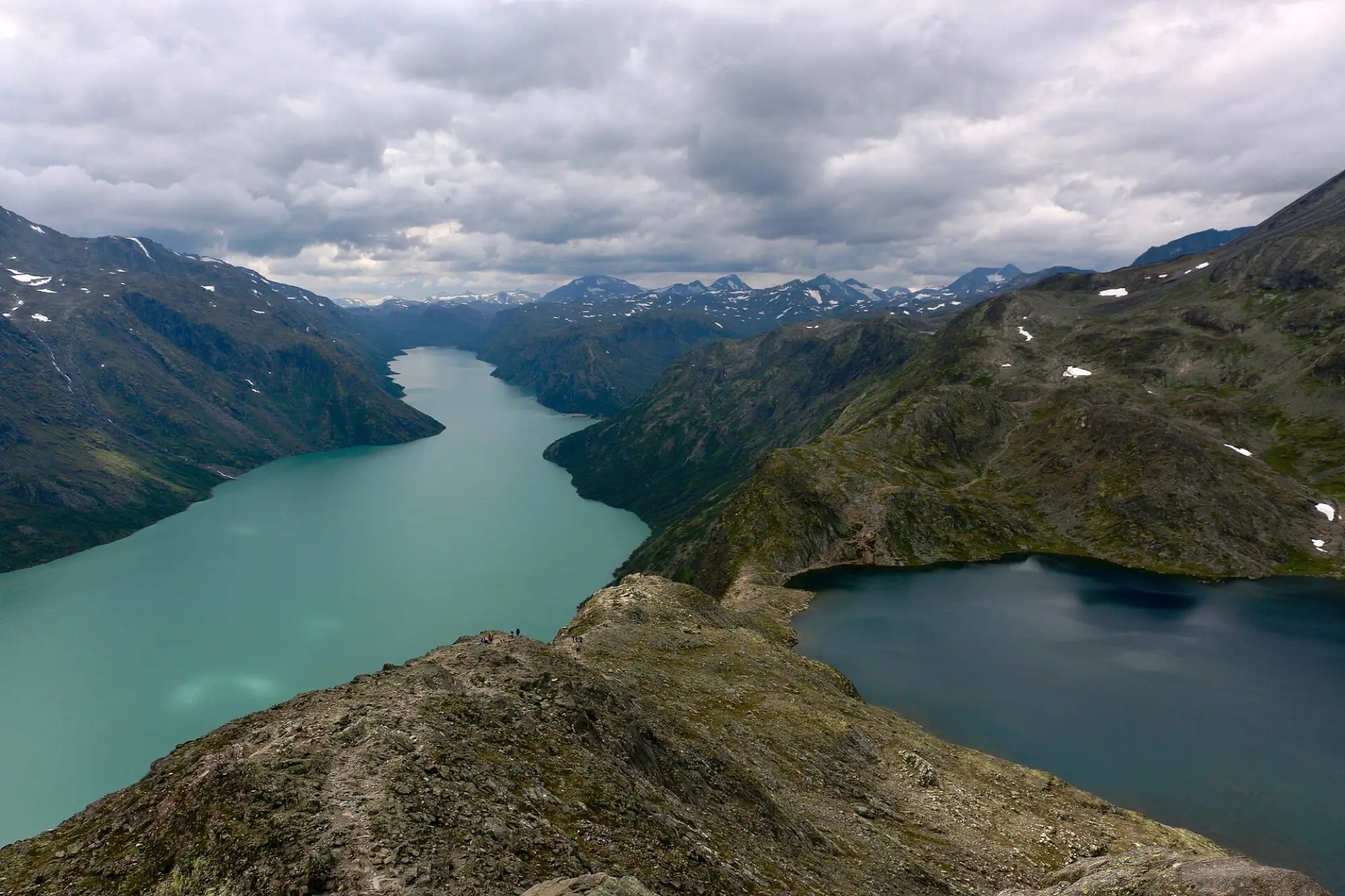

Besseggen is the ridge between the lakes Gjende and Bessvatnet in Jotunheimen, about 13 km with nearly 1,000 metres of climbing and 6 to 8 hours for most people. Most people take the Gjende boat from Gjendesheim to Memurubu and walk back. The 2026 season is over and the boat's 2027 season runs from 5 June to 25 September, with booking opening on 1 December 2026.
What Besseggen is
The boat operator calls Besseggen Norway's most hiked mountain trail, with about 50,000 visitors each year. It is also one of the hikes in our guide to Norway's famous hikes. Besseggen is the narrow ridge between the lakes Bessvatn (1,374 metres) and Gjende (984 metres), and it is 400 metres straight down to Gjende from the ridge. A large stone cairn on Veslefjell marks the highest point of the walk, 1,743 metres above sea level.
Gjende is about 20 km long and about a kilometre wide on average. At 150 metres deep, it is the deepest lake in Jotunheimen National Park, which you can explore further in our overview of Norway's national parks. The glacial river Muru, below the path up from Memurubu, carries sand particles that help give Gjende its emerald green colour. The "Bess" in Besseggen comes from the Old Norse bersi, meaning bear. In Henrik Ibsen's Peer Gynt, the ridge is called Gjendineggen.
Distance, climb and how long it takes
DNT Gjendesheim says the hike is about 13 km with nearly 1,000 metres of climbing, and most people take 6 to 8 hours including breaks. The boat operator says the hike normally takes 5 to 7 hours. The route description on DNT's ut.no, published by a private person, rates the walk extra demanding and gives 13.7 km one way, 1020 metres of total climbing and about 8 hours, with a season from June to October.
The main Besseggen season is July and August and the first weekends of September, but you can often walk it early in the season and well into the autumn.
Which way to walk it
Most people take the boat from Gjendesheim to Memurubu and then hike back to Gjendesheim. Walking from Memurubu, you climb up the ridge, which feels less airy than walking it the other way.
The boat operator says those who walk the other way, from Gjendesheim to Memurubu, get the finest view, with the Jotunheimen mountains in front of them all the way. Walking that way is tougher because you must walk down the steepest part, the ridge itself, which can be quite a challenge if you are afraid of heights. If you walk it the other way, you start from Gjendesheim or Bessheim, walk down Besseggen and end at Memurubu, where you take the boat back to Gjendesheim.
At Memurubu you can either stay the night or take the boat back to Gjendesheim. The boat operator's FAQ gives the last boat back to Gjendesheim from Memurubu as leaving at 16:50, and at 17:55 in the high season. Everyone standing on the quay at Memurubu or Gjendebu before the last advertised departure of the day gets a boat back to Gjendesheim, ticket or not, though you may wait if the boats must make extra trips. From Gjendesheim, you need a ticket bought in advance to be sure of a place.
The route from Memurubu, stop by stop
From Memurubu the route rises quite steeply for the first hour, then gradually levels off and goes down towards the narrow ridge. The path up from Memurubu is steep and looks down on the glacial river Muru. At the small lake Bjørnbøltjønn you can fill your water bottle with fresh mountain water.
Bandet is the narrow neck that keeps Bessvatnet (1374 metres above sea level) from running out into Gjende, which lies 400 metres lower, and many people stop here to eat. The steep, narrow ridge that rises from Bandet is Besseggen itself. Parts of the ridge are quite narrow, and in places it can be difficult to meet people coming the other way, but the boat operator says there is always a way if everyone cooperates.
Just before the last part of the ridge you reach the most photographed spot on the walk. A large stone cairn on Veslefjell marks the highest point of the walk, 1,743 metres above sea level. The walk down from Veslefjell is quite steep in places, but the path is good. Gjendesheim says there are no exposed sections after you have passed the ridge. About a kilometre from Gjendesheim the path divides; the left branch goes to Glitterheim and Bessheim, the other down to Gjendesheim and Gjende.
If the ridge is too much, and walking with a guide
If you find you are afraid of heights, at Bandet you can turn back to Memurubu or take the route along Bessvatnet to Bessheim or Gjendesheim instead. Gjendesheim says there are no exposed sections after you have passed the ridge.
Guides are an option for the walk. The boat operator names Beito Aktiv as a provider of guided walks, mainly on Besseggen, and of packages with the walk, food, a night's stay and the boat; the price depends on the number of people, and there are at most 15 people per guide. The boat operator also points to Gjendeguiden, which offers tailor-made guided trips with prices on request.
The Gjende boat: season, fares and booking
The Gjende boat's 2027 season starts on 5 June and runs through 25 September. The 2026 season is over. Booking for 2027 opens on 1 December 2026, and you have to book your tickets before you come on gjende.no.
According to Gjendebåten practical information, fares and conditions are set as follows:
- Gjendesheim to Memurubu costs NOK 260 one way for an adult and NOK 130 for a child.
- A day return costs NOK 300 for an adult and NOK 150 for a child.
- A return ticket must be used on the same day.
- Children under 15 pay the child fare, and children under 5 travel free.
- Online presale closes one hour before each departure, so "presale closed" does not mean the boat is sold out.
- Tickets for the Gjende boats cannot be cancelled or refunded.
There are two queues on the quay at Gjendesheim, one for Memurubu and Besseggen and one for Gjendebu, so join the right one. The operator runs two boats, Kåre Johan for 98 passengers and Gjendine for 80. You can pay by card on the boat. Dogs travel free but must stay out on deck. The boat carries luggage you don't need for the day to your destination for NOK 100 a piece; buy a baggage label on the boat or at your lodge.
Mobile coverage is poor or missing in places, so take a screenshot or print your ticket before you come. Both boats are adapted for wheelchairs, including electric ones; contact the operator in advance. The boats have been family run since the first trip on 1 July 1906, always with an Øvstedal at the wheel; the present skipper is the fourth generation.
Parking at Reinsvangen and the shuttle bus
The car park by the quay at Gjendeosen is free but only for short-term parking of up to 2 hours. There is no long-term parking at Gjendeosen, so to take the boat to Memurubu or Gjendebu you must park at Reinsvangen. The long-term car park is about 1.7 km from the quay, with a shuttle bus to and from the quay.
The shuttle bus starts from Reinsvangen one hour before the first boat departure and then runs continuously until 15 minutes before each departure. Buses back from Gjendeosen to Reinsvangen run every half hour from 15:00, and the last bus leaves at 20:00. Visit Gjende asks you to arrive at least 1 hour before your boat, especially in the high season, from 20 June to 16 August and on every weekend until 20 September. Details are on visitgjende.no.
You can pay for parking and the shuttle when you arrive at Reinsvangen, or book ahead to save time; there are ticket machines at Reinsvangen. If you come in a rental car, don't book parking until you have its registration number. Guests at Gjendesheim can park in the lodge's own car park while they are staying there. The car parks are for parking only, not tents or overnight stays in a camper; the nearest campsites in Sjodalen are Bessheim and Maurvangen.
By bus to Gjendesheim
NOR-WAY's express bus NW150 runs daily from Oslo to Fagernes and Beitostølen, and in the summer season it is extended to Gjendesheim, where the Besseggen hike starts. Oslo to Beitostølen takes about 3 hours and 45 minutes. You can take Valdresekspressen to Gjendesheim from Oslo or Sogndal, or Ottadalen Billag from Otta. Visit Valdres says NOR-WAY Bussekspress runs to Gjendesheim during summer and autumn; check entur.no for public transport timetables.
If you arrive at Gjendesheim by bus, you receive a green travel voucher worth NOK 100 for food, non-alcoholic drinks or activities at the lodge. The green card applies only to overnight guests, who show their bus ticket at check-in.
By car you reach Gjendesheim from the E6 in Gudbrandsdalen via Otta or Sjoa to Randsverk, or from Valdres via Fagernes and Beitostølen over Valdresflya. If you are travelling by car across the region, see our notes on driving in Norway. The road over Valdresflya is closed in winter until about 1 April; in winter you drive in via Randsverk. In winter there is no public transport all the way to Gjendesheim; the nearest stops are Otta (train and express bus) or Vågåmo (bus).
Where to stay before or after the hike
Gjendesheim, which DNT (Den Norske Turistforening, the Norwegian Trekking Association) calls its flagship lodge, has 185 beds in single, twin and four-bed rooms and a dormitory. If you are new to the mountain refuge network, consult our guide to DNT cabins. Gjendesheim's summer season usually runs from the first weekend in June to the end of week 40, and its winter season from mid-February to 1 May. Gjendesheim is now closed, from 4 October to 20 February. Gjendesheim rents out hiking boots, shell jackets and rucksacks. Gjendesheim does not sell bottled water, only refillable bottles.
Memurubu has about 160 beds in rooms of different sizes, most with their own bathroom and toilet, and a tent site. Memurubu began as a summer mountain farm, worked for over 100 years, and now makes its own electricity from hydropower. Memurubu is closed for the season; its 2027 opening times are 18 March to 11 April in winter and 18 June to 19 September in summer, closed 25 to 27 June for a wedding. In summer you reach Memurubu by boat or on foot; the nearest parking is at Gjendeosen and Gjendesheim.
Gjendebu, at the far end of Gjende, is DNT's oldest tourist lodge and has 119 beds. Across the area, the lodges Gjendebu, Memurubu, Gjendesheim, Hindsæter and Bessheim rent rooms, and Maurvangen, Bessheim and Sjodalen Hyttetun have cabins and camping. For other routes in the massif, see our guide to Jotunheimen hikes and lodges.
When to go
The main Besseggen season is July and August and the first weekends of September, but you can often walk it early in the season and well into the autumn. DNT says the summer trekking season in the Norwegian high mountains generally runs from the end of June until mid-September. Even from June to August, you must be prepared for sleet and snow.
For 2027, passenger boats on Gjende operate between 5 June and 25 September. Gjendesheim is usually open for hikers from the opening weekend of June through week 40, and its winter season usually runs from mid-February to 1 May.
Besseggen in winter, on skis to Veslfjellet
Gjendesheim says you can also do Besseggen on skis in winter. DNT Oslo og Omegn's ski tour from Gjendesheim to Veslfjellet (1743 metres), the highest point of Besseggen, is rated medium, 8.5 km one way with 782 metres of climbing, about 4 hours.
Choose the right route and the tour stays outside avalanche terrain, on slopes under 30 degrees all the way, following the twig-marked winter route from Gjendesheim to Bessvatnet. Make sure Bessvatnet is safe before you cross it, and watch for avalanche run-out zones, especially on the first stage up to the lake. Parts of the tour may run through avalanche-prone terrain and need knowledge of avalanches and winter navigation; always check the latest weather and avalanche forecast.
Remember that there is no winter bus all the way to Gjendesheim. Varsom, run by the Norwegian Water Resources and Energy Directorate (NVE), publishes avalanche warnings before 4 p.m. every day from 1 December to 31 May. The mountain code warns that avalanches can start on drops higher than five metres and steeper than 30 degrees, and that a cornice can break off on a ridge.
What to pack and the mountain code
Gjendesheim's packing list includes hiking boots, an extra pair of socks, a simple first-aid kit and blister plasters, sunglasses, wool underwear, a windproof and waterproof jacket and trousers, mittens, a hat, at least 1 litre to drink, a packed lunch, and a map and compass or GPS. The ut.no route description recommends a solid 30-litre rucksack, with a map and compass, a first-aid kit, a fully charged phone and a head torch.
The Norwegian mountain code begins with planning your trip and telling others the route you have chosen. Check the conditions on yr.no, storm.no and varsom.no. Be prepared for bad weather and frost, even on short trips; the weather changes quickly in the mountains. Don't be ashamed to turn around; choose your best alternative long before anyone in the group is exhausted. If an accident happens, alert the police on 112; mobile phones do not work in all areas.
Besseggen at a glance
| Item | Figure |
|---|---|
| Distance | About 13 km |
| Climb | Nearly 1,000 metres |
| Time | 6 to 8 hours including breaks |
| Highest point | 1,743 metres above sea level |
| Boat season 2027 | 5 June to 25 September |
| One-way boat fare adult and child | NOK 260 adult, NOK 130 child |
| Day return adult and child | NOK 300 adult, NOK 150 child |
| Last boats back from Memurubu | 16:50 (17:55 in high season) |
| Quay parking | Free, short-term up to 2 hours |