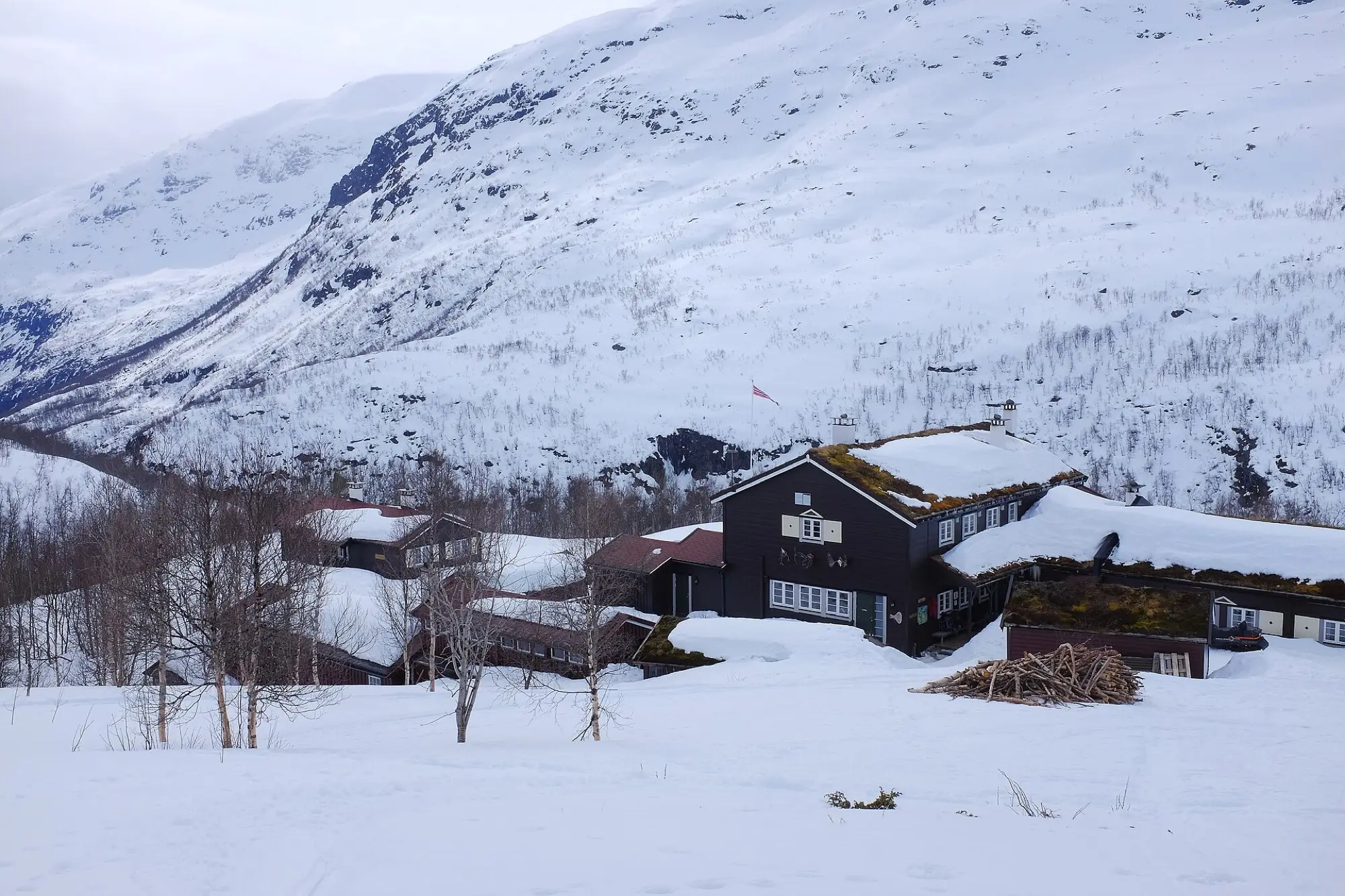

Norway's mountain cabin network is open to everyone, but using it smoothly requires knowing how the three cabin types function and how access works. At least one person in your party must be a member to enter locked self-service cabins, and unstaffed cabins operate on a trust system using a standard key. This guide sets out the exact costs, booking rules, opening windows and on-site procedures for planning a trip.
What DNT is and what the cabin network covers
Den Norske Turistforening (DNT) translates best as "the Norwegian Trekking Association". DNT dates from 1868, and DNT Oslo og Omegn, the largest member association, is a direct continuation of the original DNT. Today DNT is Norway's largest outdoor organisation, with more than 300,000 members across 56 local member organisations.
DNT's local member associations run about 600 cabins across the country. Together the associations maintain about 22,000 km of marked foot trails and about 7000 km of branch-marked ski tracks. DNT runs on volunteer work, more than 800,000 hours of it a year.
DNT cabins are open to everyone, both members and non-members, but members receive discounts, and you must be a member to get into the locked self-service cabins. When travelling, you can speak English with lodge staff and most other hikers, and map legends and many publications are bilingual.
Staffed lodges, self-service cabins and no-service cabins
There are three types of DNT cabin with accommodation: staffed lodges, self-service cabins and no-service cabins. Members get discounts on accommodation at all three types, as well as on meals at the staffed lodges.
| Cabin type | Staffing and meals | What is provided | Food access |
|---|---|---|---|
| Staffed lodge | Hosts present; breakfast and 3-course dinner served | Private rooms or dormitories; many have electricity and showers | Meals served by the lodge |
| Self-service cabin | Unstaffed; guests cook and clean | Bunks, duvets or blankets, firewood, gas, cooking utensils | Pantry of provisions, paid on trust |
| No-service cabin | Unstaffed; guests cook and clean | Beds, duvets (some blankets), firewood, cooking utensils | No food; bring all your own |
DNT runs 46 staffed lodges, located from Jotunheimen, Rondane and Trollheimen to Hardangervidda, Ryfylke and four near Oslo and Drammen. Staffed lodges serve a three-course dinner and sleep guests in private twin and four-bed rooms or in larger dormitories. Many have showers and electricity. They open only in certain seasons, though many offer self-service or no-service rooms outside the staffed season.
Self-service cabins have firewood, gas, kitchen utensils and bunks with blankets or duvets and pillows. They also hold a stock of provisions such as tinned food, coffee, tea, crispbread and soup mixes. Guests fetch water, cook, wash up and chop wood themselves. You buy from the self-service pantry on trust, meaning you do not have to carry all your food on a cabin-to-cabin trek.
No-service cabins are usually smaller. They supply beds and duvets (some only blankets), cooking equipment and firewood, but no food, so you must bring all your own provisions. They are either unlocked or opened with the standard DNT key. A few simpler no-service cabins need a sleeping bag and more equipment; each cabin's description lists what it provides.
In southern Norway the associations run large staffed lodges as well as many self-service and no-service cabins. In northern Norway they mainly offer no-service cabins. In addition, private cabins exist along the trail network. These vary in standard and price and are marked with a blue symbol on ut.no and maps. A letter "R" in a cabin overview means DNT members receive a discount there. For more details on the network, consult DNT: The different types of cabins.
The DNT key, and where to get one
The vast majority of DNT cabins without a host are locked with one standard key. Members obtain it for a small deposit and can keep it as long as their membership is active and paid. The deposit is NOK 100, which is fully refunded when you return the key. At least one person in your party must be a DNT member to use the self-service and no-service cabins.
You can pick up a key at DNT's local hiking centres, at every staffed DNT lodge, or order it from the DNT online shop, dntbutikken.no. When collecting a key in person, bring proof of membership on a physical card, in the mobile app, or by email or text message. In Oslo, the DNT office that hands out keys, called Tursenteret (the tour centre), is located at Storgata 3, a 5-minute walk from Oslo Central Station. DNT also has tour centres in many other cities, among them Bergen, Trondheim, Stavanger, Kristiansand, Ålesund, Tromsø and Lillehammer.
A key posted abroad takes 12-16 days on average to arrive. All staffed DNT lodges are told to always have keys available. Note that a few cabins, usually destination cabins or rentals for larger groups, need a special key of their own; ut.no lists which key each specific cabin requires. Be aware that a batch of wrongly made DNT keys does not fit all cabin locks. You must check the tip of your key before you go; you can swap a faulty one free at a DNT hiking centre or order a replacement from the online shop.
What DNT membership costs
DNT membership is priced by age and household status:
- Adult (aged 26-66): NOK 885
- Youth (aged 13-25): NOK 375
- Children (aged 0-12): NOK 155
- Senior (from the year you turn 67): NOK 695
- Household member (living with a main member): NOK 490
- Family (2 adults and all children under 26): NOK 1,580
Membership follows the calendar year, running from 1 January to 31 December. There is no right of withdrawal once membership is paid. From 1 September, you can purchase membership valid for the following calendar year.
DNT states that if you plan to stay more than three nights at staffed lodges, membership generally pays for itself through the overnight discounts. Furthermore, youth members (DNT Ung) pay half price for overnight stays at DNT cabins. Children aged 0-12 who are members stay free at most self-service and no-service cabins and get an extra discount at staffed lodges.
What a night costs, member and non-member
At member prices, an overnight stay at a DNT cabin costs from 250 to 350 kroner at a no-service cabin up to around 1300 kroner for full board at a staffed lodge. At a staffed lodge, the DNT pension includes the bed, a 3-course dinner, breakfast, a packed lunch you make yourself (4 slices of bread) and a shower.
Litlos, a staffed lodge on Hardangervidda, bases its rates on DNT Oslo og Omegn's price list. Prices at other DNT cabins run by different local associations may be different.
| Accommodation with DNT pension (Litlos) | Member price | Non-member price |
|---|---|---|
| Dormitory bed (adult) | NOK 1,095 | NOK 1,430 |
| Bed in 4-6 bunk room (adult) | NOK 1,235 | NOK 1,630 |
| Bed in 1-3 bunk room (adult) | NOK 1,315 | NOK 1,710 |
| Child aged 4-12 | from NOK 515 | from NOK 805 |
In a dormitory with DNT pension at Litlos, an adult member pays NOK 335 a night less than a non-member. Over three nights, that difference comes to NOK 1,005, which is more than the NOK 885 cost of an adult membership. For general trip budgeting alongside these rates, see our overview of is Norway expensive.
Paying at a cabin with no staff
Most staffed lodges have card terminals that take standard debit and credit cards. At self-service and no-service cabins, you pay for the night and any provisions via the DNT app, paying by card or Vipps. The payment is transferred directly to the local association that maintains the cabin.
The DNT app works offline. You register your stay while at the cabin and submit payment as soon as your phone reconnects to network coverage. You must open the app at least once before your trip so it can download the cabins, goods and price lists. Inside the app, select the cabin, enter the number of nights and people, and log any provisions or cabin products used. If you booked ahead online, your lodging is already paid, so you only log and pay for the provisions consumed. One person can register and pay for an entire group, or individuals can pay for themselves.
The app is not yet available at every single self-service and no-service cabin; consult each cabin's page on ut.no to verify the local payment method. At self-service cabins run by DNT Oslo og Omegn, you can still fill out a paper payment form to receive an invoice, but doing so adds an administrative fee of NOK 50. Cash is no longer accepted at these cabins. Regardless of whether you pre-booked or are dropping in, you must sign the physical cabin register with your name and membership number immediately upon arrival.
Booking, drop-in beds and cancelling
You do not need to book in advance before arriving at a cabin, provided the cabin is open. Anyone who turns up receives a place to sleep, either in a bunk or on a mattress placed on the floor. Most cabins reserve a portion of beds that cannot be booked ahead, leaving them free for drop-in guests on a first-come, first-served basis. The cabin's page on ut.no specifies its exact number of drop-in beds.
Advance reservations are made on DNT's booking platform, hyttebestilling.dnt.no. The system requires you to book one cabin at a time; when planning a hut-to-hut trip, you must complete and pay for the first cabin reservation before starting the next. Booking ahead is advisable if you intend to stay at a staffed lodge for two days or more. At some staffed lodges, such as Sæteren gård and Kobberhaughytta, advance booking is mandatory. During the busy high seasons of Easter and summer, a warden helps sort out beds at the busiest cabins.
Cancellation terms depend on the property type. As a basic rule, you receive your money back if you cancel a self-service or no-service cabin booking more than five days before arrival, or a staffed lodge booking at least 8 days before arrival, with some local exceptions. At Litlos, a stay cancelled up to 8 days before arrival is refunded minus a NOK 300 admin fee, while cancellations made 0-7 days before arrival are charged in full.
When the cabins are open
Most staffed lodges operate from late June until early September, although specific properties have shorter or longer operating seasons. Always check ut.no for individual dates. Some staffed lodges open from the end of February until well into May, but most winter openings run only over Easter, from the Friday before Palm Sunday to Easter Monday. Haukeliseter, situated on the E134 mountain pass over Haukelifjell, is open all year.
Most self-service and no-service cabins remain open all year. However, cabins in Jotunheimen, Skarvheimen, Hardangervidda and select other mountain regions close from 15 October until mid-February or early March. Many DNT cabins and lodges also close during the spring calving season, as wild reindeer are exceptionally vulnerable to disturbance during this period. To choose suitable months for trekking, read our guide on the best time to visit Norway.
Logistics change with the seasons. Temporary "summer bridges" across mountain rivers are installed when staffed lodges open and are removed when the nearest staffed lodge closes, so rivers can be hard to cross in June and after the season. In winter, high mountain areas do not have groomed ski tracks; winter routes are marked with branches or poles, and most are marked only until Easter. Litlos provides an example of mixed operation: in 2026 it was staffed from March 27 to April 12 and from July 3 to September 6, and works as a self-service cabin opened with the DNT key the rest of the year.
A night in a self-service cabin, step by step
When packing for an unstaffed cabin, bring a sleeping bag liner (often called a "hut sleeper") or your own bed linen. You do not need to carry a full sleeping bag, as cabins supply mattresses, pillows, blankets and duvets.
Follow these procedures during your stay:
- Sign the cabin register immediately upon entering.
- Light the wood stove for heating. Propane gas burners are provided for cooking; the gas regulator must be switched to open before lighting and closed before bed or leaving.
- Locate the water supply. A notice in the cabin directs you to the nearest water source. In winter, you may need to melt snow, ideally on the wood stove to save gas. All water containers must be emptied before you leave.
- Access the pantry. DNT's standard food store contains items such as crispbread, porridge oats, pancake mix, liver paste, mackerel in tomato sauce, fish soup, tinned stew, pasta, chili con carne and chocolate pudding, subject to local variations. Remote cabins may not be restocked during the season. Self-service cabins receive one provisions delivery a year, for most of them by snowmobile in winter. As a result, you may encounter tins and dry goods past their best-before date; DNT notes these are safe to eat if the packaging is undamaged.
- Observe the quiet hours between 23:00 and 06:00.
- Use the outdoor toilets. Sprinkle peat or bark over what you leave.
- Clean thoroughly before departing. Wash up and clean the rooms you used, make the bed, bring in firewood for the next guest, close the gas and check windows and doors.
- Manage your waste. Check each cabin's posted rules for rubbish. At many cabins, including the cabins in Oslomarka, you carry all your rubbish home.
Practical operational guidelines are further outlined in DNT: Guide to your stay at a DNT cabin.
Getting to the trailhead by train and bus
Several mountain areas and national parks are easy to reach by train or long-distance bus. Finse, located between Hardangervidda and Skarvheimen, is a good place to start or finish, and Entur plans the journey. You can read more about this route in our guide to the Oslo to Bergen train.
For southern mountain areas, the long-distance Haukeliekspressen bus operates daily departures from Oslo, Bergen and Haugesund, dropping passengers directly outside Haukeliseter's main entrance. Haukeliseter participates in DNT's "green card" scheme: overnight guests who arrive by bus receive a NOK 100 gift card when presenting their bus ticket at check-in.
Camping between cabins and the right to roam
Allemannsretten, the right to roam, gives everyone the right to walk freely and stay where they like in nature, whoever owns the land. This right is set out in the Outdoor Recreation Act (friluftsloven).
The right applies to uncultivated land (utmark), which is most forest, mountain, bog, shore and water. Cultivated land, including gardens, farmyards and cultivated fields, is excluded. On uncultivated land, you may pitch a tent at least 150 metres from the nearest inhabited house or cabin. You may stay for up to 2 nights in one place, or longer in the high mountains or far from settlements.
Lighting a fire in or near forest and other uncultivated land is banned from 15 April to 15 September without the municipality's permission, unless it obviously cannot start a fire. Never light a fire on bare rock, which can crack.
Trail marking, grading and the mountain code
Summer trails in the mountains are marked with red Ts painted on cairns and rock, spaced so you can see from one mark to the next even in fog. In forests and along the coast, the marks are blue strips on trees or poles.
Marked trails are graded into four categories:
- Green (easy)
- Blue (moderate)
- Red (demanding): up to 1000 m of ascent and 20 km; needs navigation skills
- Black (expert)
Even in summer, from June to August, be ready for sleet and snow, and on glaciers winter conditions can occur all year. Hikers must follow the Norwegian mountain code (fjellvettreglene), which starts with planning your trip and telling others the route, adapting to ability and conditions, watching the weather and avalanche warnings, carrying a map and compass, and not being ashamed to turn around. Check conditions on yr.no, storm.no and varsom.no.
Varsom, run by the Norwegian Water Resources and Energy Directorate (NVE), publishes regional avalanche warnings before 4 p.m. every day from 1 December to 31 May, on a danger scale from 1 (low) to 5 (very high). If there is an accident, alert the police on 112. Mobile phones do not work in all areas.