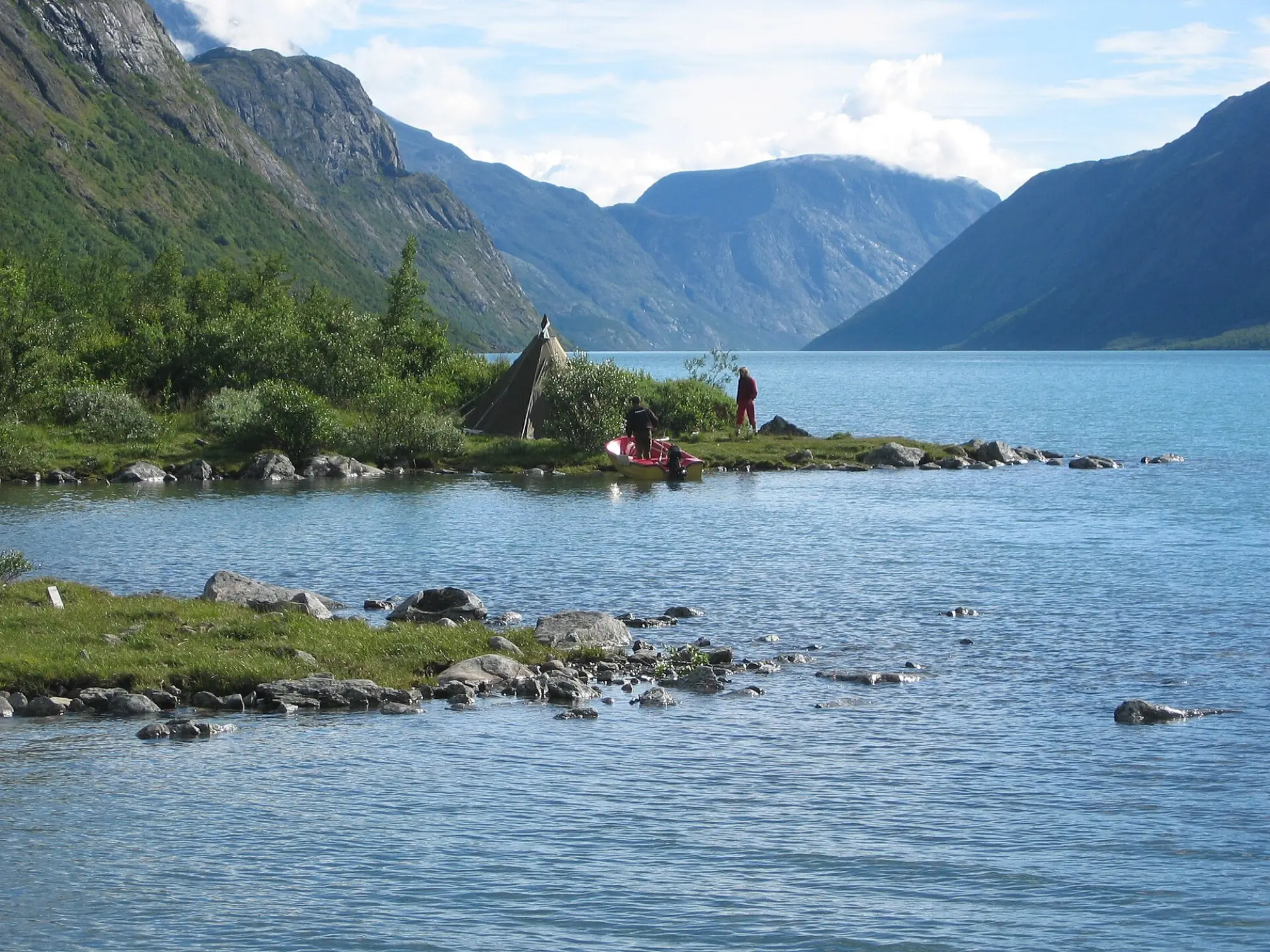

You can wild camp in Norway on uncultivated land, provided you stay at least 150 metres away from an inhabited house or cabin. You can remain up to two nights in one place without asking the landowner. No fires are permitted in or near forest from 15 April to 15 September, and certain popular areas have local bans.
Wild camping in Norway in short
The Norwegian Environment Agency (Miljødirektoratet) states that the right to roam (allemannsretten) gives everyone the right to walk freely and stay where they like in nature, regardless of who owns the land.
The Outdoor Recreation Act states that a tent must not be pitched so close to an inhabited house or cabin that it disturbs the residents' peace, and in any case not closer than 150 metres. In addition, the Act says camping or any other stay is not allowed for more than 2 nights at a time without the owner's or user's consent.
Under the fire prevention regulation (forskrift om brannforebygging), it is forbidden from 15 April to 15 September to light a fire in or near forest and other uncultivated land. Beyond national rules, the Environment Agency notes that camping is restricted in some places, so you must always check local rules before setting up camp. If you travel by road, Statens vegvesen, the Norwegian Public Roads Administration, reminds campers and motorhome drivers that ferry terminals and rest areas are not intended for overnight stays. For other ways to keep costs down, see is Norway expensive.
Where the right to roam applies, and what it does not cover
The right to roam is written into law in the Outdoor Recreation Act (friluftsloven), and it applies when you move about "considerately and with due care".
The law divides Norwegian terrain into two primary categories:
- Uncultivated land (utmark): Defined by the Act as all uncultivated ground that does not count as cultivated land. In the Environment Agency's words, this includes most forest, mountain, bog, shore and water.
- Cultivated land (innmark): Defined as farmyards, house plots, cultivated fields, hay meadows and cultivated pasture, and similar areas where the public would unduly intrude on the owner. Small patches of uncultivated land enclosed by cultivated land, as well as areas fenced off for drinking water, game farming, business or the military, count as cultivated land.
You need the owner's consent to rest or sleep on cultivated land, and you may cross cultivated fields from 15 October to 29 April only when the ground is frozen or covered by snow.
The right to roam does not give limitless freedom. It does not cover driving motor vehicles in uncultivated land, such as snowmobiles, nor does it cover freshwater fishing, hunting or riding an e-bike. For foraging, section 5 of the Act lets the public eat wild nuts on the spot and pick and take home wild flowers, plants, berries and wild mushrooms while out in uncultivated land, provided this is done with care. In Nordland, Troms and Finnmark, the owner of cloudberry land may expressly ban picking cloudberries, though anyone may always pick cloudberries to eat on the spot. Section 19 of the Act states that the right to roam applies strictly within the limits set by other laws and regulations made under them.
The 150-metre rule
Section 9 of the Outdoor Recreation Act states that you may not take a place to rest, sunbathe or sleep on cultivated land without the owner's or user's consent. On uncultivated land, the Act says a tent must not be pitched so close to an inhabited house or cabin that it disturbs the residents' peace, and in any case not closer than 150 metres.
The Environment Agency applies this standard to any night spent outdoors, whether you pitch a tent or sleep under the stars: camping or sleeping out must be more than 150 metres from an inhabited house or cabin. DNT, the Norwegian Trekking Association, points out that people in houses and cabins near the wilderness have a right to a private zone, and that terrain, vegetation and noise affect how close you can respectfully be. The 150-metre threshold is a statutory minimum, not an automatic clearance to disturb people.
There are specific exceptions and environmental restrictions to this rule:
- The distance rule does not apply in an area specially laid out for camping.
- The ministry may make a regulation allowing tents closer than 150 metres to an inhabited house or cabin in coastal areas.
- You may not rest or camp where it could cause significant damage to young forest or areas of newly planted forest.
- On uncultivated land, you may not take a place in a way that unduly crowds out or inconveniences others.
Understanding these boundaries is an essential element of general Norway etiquette.
The two-night limit and where you may stay longer
The baseline duration rule in the Outdoor Recreation Act says camping or any other stay is not allowed for more than 2 nights at a time without the owner's or user's consent. DNT notes that you can camp in the same spot for up to two nights without asking the landowner, and that you must agree longer stays with the landowner elsewhere.
You can remain pitched for longer in specific wilderness areas. Consent for a longer stay is not needed in the high mountains or in areas far from settlement, unless the stay can be expected to cause significant damage or nuisance. The Environment Agency's camping guide confirms that you can camp for up to 2 nights in the same place, and longer if you are in the high mountains or far from settlement.
Two key caveats apply when camping in more remote territories:
- Just before and during the wild reindeer hunt, the ministry may ban or regulate pitching tents in defined high mountain areas where tents could disturb the hunt.
- You camp and travel at your own risk for any harm animals do to you, your tent or your belongings.
If you prefer not to carry a tent through rough terrain, you can alternate wild camps with stays at DNT cabins.
Campfires, stoves and the summer fire ban
Under the fire prevention regulation, it is forbidden from 15 April to 15 September to light a fire in or near forest and other uncultivated land. A fire is still permitted during that window only if the municipality has given permission, if the municipal council has allowed it in a local regulation, or if it is obvious that a fire cannot start.
When the fire risk is especially high, the municipality can ban fires anywhere outdoors at any time of year, for up to 60 days at a time. A fire must never be left until it is completely out. DNT reminds you that even outside the ban period you are legally responsible for any fire you light.
DNT notes that the summer ban covers disposable grills and fire pans too. DNT gives fires on snow or at approved, permanent campfire sites as examples of where lighting a fire may still be clearly safe. The Environment Agency says never to light a fire on bare rock, because the rock can crack from the heat. When preparing a fire, DNT advises keeping fires small, building them on sand, gravel or rocks that will not be damaged, and making sure the embers are cold before you leave. The Environment Agency asks you not to damage trees when looking for firewood and to use dry twigs found on the ground. DNT states that it is illegal to burn plastic, construction materials or general rubbish on a campfire. In the north, the Lofoten outdoor regulation does not recommend disposable grills and states that fires and open grills should be used at marked fire sites.
Local camping bans, from Lofoten to Oslo
Under section 15 of the Act, in areas where many people go out, the municipality can set rules of conduct for an area with the owner's consent to protect peace and order, wildlife, plants, and sanitation. Under section 16, the municipality can close a property that is especially exposed to public use, wholly or in part, with the owner's consent, for no more than 5 years at a time. The Environment Agency stresses that camping is restricted in some places, so you must always check the local rules.
The Lofoten outdoor regulation (friluftsforskrift for Lofoten) was adopted in 2021 by the municipal councils of Vågan, Vestvågøy, Flakstad, Moskenes, Værøy and Røst under section 15 of the Outdoor Recreation Act, and was last changed in 2024. The regulation applies across all Lofoten municipalities, with special rules on tents, campervans and caravans in Vågan, Vestvågøy, Moskenes and Værøy. Elsewhere, it repeats the national rule requiring a distance of at least 150 metres from an inhabited house or cabin.
Under this regulation, tents are prohibited in a list of named outdoor locations:
| Municipality | Place | When tents are banned |
|---|---|---|
| Vågan | Stranda under fjellet | 1 May to 1 October |
| Vågan | Parts of Kalle | 1 May to 1 October |
| Vågan | Parts of Rørvika | 1 May to 1 October |
| Moskenes | Olenilsøya | 1 May to 1 October |
| Moskenes | Andøya | 1 May to 1 October |
| Moskenes | Vindstad | 1 May to 1 October |
| Moskenes | Tennes and Veines | 1 May to 1 October |
| Moskenes | Bollhaugen | 1 May to 1 October |
| Moskenes | Reinebringen | 1 May to 1 October |
| Moskenes | Sørvågvatnet | 1 May to 1 October |
| Moskenes | Langhaugen | 1 May to 1 October |
| Moskenes | Reine | 1 May to 1 October |
| Vestvågøy | Haukland | 1 January to 31 December |
These Lofoten rules apply to all kinds of tent, lean-tos (gapahuk) and hammocks. A stay longer than 2 nights always requires the landowner's consent, except in the high mountains or far from settlement. In some Lofoten areas you may camp only for a fee and on terms approved by the municipality. Breaking the Lofoten regulation can be reported to the police and can lead to being sent away from the area as well as criminal liability. If you are exploring a Lofoten 5-day itinerary, take note that Visit Lofoten reports that areas where tents or campervans are unwelcome cover only 3 per mille of Lofoten's total area. A tourist map of places to pitch a tent in Lofoten has been drawn up by Lofoten Friluftsråd and Destination Lofoten, directing campers toward dedicated tent areas, campsites, or deeper into the backcountry.
Urban bans also exist. Oslo's local police regulation bans sleeping out, camping and tents in public parks, green spaces, open areas and on roads or squares in built-up areas without special permission from the municipality. However, if you are visiting Oslo in summer, camping is permitted on Langøyene in the inner Oslofjord. The City of Oslo allows camping with a tent or hammock for up to two nights in a marked area on the northern island, which is split into 7 tent zones that close at set times in summer. After two nights you must pack up and leave Langøyene; after 24 hours you may return and camp for two more nights. Langøyene provides toilets and water open until week 40 and marked places for grilling, but campfires are banned.
National parks and nature reserves
The Environment Agency confirms that the right to roam applies in protected areas, but an area's individual protection regulation can exclude specific activities, especially in nature reserves, and drinking water regulations can also restrict access. Check with the relevant municipality if you are in doubt when routing through Norway national parks.
In Lofotodden National Park, all travel must be careful of vegetation, wildlife and cultural heritage, and cycling and organised riding are allowed only on roads and paths. Within defined parts of Lofotodden National Park, the Environment Agency has the legal power to regulate or ban travel that may harm the natural or cultural environment via a separate regulation.
Campervans, cars and where to park for the night
The Motor Traffic Act (motorferdselloven) bans motor traffic in uncultivated land and watercourses unless the Act or an official decision under it allows it. Because of this, you may not drive a car or campervan off the road to reach a wild camping spot.
Section 4 of the Outdoor Recreation Act allows you to park in uncultivated land by a public road, as long as it causes no significant damage or nuisance. However, the owner of a private road has the right to ban motor vehicles and parking on or along that road. Statens vegvesen reminds campers and motorhome drivers that ferry terminals and rest areas are not intended for overnight stays. Statens vegvesen instructs drivers to empty toilets and waste bins only at approved dump stations, which are listed at bobilplassen.no, and to follow all signs and markings to avoid fines or towing. Reviewing the rules for driving in Norway will help keep you on legal parking ground.
In Lofoten, overnight parking is restricted. The Lofoten outdoor regulation bans parking caravans or campervans between 24:00 and 06:00 at a specific list of car parks: Stranda under fjellet, Kalle, Rørvika, and the car park along Lille Kongsvatn in Vågan; and Vika, Marka, Sørlandshagen, Skaret, Skiphalsen, Teisthammarn, Nevan, and Skarsvollsand on Værøy.
Other popular trailheads enforce their own prohibitions. At the Kjerag trailhead, the car park operator says camping or sleeping in vehicles is strictly forbidden and directs campers down to Lysebotn; keep this in mind when organising a Kjeragbolten hike.
Visit Lofoten provides further practical road advice: use campsites and dedicated motorhome pitches whenever possible, stay at least 150 metres from buildings when parking overnight elsewhere, avoid private property and farmland, and never drive off-road. For road safety on narrow corridors, Visit Lofoten asks drivers not to park in passing places. For fire safety, Visit Lofoten advises parking at least four metres away from other vehicles when spending the night.
Toilets, rubbish and leaving no trace
The Environment Agency states that your duties on a camping trip begin by clearing up your tent site when you leave and taking your rubbish home. It asks you to use public toilets where available, and otherwise to bury your waste or ensure it does not bother others.
DNT provides explicit advice for outdoor toilet stops:
- Move at least 50 metres away from paths or rest areas.
- Stay 100 to 150 metres away from lakes and rivers.
- Dig a hole about 15 cm deep using a small garden spade, stick or stone.
- Fill the hole with soil, stones or moss afterwards so animals cannot dig it up.
- Put used toilet paper in a sealable bag and take it home, which DNT cites as the best approach for nature.
The Pollution Control Act (forurensningsloven) strictly forbids leaving waste where it can be unsightly or harm the environment, and whoever leaves rubbish must clear it up. DNT's working rule of thumb is "if you brought it in, take it out", which includes organic waste like apple cores. DNT suggests carrying a small rubbish bag at all times, and notes that plastic and metal must always be taken home.
If you sleep in a hammock, DNT advises using wide, flat tree straps that do not damage bark, choosing sturdy trees, and avoiding hanging multiple hammocks from a single trunk.
The Environment Agency asks campers not to disturb wild animals and birds, particularly in the breeding and nesting season, not to disturb grazing livestock, and to shut all gates behind them. Under the Dog Act (hundeloven), dogs must be kept on a lead or securely fenced in from 1 April to 20 August. If you encounter wild reindeer in the mountains, DNT advises staying completely still and allowing the herd to move away undisturbed.
The rules at a glance
| Rule | What it says | Where it comes from |
|---|---|---|
| Distance from buildings | Pitch at least 150 metres from an inhabited house or cabin and do not disturb residents' peace | Outdoor Recreation Act |
| Duration limit | Camp up to 2 nights in one spot without consent; longer stays allowed in high mountains or far from settlement | Outdoor Recreation Act |
| Summer fire ban | Fires forbidden in or near forest and other uncultivated land from 15 April to 15 September | Fire prevention regulation |
| High fire risk ban | Municipalities may ban outdoor fires anywhere at any time of year for up to 60 days | Fire prevention regulation |
| Lofoten seasonal tent ban | Tents prohibited at named sites from 1 May to 1 October | Lofoten outdoor regulation |
| Haukland tent ban | Tents prohibited all year from 1 January to 31 December | Lofoten outdoor regulation |
| Oslo city ban | No camping, tents or sleeping out in public parks, green spaces, open areas, roads or squares without permission | Oslo local police regulation |
| Rest areas and ferry docks | Ferry terminals and rest areas are not intended for overnight stays | Statens vegvesen |
| Toilet distance | Dig toilet holes about 15 cm deep, 50 metres from trails and 100 to 150 metres from water | DNT advice |
| Dog leash period | Dogs must be kept on a lead or securely fenced from 1 April to 20 August | Dog Act |