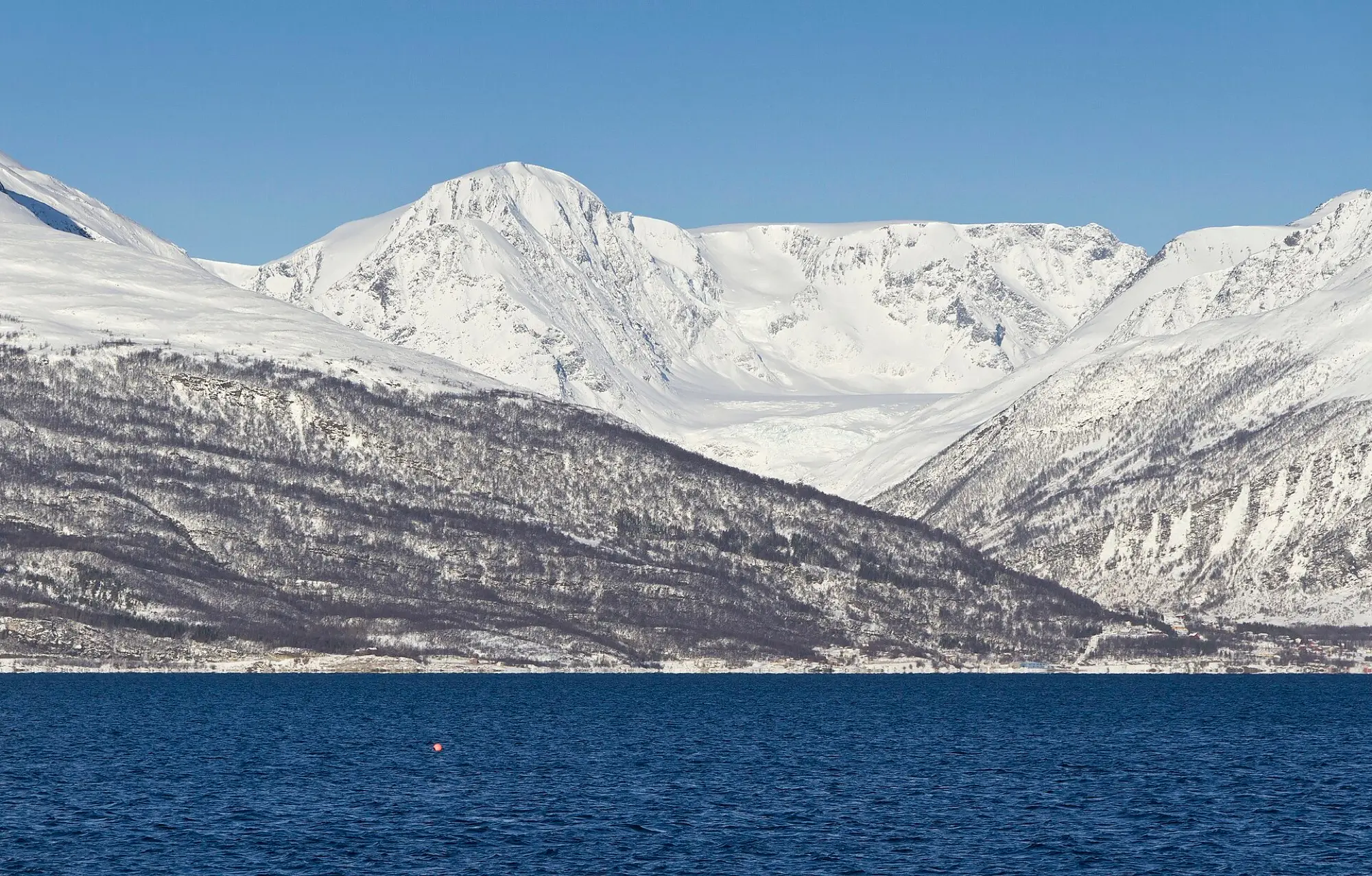

The Lyngen Alps lie on the Lyngen peninsula, approximately 50 km east of Tromsø, reached by the Breivikeidet-Svensby car ferry or by road round the fjords. Check tonight's aurora verdict and dark hours for Tromsø, the nearest place the site forecasts, before planning travel in the darker months.
What the Lyngen Alps are
Store norske leksikon describes the Lyngen Alps (Lyngsalpan) as a mountain chain on the Lyngen peninsula, spread across the municipalities of Lyngen, Storfjord, Tromsø and Balsfjord. The range is roughly 80 kilometres long and never more than 15 kilometres wide. The chain has around 50 peaks higher than 1,300 metres and is regarded as the mightiest mountain massif in Northern Norway.
The highest peak in the Lyngen Alps is Jiehkkevárri, at 1,834 metres above sea level, which is also the highest point in Troms. The height of Jiehkkevárri is measured on the summit glacier; the rock underneath, hard gabbro, is lower. Jiehkkevárri was first climbed in 1899. The name Jiehkkevárri is Northern Sámi and means a glacier mountain, a glacier-covered peak.
The peaks catch moisture from the clouds, and there are around 140 larger and smaller glaciers in the range, covering around 100 square kilometres in all. The Lyngsalpan landscape protection area covers 961.2 square kilometres and was protected in 2004; flying drones is not allowed there because the area is protected against noise. Because the landscape is protected, there are only a few paths in the area, often unmarked, and most of them were made by grazing animals.
Visit Tromsø says about 3,000 people live in Lyngen municipality. The name Lyngen comes from the fjord of the same name and means "quiet" or "peaceful" in Old Norse. Arctic Norway places the Lyngen peninsula at 69° north, approximately 50 km east of Tromsø.
Driving from Tromsø and the Breivikeidet-Svensby ferry
From Tromsø you follow the E8 for 20 km to Fagernes, then road 91 to the ferry quay at Breivikeidet, and cross to Svensby on the Lyngen peninsula. Statens vegvesen's route planner takes the route from central Tromsø to Lyngseidet along the E8 and the Breivikeidet road with one ferry, a route of 76,080 metres, about seventy-six kilometres, of which 6,218 metres are on the ferry. The route planner gives 93.6 minutes for that route including the crossing, just over an hour and a half, before any wait for the ferry.
The route planner's alternative without a ferry goes round by road via the E8 and Vestersidaveien, a route of 131,075 metres, about one hundred and thirty-one kilometres. The route planner gives 119.05 minutes of driving for the route without a ferry, just under two hours. Arctic Norway says the alternative to the ferry is to drive via Nordkjosbotn to Lyngseidet, a drive of approximately two hours from Tromsø. Check rules for driving in Norway before setting off in a hire car. Both routes pass one toll point, NOK 14 for a small car according to the route planner.
The ferry crossing from Breivikeidet to Svensby usually takes about 20 minutes. Visit Lyngenfjord calls the 20-minute crossing a chance to see the Lyngen Alps in a panorama from the ferry café, which serves coffee, drinks and waffles. The Breivikeidet-Svensby ferry is run by Norled; the ferry on the route is MF Folkestad. The ordinary 2026 fare for a car under 6 metres is NOK 104 per crossing. An electric car under 6 metres pays NOK 73. Passengers in vehicles and foot passengers travel free of charge. The fare is charged at the crossing through an AutoPASS agreement, FerryPay or the other payment methods available on board; our guide to car ferries in Norway explains how AutoPASS and FerryPay work. The timetable for the Breivikeidet-Svensby ferry, together with the Lyngseidet-Olderdalen ferry, is published by Svipper, the public transport company for Troms. The drive from Svensby to Lyngseidet takes about 30 minutes.
Getting there without a car
The Arctic Route bus, run by Best Arctic, runs daily between Tromsø and Breivikeidet from 1 December to 31 March. The bus leaves Tromsø at 08:45 and reaches the Breivikeidet ferry quay at 09:50. In the other direction the bus leaves Breivikeidet at 10:00 and reaches Tromsø at 11:00. A ticket from Tromsø to Breivikeidet costs NOK 300, and Tromsø to Breivikeidet and back NOK 600. The ferry crossing to Svensby is included in the Arctic Route ticket; Best Arctic says it takes approximately 25 minutes. Onward transport from Svensby to Lyngseidet or further north in Lyngen is not included in the Arctic Route ticket, and onward and return travel must be planned separately.
Regular buses leave from the main bus station in Tromsø, Prostneset; one route runs to Alta and Storslett via Svensby and Lyngseidet in Lyngen and Olderdalen. Travelling around the region by bus needs planning, because many buses only run once a day. For some hikes, such as Blåisvatnet, there is no return bus that makes a day trip possible.
Norled's express boat between Tromsø and Skjervøy stops at Nord-Lenangen, on the north of the Lyngen peninsula, and leaves from the Prostneset terminal in Tromsø. The express boat only runs on certain days and does not take cars. Lyngen Experience gives the express boat fare as NOK 350 per person each way, with tickets bought at the terminal, and warns that it may be cancelled in bad weather.
Lyngseidet and Lyngen church
Lyngseidet is the administrative centre of Lyngen municipality, on the west side of the Lyngen fjord. Lyngseidet had 768 inhabitants in 2025. Lyngseidet has been a trading post since 1789 and has a number of older buildings worth preserving. The village sees a lot of visitors, among other things as a starting point for trips into the Lyngen Alps. Lyngseidet has a breeding station for the Lyngen horse, also called the Nordland horse.
In the south of the village stands the former Solhov folk high school, the largest wooden building in Northern Norway, which after restoration is now used for overnight stays. Lyngen church stands in the centre of Lyngseidet, with its choir facing the sea. The first church was built at Karnes, a few kilometres up the Lyngen fjord, in 1731, and a few years later it was taken down and moved to Lyngseidet. Today's church is a cross-shaped timber church with a steeple, clad in white-painted vertical panelling. The roof is covered with red pantiles and the steeple is sheathed in copper.
From Lyngseidet a second car ferry crosses the fjord to Olderdalen in Kåfjord in 40 minutes. For lift-served skiing there is only a small hill in Lyngseidet. Visit Lyngenfjord points to the Aurora Spirit distillery at Årøybukt on the Lyngen peninsula, which it calls the world's northernmost whisky distillery.
Ski touring season, month by month
Visit Lyngenfjord gives the ski-touring season in the Lyngen Alps as February to May. The first snow on the peaks usually comes in October, but the amount of snow varies greatly from year to year. There is no guarantee of enough snow for ski touring until January. Skiing in the dark winter months needs the right equipment, including a headlamp. March and April normally bring plenty of snow and daylight and are regarded as the best time for ski touring in the Lyngen Alps.
What sets Lyngen apart is alpine terrain that starts at sea level, so many tours go straight up from the road. Elevation gains of 2,000 metres in one day are not unusual. There are also plenty of tours where the slope does not exceed 30 degrees, though the area is still relatively demanding to ski. Lyngen has a coastal climate with a lot of precipitation, and long spells of bad weather happen; locals advise setting aside plenty of days.
- Rørnestinden (1,041 m): Close to Lyngseidet and has several descents, from easy to advanced.
- Russelvfjellet (818 m): At the far end of the peninsula, a relatively easy tour.
- Storgalten (1,290 m): In northern Lyngen, a large, rounded ski-touring mountain rated medium.
Guides, packages and where to stay
The managing director of the mountain-guide company Ascent Descent recommends hiring a guide every time you go out, because a guide who knows the area plans the tour around the group. He says anyone skiing Lyngen without a guide should be an expert at assessing risk. Local guides keep watching the weather, the snow conditions and the avalanche forecasts to choose the day's mountain. Lyngen Experience's certified guides take groups of 4 to 6 people, and some of its summit tours reach peaks that can only be reached by boat.
The cheapest package listed on Visit Lyngenfjord's ski-touring page is from NOK 7,150 per person, for three nights at Manndalen Sjøbuer with two guided tours with an Arctic nature guide. The most expensive listed is from NOK 39,900 per person, for seven nights at Lyngen Experience Lodge, full board, with six tours with an IFMGA-certified guide.
Visit Lyngenfjord lists rorbu cabins from NOK 2,535, lodges and hotels from NOK 1,700, aurora huts from NOK 4,900 and fjord cabins from NOK 1,250. Readers who stay in Tromsø and visit Lyngen for the day can compare options in our guide on where to stay in Tromsø.
Avalanche safety and the Varsom forecast
The Norwegian Avalanche Warning Service publishes regional avalanche warnings on varsom.no every day from 1 December to 31 May. Its forecasting regions are large compared with those in central Europe, so you still have to judge the local conditions and weather yourself. For the Lyngen Alps the forecast regions to read are Lyngen and Nord-Troms.
Varsom says anyone ski touring in Norway needs its free app, which has the avalanche forecasts and terrain and topographic maps for offline use. Download the maps before setting off, because mobile coverage in the mountains may be poor or absent. Persistent weak layers can be found all over Norway, even in spring, and cornices can break off at any point. Guides in Lyngen often find persistent weak layers on several aspects even when spring is well under way at sea level, and the midnight sun on the slopes all night also changes the snow. Varsom warns that the weather near the sea changes quickly, can catch you by surprise and can change the snow and avalanche conditions.
Visit Lyngenfjord says more than 100 people have died in avalanche accidents in Norway in the last 15 years. Norway has no formal requirement for offering mountain guiding; a Nortind (IFMGA) guide is a highly qualified guide who also knows the area. The Norwegian standard Nortind recommends is 6 guests per guide for ski touring. The police lead search and rescue in Norway; long distances and the weather often mean waiting at least 1 hour for help, so be equipped to keep warm. For search and rescue call 112; for a medical situation that needs no rescue, call 113.
Blåisvatnet, the blue lake
Blåisvatnet, "the blue lake", lies in Sør-Lenangen at the foot of the Lenangsbreen glacier; the silt in the glacier's meltwater may explain its blue colour. The walk to the lake and back is roughly 8 km, following markers painted red at the top. Allow about 90 minutes to reach the lake and an hour to walk back; Visit Lyngenfjord estimates 3 hours in total.
The lake lies 189 metres above sea level and most of the walk is on gentle, fairly flat ground. The last part climbs over large stones and scree, and the trail is rocky, so wear sturdy shoes. Park in Sør-Lenangsbotn, following the "Lyngsalpan" sign from the main road; parking is paid with the EasyPark or Parkly app and the fee goes to hiking infrastructure in Lyngen. There are toilets near the car park, and the trail has planks across streams and boggy sections.
The best time to walk to the lake is summer or autumn; the blue is strongest on sunny afternoons. Ice normally covers the lake until the beginning of June. In winter the walk is for experienced winter hikers only, on skis or snowshoes once the snow is deeper than your boots, and Visit Lyngenfjord recommends other winter trips instead.
The Steindalsbreen glacier walk
The Steindalsbreen glacier is in the Steindalen valley (Gievdanvággi), reached from road 868 between Oteren and Lyngseidet; park at the large car park by "IMA tursenter" and follow the tractor road into the valley. It is 2.4 km to the Steindalshytta cabin by the Tverrelva river, about an hour's walk. It is 6.2 km one way from the car park to the glacier, and 12.4 km there and back. Visit Lyngenfjord says to allow 5-6 hours in total.
The highest point of the walk is 480 metres above sea level, and the path is clear, with information signs. Do not walk onto the glacier alone without experience; guided glacier walks can be booked with Lyngen Outdoor Experience. Signs near the glacier show how it has retreated year by year, and the valley holds glacier front positions spanning more than 8,000 years.
The walk is in a protected area, so drones and e-bikes are not allowed, fires go only in the fixed fire pits, dogs must be on a leash because of sheep, and reindeer must be given room.
Day tours from Tromsø
Best Arctic's organised tours include transport from Tromsø, while Lyngen Experience runs its trip from Nord-Lenangen:
- Snowmobile safari: Best Arctic's snowmobile safari in the Lyngen Alps includes return transport from Tromsø by bus and ferry, about 60-90 minutes on the snowmobile with two guests per machine, winter clothing and a hot fish soup afterwards. It costs from NOK 2,590 for an adult and NOK 2,250 for a child aged 6-11; prices vary by season. The morning tour leaves Tromsø at 08:30 and is back at about 16:00; the whole trip takes about 7-7.5 hours. Drivers must be at least 18 and hold a valid driving licence; others ride as passengers.
- Snowshoe tour: Best Arctic's snowshoe tour drives about 60 minutes from Tromsø to walk with views of Ullsfjorden and the Lyngen Alps, with stories of coastal Sámi culture; it takes about 5 hours 30 minutes, for a minimum age of 8. The snowshoe tour costs from NOK 1,790 per person and leaves at 09:30.
- Dog-sledding day trip: Best Arctic's dog-sledding day trip is at Breivikeidet, at the foot of the Lyngen Alps, about 45-50 minutes by coach from Tromsø. See our guide to husky and reindeer tours in Tromsø for details on winter excursions in the area.
- Outer Lyngen snowmobile: Lyngen Experience, based in Nord-Lenangen, runs a 1.5-hour snowmobile trip in outer Lyngen from December to March, at 10:45 or, for a chance of the northern lights, at 20:00. Drivers need a valid class B driving licence, and the tour takes no one under 12.
Northern lights and summer festivals
In the early, dark part of the ski season the northern lights are often in the sky, and Visit Lyngenfjord notes that this period is best suited to those with a special interest in skiing under them. Store norske leksikon notes that the Lyngen Alps draw many climbers, fishing visitors and northern lights visitors. Organised northern lights tours from Tromsø usually run from September to early April. July is festival month in the region, and the Riddu Riđđu festival takes place in the Lyngenfjord area.