Can you see the northern lights in Svalbard tonight?
Possible after 17:48 — Kp 0.67, and Svalbard is just north of the main auroral oval, so a higher Kp would not raise the chance.
Checked against NOAA SWPC and the MET Norway Locationforecast.
Tonight Svalbard is 1 of 26 on the ranked table of places.
Get an alert when Svalbard lights up
A heads-up in the hours before dark when tonight's forecast Kp reaches your choice and the cloud forecast leaves a gap, and an alert when the field is active over a clear enough sky at Svalbard. Two a night at most, nothing on the other nights.
Svalbard is just north of the main auroral oval, and a storm moves the oval south. So from Kp 5 nothing goes out on Kp alone, only when NOAA's OVATION model puts the aurora overhead at Svalbard itself.
Alerts come to this browser on this device. No email, no account; turn them off here or from any alert.
Aurora forecast for Svalbard: the next three nights
| Night | Dark, local time | Forecast Kp | Kp needed | Clearest hour |
|---|---|---|---|---|
| TonightFri 13 Nov | 17:48–05:40 | Kp 1.67 | any Kp | 0% at best |
| Possible — Kp 0.67. | ||||
| Saturday nightSat 14 Nov | 17:44–05:44 | Kp 1.67 | any Kp | 0% at best |
| Possible — Kp up to 1.67 is forecast while it is dark, and Svalbard is just north of the main auroral oval, where a higher Kp would not raise the chance. 0% cloud at best. | ||||
| Sunday nightSun 15 Nov | 17:40–05:50 | Kp 1.67 until 01:00 | any Kp | not forecast yet |
| Possible — Kp up to 1.67 is forecast until 01:00, and Svalbard is just north of the main auroral oval, where a higher Kp would not raise the chance. The cloud forecast does not reach this night yet. | ||||
Checked . Kp from the NOAA SWPC three-day forecast, issued ; cloud from MET Norway Locationforecast, issued . Tonight's row is the verdict above, which also reads the Kp now, OVATION and the magnetometers; the nights after rest on the forecasts alone.
Key facts
- Astronomically dark in Svalbard tonight from 17:48 to 05:40 local time, 11 hours and 52 minutes, as of .
- Aurora outlook for the next three nights: Fri 13 Nov, Possible; Sat 14 Nov, Possible; Sun 15 Nov, Possible, as of .
- In the 2026–27 season, astronomical darkness returns between 1 October and 15 October and ends between 1 March and 15 March.
- Svalbard is at 78.22°N, 15.63°E.
Updated
At 78.2°N in Norway, Svalbard experiences polar night around the winter solstice, and at this latitude a quiet geomagnetic night is often enough to see the northern lights.
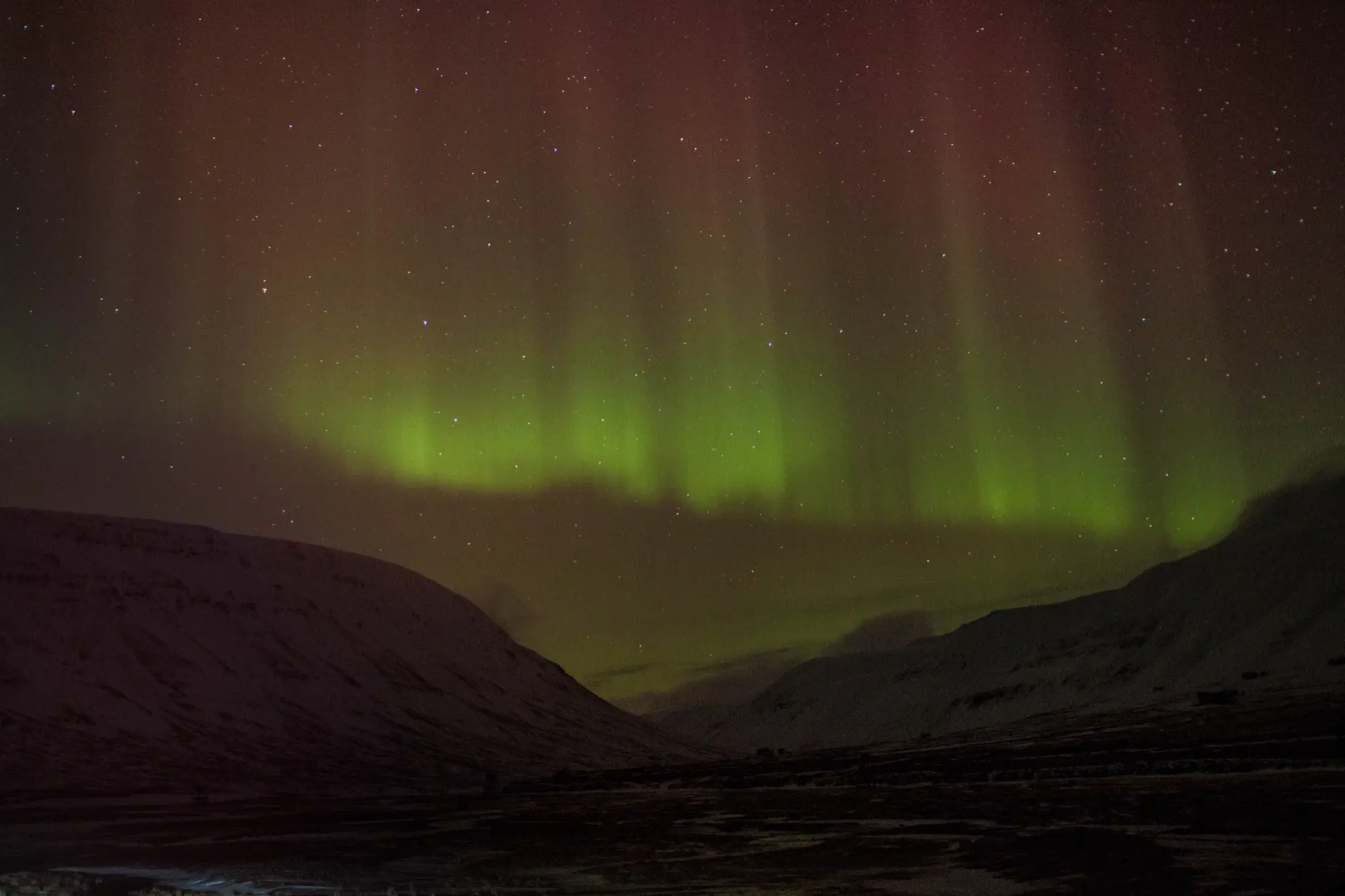
Photo: Martyn Smith, CC BY 2.0

The evidence
- Geomagnetic activity
- Kp 0.67 (quiet) NOAA SWPC, estimated Kp,Forecast peak Kp 1.67 during the dark hours NOAA SWPC 3-day forecast, issued 01:30 CET5% chance of aurora overhead NOAA SWPC OVATION,
- Cloud over the dark hours
- 0% cloud at best around 04:00, 11% at worst MET Norway Locationforecast, covering 17:48–05:40
- Darkness
- Astronomical dark 17:48–05:40 (11h 52m) computed here from the date and the coordinatesPolar night — the sun does not rise computed here
- Moon
- Waxing crescent, 17% lit, below the horizon at the start of the dark hours computed here
Cloud forecast: MET Norway, under CC BY 4.0, reduced here to the clearest and cloudiest hour of the dark window. See where the data comes from.
How dark does it get in Svalbard tonight?
It is astronomically dark — dark enough to see the aurora — from 17:48 to 05:40 local time, 11 hours and 52 minutes.
Dark hours by date, 2026–27 season
| Date | Dark from | Dark until | Hours of darkness |
|---|---|---|---|
| 1 October | Not dark enough for the aurora | ||
| 15 October | 22:14 | 03:16 | 5h 02m |
| 1 November | 18:56 | 04:32 | 9h 36m |
| 15 November | 17:40 | 05:50 | 12h 10m |
| 1 December | 16:40 | 06:58 | 14h 18m |
| 15 December | 16:16 | 07:32 | 15h 16m |
| 1 January | 16:30 | 07:32 | 15h 02m |
| 15 January | 17:16 | 06:58 | 13h 42m |
| 1 February | 18:38 | 05:44 | 11h 06m |
| 15 February | 20:08 | 04:14 | 8h 06m |
| 1 March | 22:28 | 01:50 | 3h 22m |
| 15 March | Not dark enough for the aurora | ||
Astronomical darkness (the sun more than 18° below the horizon), Svalbard local time, computed here from the date and the coordinates.
In the polar night it is dark even at noon, so in winter in the far north, as in Svalbard, daytime aurora can be seen with the naked eye. Svalbard lies slightly north of the main auroral oval, so the aurora there is often weaker and more diffuse than further south in the oval. Viewing requires planning around the dark season and strict adherence to local polar bear safety rules.
When to see the northern lights in Svalbard
Visit Svalbard calls the season from 1 October to 28 February the Northern Lights Winter. Visit Svalbard says the evenings are already darkening as October begins, and by the end of October the dark season is in full swing, with midday twilight and no direct sunlight at all. Visit Svalbard says the polar night makes it possible, with luck, to see the northern lights even in the middle of the day.
On the dayside of the Earth near the magnetic poles lies the polar cusp, so in winter in the far north, as in Svalbard, the aurora can be seen even in the middle of the day; in the polar night it is dark even at noon, so the daytime aurora can be seen with the naked eye. Daytime aurora is usually somewhat weaker and more diffuse than night-time aurora; the more colourful, intense aurora is the one most often seen in the evening and at night. Visit Svalbard's explanation of the northern lights was scientifically reviewed by Jøran Moen of the University Centre in Svalbard (UNIS).
Svalbard lies slightly north of the main auroral oval, so the aurora there is often weaker and more diffuse than further south in the oval; when the Sun is very active, the oval expands southward. The Finnish Meteorological Institute says auroras show on every night on the Arctic Ocean coast of northern Norway, and that further north still, inside the auroral oval, the number of aurora nights falls again.
Visit Svalbard says that on clear days in the polar night the stars shine all day, and a full moon casts shadows and lights the landscape, so the dark season is not as dark as many imagine. Visit Svalbard says forecasts are not everything and you also need clear skies, and recommends Yr for checking the weather in Svalbard. Yr is a joint service of the Norwegian Meteorological Institute and the Norwegian Broadcasting Corporation, and Visit Svalbard notes it is their best recommendation for checking the local weather; for aurora activity they recommend the Aurora Forecast 3D app by Professor Fred Sigernes of UNIS.
How to get to Svalbard
Norwegian and SAS fly to Svalbard; the flight from Oslo takes about three hours and from Tromsø about an hour and a half. Visit Svalbard says Norwegian normally flies to Longyearbyen directly from Oslo all year, with more flights in the peak season from March to August. SAS normally has several flights a week to Longyearbyen all year, both direct and via Tromsø, rising to several a day in the peak season from March to August.
Svalbard is outside the Schengen area, so there is an identity check for everyone travelling to and from it, Norwegians included, and every visitor must bring a passport or national ID card. Every visitor to Svalbard pays an environmental fee of NOK 150, which airlines and cruise lines add to the ticket price automatically.
Avinor says the airport bus runs for every arrival and before every departure, stops at all the hotels, costs 110 kr and takes about 15 minutes. For broader context on costs and planning, read is Norway expensive? and the Norway guide.
The European Health Insurance Card does not apply in Svalbard, Longyearbyen has only a small hospital for emergencies, and Visit Svalbard strongly recommends travel insurance that covers a stay there. Visit Svalbard says frostbite is one of the most common injuries in Svalbard, the normal winter temperature from October to May is between −30 and −11 °C, and strong wind makes it feel colder still; a reflective vest helps in the dark, and spikes help on icy roads.
Where to stand to see the aurora
The Governor of Svalbard (Sysselmesteren) says that because of the danger of polar bears, everyone who goes outside the settlements must carry a suitable means of scaring polar bears away. Visit Svalbard says the polar bears are also active through the Northern Lights Winter, and says not to go out of the settlements without a professional guide from one of the local activity providers.
In Longyearbyen there is a zone, marked in red on a map available free at the tourist information office, inside which you need no polar bear protection. For visitors staying in town, Visit Svalbard suggests asking the hotel or guesthouse reception whether the northern lights are out and where in town to see them most clearly without polar bear safety equipment.
Because of the polar bears, Visit Svalbard highly recommends an organised aurora trip, and says a guide can also take you away from Longyearbyen's lights, where fainter aurora is easier to see. Visit Svalbard says the best aurora experience needs a place that is completely dark and far from artificial light, and that from Longyearbyen you do not have to travel far to find one. Visit Svalbard highly recommends a guided trip with a professional guide from a local provider, noting that local providers offer northern lights trips by snowmobile, dog sled or boat, on snowshoes, or by snowcat for those who want to leave Longyearbyen in comfort.
New field safety regulations came into force on 1 January 2026, and from 1 July 2027 tourist businesses that travel or stay outside inhabited areas in Svalbard must use guides approved by the Governor. Visit Svalbard says visitors who want to learn more about the aurora can do so at the Kjell Henriksen Observatory.
Where to watch near Svalbard
- Longyearbyen, inside the town zone in the centre. You can watch inside the town zone without polar bear safety equipment. Visit Svalbard suggests asking your hotel reception if the aurora is out and where in town to see it most clearly.
- Adventdalen (guided trips only) 6.8 km south-east. To leave Longyearbyen's lights and look for the daytime aurora, you can join guided snowmobile, photo safari, or car trips listed by Visit Svalbard, who advises not leaving settlements without a professional local guide.
- Camp Barentz (guided evenings) 9.4 km south-east. Listed by Visit Svalbard, this organised trip takes you away from town lights to make fainter aurora easier to see, with guides carrying polar bear safety equipment.
What the numbers mean
Four things have to line up before you see anything, and three of them are on this page above. The fourth is your own eyes adjusting, which takes about twenty minutes in real darkness and does not survive a glance at a phone.
Darkness comes first because it cannot be argued with. The aurora is always there when the field is active; you can only see it once the sun is more than 18° below the horizon, which is what the dark band above marks. In Svalbard that is 11 hours and 52 minutes tonight.
Kp is a global index of how disturbed the Earth's magnetic field is, from 0 to 9, published every three hours. It is a blunt instrument: it says the whole planet was disturbed, not that the aurora is over Svalbard now. At 78°N Svalbard is just north of the main auroral oval, and when the Sun is very active the oval moves south: here a high Kp is no better a chance, and a storm can take the aurora away.
The local disturbance is the better number, and it is the one most aurora pages do not have. FMI runs magnetometers across Lapland; we take the rate of change of the horizontal field at the nearest one, in nanotesla per minute. Svalbard has none within 120 km, so its verdict rests on Kp and OVATION. A field moving fast overhead means current flowing overhead, which is the aurora itself. Above roughly 40 nT/min it is usually visible; above 100 a substorm is running and it will be moving.
Cloud ends most attempts. The figure above is the total cloud cover MET Norway's Locationforecast forecasts for the dark hours, at these exact coordinates. Anything over about 70% and you will not see through it; under 30% and it stops mattering.
The moon does not stop the aurora. A full moon high in the sky washes out the faint green arcs that make up most displays, so a strong night still shows and a marginal one does not.
Plan the trip
- Best places to see the northern lights
- Northern lights in Norway: when and where to go
- Is Norway expensive? Real prices and rules
- Daylight in Tromsø through the year
Nearby
Also on this site: how the daylight changes through the year, and the other 25 places.