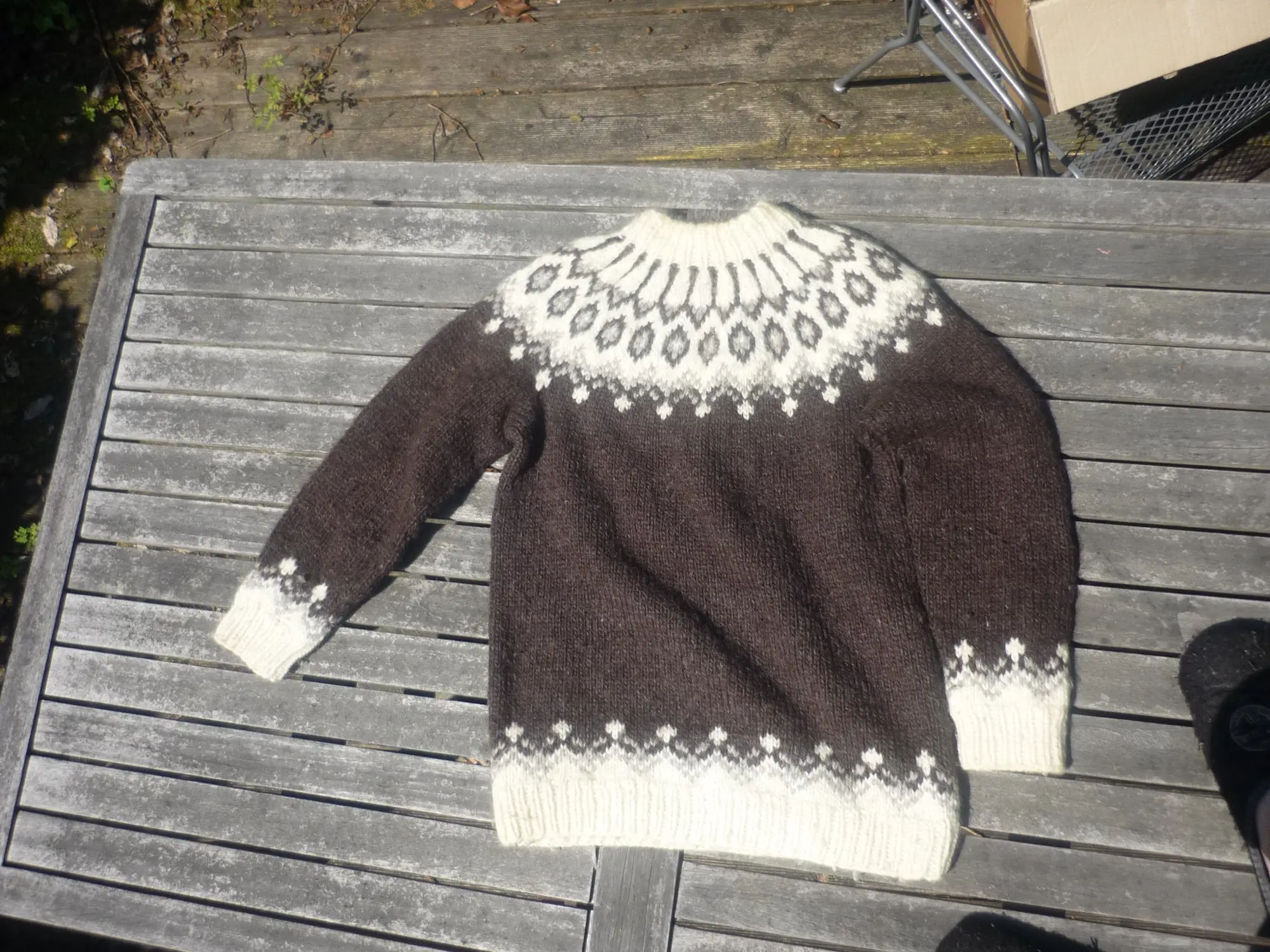

A real lopapeysa is hand-knitted in Iceland, seamless, with a circular yoke, from new Icelandic wool and Icelandic yarn. A label that says "designed in Iceland" usually means it was not made there. Visit Iceland puts the price of a genuine one at 30,000 ISK to 60,000 ISK.
What a lopapeysa is
Visit Iceland describes Icelandic knitting as a traditional craft built around lopi wool from Icelandic sheep, and the lopapeysa (wool sweater) as a sweater with a circular yoke pattern. Visit Iceland says the lopapeysa has become a national symbol that Icelanders of all ages still wear. According to the tourism board's lopapeysa guide, Iceland has approximately one million sheep, and they give the wool for the lopapeysa, the Icelandic wool sweater. To see how this garment fits among other living customs, read about Icelandic culture.
Visit Iceland says Icelandic wool has two layers: tog outside, which is long and water-resistant, and þel inside, which is soft and warm. Together, they keep you warm even when the wool is wet, which is practical for unpredictable conditions outlined in our guide to Iceland weather by month. Visit Iceland says many visitors are surprised how many Icelanders they see wearing one, and calls it more than a souvenir, describing it as a garment that lasts a very long time.
The five rules behind the name
Visit Iceland says the name lopapeysa was made a registered trademark in 2020, and that a sweater must meet set criteria to carry it. The rules for an original lopapeysa require the following:
- The wool must be sheared from an Icelandic sheep and must be new wool, not recycled.
- The yarn must be Icelandic yarn, such as plötulopi, álafosslopi or léttlopi.
- The sweater must be knitted in the round without a seam, with a circular knitted yoke whose pattern runs from the shoulder line to the neckline.
- It must be hand-knitted in Iceland.
- It must be either a whole sweater or a cardigan.
How to spot an imitation
Visit Iceland says rising demand led to many imitations, often made abroad and misleadingly called lopapeysa. Visit Iceland's first warning sign is a "designed in Iceland" label, which means the sweater was not produced in Iceland. The second warning sign is softness. Icelandic wool is rougher than cashmere or alpaca, and when in doubt you should ask whether it was knitted from Icelandic wool.
The third warning sign is seams joining the shoulders and sleeves. An original has only 8-11 underarm stitches, invisible to the untrained eye. The fourth warning sign is a very low price, because handicraft has its price, though Visit Iceland warns that imitations are also sold at high prices.
Visit Iceland says that if a sweater claims to be handknitted in Iceland and the seller can tell you it was knitted with Icelandic wool and by whom, it is highly likely an original. Handicraft shops in most towns often tag pieces with the knitter's name. Visit Iceland's advice is to look for the label "handknitted in Iceland"; machine-knitted versions may look similar but are generally not considered authentic.
What a real one costs
Visit Iceland says to expect to pay between 30,000 ISK and 60,000 ISK for a genuine lopapeysa, reflecting the hours of skilled work in each one. Visit Iceland says smaller shops outside Reykjavík and second-hand stores tend to charge less than city-centre prices. Low prices can indicate an imitation, but imitations are also sold at high prices.
A sweater bought on one receipt of at least ISK 12,000 qualifies for a VAT refund when you leave; see what else Iceland costs in is Iceland expensive. Everyone not resident in Iceland can claim a VAT refund, with a minimum of ISK 12,000 on one single purchase receipt and the original receipts attached to the form the shop fills in. The goods must leave Iceland within three months of purchase, and the forms must be stamped at the airport before you check in.
Where to buy one in Reykjavík
The Handknitting Association of Iceland (Handprjónasambandið) says its pieces have been hand-knitted since 1977, locally, from 100% Icelandic wool. Visit Iceland calls the Handknitting Association of Iceland at Skólavörðustígur 19 the top stop in the city, with finished sweaters, hats and mittens upstairs and a full wall of lopi yarn downstairs. If you are exploring the capital using our guide to things to do in Reykjavík, you can visit their two premises during these opening hours:
- Skólavörðustígur 19: open Monday to Friday 09:00-19:00, Saturday 09:00-17:00, and Sunday 10:00-17:00.
- Borgartún 31: open Monday to Friday 09:00-18:00 and Saturday 09:00-17:00; closed on Sundays.
In Reykjavík, Visit Iceland also names Icewear Magasín, which carries lopi alongside other Nordic yarns, Rammagerðin, which stocks léttlopi, and Storkurinn at Síðumúli 20, which stocks hand-dyed yarns from local dyers. Visit Iceland says Álafoss, at Álafossvegur 23 in Mosfellsbær, in an old factory building next to the Álafoss waterfall, has sold Icelandic wool since 1896.
Beyond Reykjavík
Visit Iceland says you can find lopapeysas at a remote guesthouse, a Westfjords petrol station or a local market, and many places to stay keep a few hand-knitted pieces. In west and northwest Iceland, Visit Iceland names Ullarselið, the wool centre at Hvanneyri, with hand-spun yarns and traditional garments by local craftspeople, and the Kidka wool factory shop in Hvammstangi. In south Iceland, it names Uppspuni, a mini mill and yarn shop near Hella that shows how wool goes from sheep to skein, and the Hespa plant dye studio, which dyes yarn with native plants and lichens. For seasonal travel, see our guide to Christmas in Iceland.
How old the design really is
Visit Iceland says the history of the Icelandic sweater begins with a pair of brown mittens from the first half of the 16th century, found in southeast Iceland, which provide the first proof of knitwear in Iceland. It notes that 72,000 pairs of socks and 12,000 pairs of mittens were exported in 1624, from a country of 50,000 people.
Visit Iceland says the familiar design is not as old as people think. The first knitting pattern for a round-yoke sweater was published in a knitting magazine in 1956. Visit Iceland's knitting article says the lopapeysa itself dates back only to the 1950s, and that after independence in 1944 it became a symbol of national identity. Demand rose in the 1960s and 1970s, and it was then that the Icelandic Handknitting Association was founded, a cooperative of around 1000 knitters, mostly women, many of whom worked from home. Visit Iceland says the association still runs and has 400-500 active members.
How it is knitted, and the yarn
A classic lopapeysa is knitted from two to three strands of unspun plötulopi or one strand of léttlopi or álafosslopi, usually in two or three colours for the pattern. Visit Iceland reckons 800-900 grams of yarn for a medium-sized sweater, and says each sheep gives about two to three kilograms of wool at shearing in spring or autumn. An experienced knitter takes roughly two days to finish a medium-sized lopapeysa. Visit Iceland cites a report in the newspaper Morgunblaðið on 8 December 1984 stating that Kolbrún Sigfúsdóttir knitted a medium-sized sweater in 6 hours, 34 minutes and 50 seconds, breaks included.
Ístex, which makes lopi, says its hand-knitting yarn is produced in Iceland, in hundreds of colours, including natural Icelandic colours. Ístex says it takes its wool from Icelandic farmers.
How to wear and wash it
Asked when to wear one, Visit Iceland's short answer is always; it is accepted everywhere in Iceland, from horse riding to a dinner party or a work meeting. Visit Iceland suggests wearing it as a second or outer layer rather than on the skin, in case it itches. It says Icelandic wool has a high fat content, so it is quite water-repellent, and worn over a fleece or a light windproof jacket it keeps you warm and dry.
How warm a sweater is depends on how many strands of yarn were used, and Visit Iceland's advice is to pick the one you would wear most at home too. It need not be washed often; in most cases airing it outside is enough. To wash it, soak it by hand in lukewarm water with perfume-free wool soap for 15-20 minutes, squeeze the water out carefully, dry it flat on a towel, never in a dryer or hanging, and pull it into shape.