
Icelandic culture centres on shared public spaces, seasonal markers, and enduring naming conventions. Ten distinct traditions shape daily life: last names derived from a parent's first name, the geothermal swimming pools, Þorrablót in midwinter, the first day of summer (Sumardagurinn fyrsti), 17 June, Réttir in September, the 13 Yule Lads, Christmas Eve, the Christmas book flood, and New Year's Eve through to Þrettándinn.
1. Last names from a parent's first name
According to Registers Iceland, parents' names are used as surnames in Iceland, with children generally taking the father's name, the mother's name, or both. A surname based on a parent's name is formed by adding -son or -dóttir to the parent's given name.
A boy takes his father's or mother's name with the ending -son. For instance, a boy is named Jón Sigurðsson if his father is Sigurður, or Jón Guðrúnarson if his mother is Guðrún. A girl takes her father's or mother's name with the ending -dóttir, becoming Embla Sigurðardóttir if her father is Sigurður, or Embla Guðrúnardóttir if her mother is Guðrún. Because of this patronymic and matronymic structure, members of the same immediate family often carry different surnames.
Taking up a new family name is not allowed. If parents choose a given name that is not already listed on the national register, it requires an application to the Personal Names Committee for formal approval. Read more about the naming system in this guide to Icelandic names.
2. The swimming pools
Visit Iceland notes that Icelanders use public swimming pools and hot tubs in rain, snow or shine. Public pools operate in towns across the country, and many facilities include outdoor hot tubs and steam rooms. In the capital, Laugardalslaug and Vesturbæjarlaug serve as local favourites. The City of Reykjavík maintains pools at eight separate sites, and Icelandic swimming pool culture is inscribed on UNESCO's list of the intangible cultural heritage of humanity.
Strict municipal regulations govern every visit. Swimmers must shower thoroughly without swimwear before entering the pool water. In addition, safety and conduct rules explicitly ban cameras, mobile phones, and other smart devices in all changing rooms and pool areas. For advice on visiting during the colder months, see our overview of Reykjavík in winter.
3. Þorrablót, the midwinter feast
The City of Reykjavík states that Þorri, the fourth winter month under the old Icelandic calendar, runs from between 19 and 25 January to between 18 and 24 February. The period is marked by þorrablót (a midwinter festival) and traditional winter food.
During the old Nordic month of Þorri, Icelanders gather for feasts centred on a buffet of traditional foods known as þorramatur (food of Þorri). This feast features an assortment of preserved meat and fish, including fermented shark (hákarl), singed and boiled sheep's head (svið), and cured ram's testicles (súrsaðir hrútspungar). These cured and soured dishes are typically served alongside dense rye bread (rúgbrauð), butter, and brennivín, the traditional Icelandic caraway schnapps. Visit Reykjavík suggests that travellers visiting the city during midwinter join a þorrablót gathering or sample þorramatur selections at local restaurants. Discover more about traditional dining in our overview of Icelandic food.
4. The first day of summer
The First Day of Summer (Sumardagurinn fyrsti) marks the first day of the old calendar's six summer months. It always falls on a Thursday between 19 and 25 April.
5. 17 June, the national day
Iceland celebrates its national holiday on 17 June each year. The date marks the anniversary of the founding of the Republic of Iceland on 17 June 1944. Learn more about seasonal events in our guide to Iceland in summer.
6. Réttir, the sheep round-up
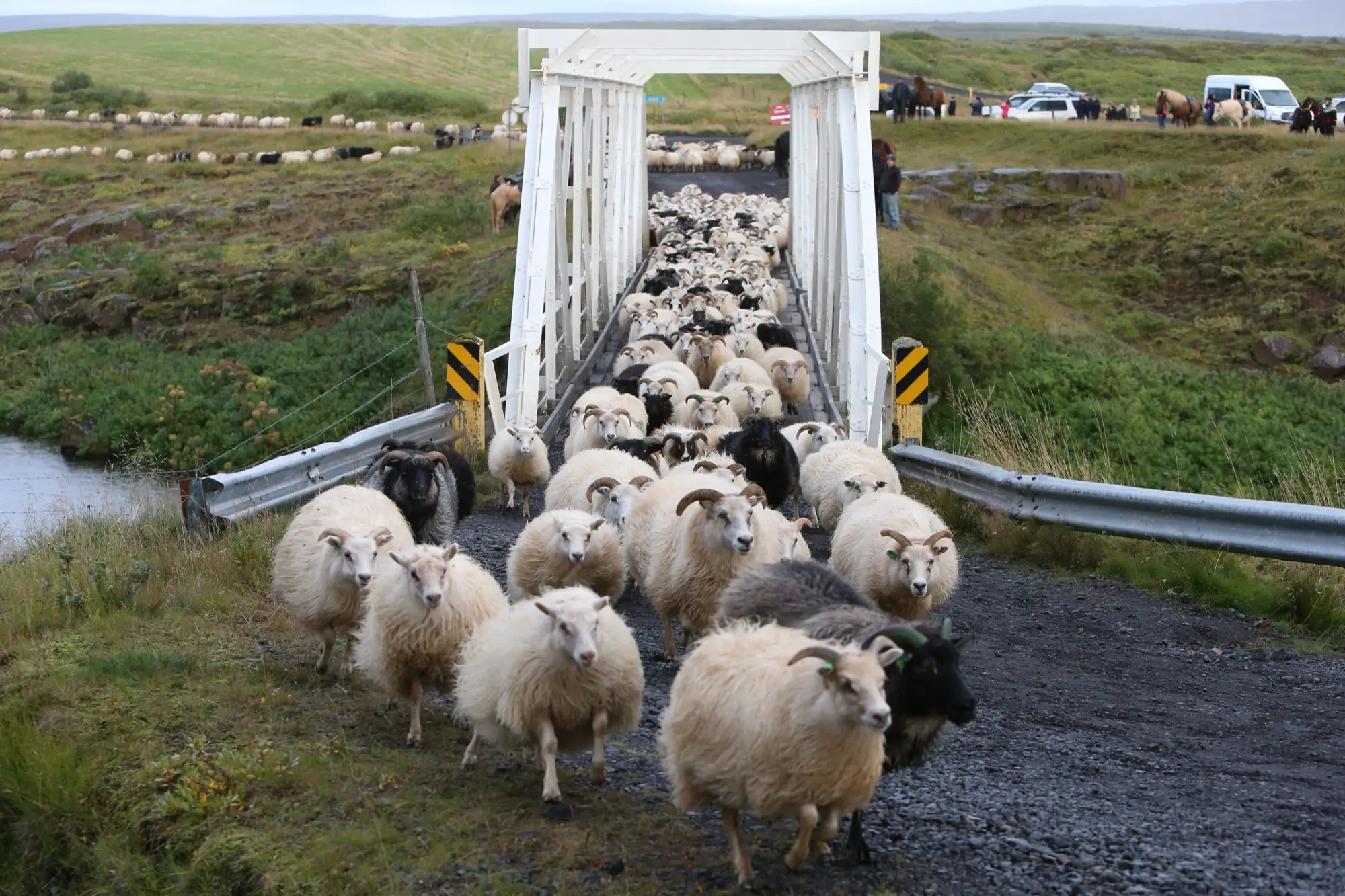
Visit Iceland states that every September, communities across Iceland hold Réttir, the centuries-old round-up that brings the sheep down from the mountains, and many welcome visitors. Visit Iceland also notes that Culture Night (Menningarnótt), one of the biggest events on the calendar, is held in Reykjavík each August. Learn more about wool garments in our guide on how to spot a real lopapeysa.
7. The 13 Yule Lads
Visit Iceland describes the 13 Yule Lads (jólasveinar) as pranksters, each possessing a specific craving or habit reflected in his name. Visit Reykjavík notes that their depiction softened over time, transitioning from frightening figures into playful tricksters and eventually beloved seasonal visitors.
According to Visit Iceland, children place a shoe on their bedroom windowsill for 13 nights in the hope of receiving gifts. Visit Reykjavík notes that a well-behaved child wakes up to find a small gift tucked into the shoe, while a mischievous child may find a raw potato.
The lads arrive one by one from the mountains. Sheep-cote Clod (Stekkjastaur) arrives first on 12 December, thirteen nights before Christmas. The last lad, Candle Beggar (Kertasníkir), arrives on 24 December. Each lad remains for thirteen days before departing in the order he arrived. The first lad departs on 25 December, and Candle Beggar leaves on 6 January.
Folklore also includes the Yule Cat (Jólakötturinn). Visit Iceland describes it as a large, vicious feline with glowing eyes that prowls the snowy mountains on Christmas night, searching for people who have not received new clothes to wear. Visit Reykjavík notes that this tale now persists more playfully as an incentive to give warm socks, mittens, or clothing before the holiday begins. Full details on the folklore are covered in our guide to Christmas in Iceland.
8. Christmas Eve and Þorláksmessa
Seasonal dining customs precede the main holiday. St Thorlákur's Day (Þorláksmessa) takes place on 23 December, named after Thorlákur, an Icelandic saint who died on that date in the 12th century. On this day, Icelanders eat kæst skata (fermented skate). Visit Iceland calls it the most perplexing of Iceland's traditional Christmas dishes, noting that it carries a pungent smell and strong taste, is typically paired with strong liquor, and enjoys greater popularity among older generations.
Visit Iceland explains that Icelanders celebrate Christmas on the evening of 24 December. Visit Reykjavík observes that as church bells ring across Reykjavík at 18:00 on Christmas Eve, the city pauses, marking the moment Christmas formally begins. Following a celebratory dinner on the evening of 24 December, families open their presents together.
9. The Christmas book flood
Visit Iceland states that giving books as Christmas gifts has been an established national tradition for decades. Because Iceland's population was historically too small to support year-round commercial publishing, publishing houses concentrated their releases at the end of the year, creating an intense seasonal sales peak.
Every year since 1944, the national book trade has issued a comprehensive catalogue called Bókatíðindi (Book News). Sent to every household in mid-November, the catalogue is used by residents to order books for friends and family. The retail cycle surrounding this release is called jólabókaflóð ("the Christmas book flood"). Visit Iceland notes that the custom has developed into a broader cultural ritual: people exchange books on the evening of Christmas Eve, then spend the rest of the night, and often the following day, reading their new titles.
10. New Year's Eve to Þrettándinn
Visit Reykjavík states that by 22:00 on New Year's Eve, city streets empty out as the public gathers indoors to watch Áramótaskaupið, the annual televised comedy broadcast that satirises the events of the past year. Just before midnight, residents take to the streets to set off private fireworks across Reykjavík. Visit Reykjavík notes there is no single official public display, and fireworks are sold by local search-and-rescue teams.
The regulation limits general use of fireworks to 28 December to 6 January, both days included, except category 1. Even within that period, setting off fireworks is banned from 22:00 to 10:00 the next morning, except on New Year's night.
The extended festive season closes on 6 January, known as Þrettándinn ("the thirteenth"). The City of Reykjavík notes that Candle Beggar, the final Yule Lad, leaves towns on this day to return to the mountains, formally ending Christmas. Visit Iceland states that the thirteenth is typically marked by community bonfires, burning the remainder of the holiday fireworks, and, in several towns, costumed processions of elves and trolls.