A foreign citizen can marry a Norwegian citizen in Norway on any legal stay, including a standard visitor visa or a visa-free entry. Getting married does not give you an automatic residence permit, and you must obtain an official marriage licence before any ceremony can take place. If you plan to settle in the country together afterwards, you will need to apply separately for family immigration.
Can a foreigner marry in Norway
The Marriage Act says a foreign citizen must have legal stay in Norway to marry in Norway. That legal stay can be a residence permit, residence as an EU/EEA national, a visitor visa, or a valid visa-free stay. You do not need a residence permit or Norwegian citizenship to marry in Norway, but your stay must be legal. If you enter on a short stay, check the entry rules under a Norway visa.
If the officiant or the Tax Administration (Skatteetaten) asks for proof of legal stay, a visitor shows their passport containing the visa sticker. A citizen of a visa-free country shows their passport along with proof of entering Norway less than 90 days ago.
The conditions in the Marriage Act
Under the Marriage Act (ekteskapsloven), two people of the opposite or the same sex can marry. The law sets clear legal conditions:
- Nobody under 18 can marry.
- A marriage must be entered into of the partners' own free will and with their own consent.
- Nobody can marry while an earlier marriage or registered partnership still exists.
- Relatives in a direct line and siblings cannot marry.
Cousins or relatives closer than cousins cannot marry either, although the County Governor (Statsforvalteren) can consent to a cousin marriage for strong reasons. The ban on marriage between cousins came in with an amendment in force from 1 January 2025.
The certificate of no impediment (prøvingsattest)
Before you marry, the Tax Administration checks that you meet the legal conditions for marriage. You must apply to it for a marriage licence, the certificate of no impediment (prøvingsattest). When a foreign partner is involved, extra supporting documents are required.
These extra documents are not needed if both of you are Norwegian citizens, hold permanent residence permits, have been granted asylum in Norway, are EEA citizens with a permanent right of residence, or are Nordic citizens resident in Norway. In those cases, you apply using the simple route just as two Norwegian citizens do.
Once approved, the certificate is valid for four months. The Marriage Act sets the same rule, stating that the certificate is valid for four months after it is issued. It arrives digitally in your inbox and needs no stamp or signature, or it comes by post if you have opted out of digital communication. You are responsible for sending the certificate to the person who will conduct the ceremony, and for agreeing the date and time with them. If you do not meet the legal requirements you will receive a refusal letter, and you can appeal to the County Governor where one of you lives.
Detailed guidance on applying for the certificate is provided by Skatteetaten.
Documents the foreign partner sends
A foreign partner with a Norwegian national identity number does not need to submit documents proving their name, age, and citizenship. Without a Norwegian national identity number, you must send a passport, national ID card, or birth certificate. For a passport or ID card, you send a high-quality colour copy, not the original. National ID cards are accepted only from EU/EEA/EFTA citizens. A birth certificate must be submitted as an original document with an apostille or legalisation.
You must provide the original certificate of no impediment to marriage issued by the authorities in your home country, confirming there are no legal obstacles to marrying in Norway. If your country does not issue such certificates, you provide proof of your civil status from your home country instead. This home-country certificate must be apostilled or legalised and must be no older than four months.
Certificates must be in English or a Nordic language. If they are in another language, they require a certified translation; you must send both the original and the translation, and any translation made abroad must also be apostilled or legalised.
Electronic certificates are not accepted. All original supporting documents must be sent by post, even if you fill out the application online. If you live in a country other than your country of citizenship, you must also provide proof of civil status from your country of residence. A citizen of a country outside the Nordic region must also submit proof of lawful residence in Norway. A marriage licence issued in another Nordic country can be used, but it must be converted into a Norwegian certificate; a Nordic certificate of no impediment alone is not enough.
Sponsors, previous marriages and foreign divorces
Each partner needs a sponsor (forlover) who completes a written statement. You cannot act as each other's sponsors, and all sponsors must be at least 18. A sponsor does not have to be one of the individuals who physically witness the wedding ceremony.
If either of you has been married before, you must also complete a declaration of division (erklæring om skifte). This form is available in Norwegian only. A divorce granted under foreign law must be recognised by the County Governor, unless the divorce was granted in another Nordic country and both spouses were residents and citizens of a Nordic country at that time.
How to apply and how long it takes
You can apply online only if both partners and both sponsors can log in with BankID or a similar electronic ID, and you have all four national identity numbers. Even with an online submission, the foreign partner's supporting documents must still be sent by post. If you cannot use the online service, you apply on paper and post the forms and all required documents together to Skatteetaten, Postboks 9200 Grønland, 0134 Oslo, Norway.
According to Skatteetaten's processing times, the Tax Administration gives up to 5 weeks for checking the conditions for marriage, or 4 to 5 weeks when the case is processed manually. A case that is approved automatically receives the certificate at once in Altinn. If foreign documents are sent for an authenticity check, processing may take longer. The Directorate of Immigration (UDI) also notes there is a waiting time for the certificate, so you should leave plenty of time before the wedding date.
Norwegian law does not require you to change your name when you marry. If you are registered as living in Norway, you can apply for a name change alongside the certificate. The Tax Administration suggests waiting until after any trip soon after the wedding to change your name.
Choosing the ceremony
A marriage is legally made when both partners appear before an officiant together and declare that they want to marry each other, after which the officiant declares them married. Under the Marriage Act, a marriage entered into without a valid certificate is not a valid marriage. At least two witnesses must be present at the ceremony.
Civil weddings are conducted by mayors, deputy mayors, and municipal employees or elected members whom the municipal council gives that authority. Since 1 January 2018, every municipality has had a legal duty to offer weddings to its residents and to people not resident in Norway who meet the legal conditions for marrying in the country.
Priests of the Church of Norway and people given the right to marry couples under the Religious Communities Act can also conduct weddings, as can Norwegian foreign service staff posted abroad and the Governor of Svalbard. However, an officiant from a religious or belief community may refuse to marry a couple if one partner is not a member of that community. Church of Norway priests and other faith community officiants may also refuse if either partner is divorced with a former spouse still living, or if the couple are of the same sex.
A civil wedding at Oslo City Hall
To marry at Oslo City Hall, you book a time, apply to the Tax Administration for the certificate and upload it, pay any applicable fee, and bring two witnesses over the age of 18. Oslo City Hall holds about 2,000 civil weddings a year and does not provide witnesses. On the day, both partners and both witnesses must present valid identification. Oslo accepts a driving licence, a Norwegian bank card with a photo and personal number, a national ID card issued in the Schengen area, or any passport. No other digital ID is accepted.
Weddings at Oslo City Hall take place on Wednesdays, Fridays, and Saturdays, excluding public holidays. The city hall is closed for weddings in weeks 6, 28, 29, and 30. Slots can be booked up to one year ahead, and a couple can hold only one active booking at a time. Both partners must have legal stay in Norway on the wedding day.
Oslo requires the certificate to be uploaded at least 4 weeks before the wedding, and you can lose your booking if it is late. Couples who want a ceremony within four weeks and already hold a valid certificate can contact the municipality to ask about free times.
Fees depend on where you live and the day of the week:
- Couples with an address in Oslo or abroad: Wednesday and Friday ceremonies are free; a Saturday wedding costs NOK 3,478.
- Couples with an address in another Norwegian municipality: Wednesday and Friday ceremonies cost NOK 3,172; a Saturday wedding costs NOK 3,478.
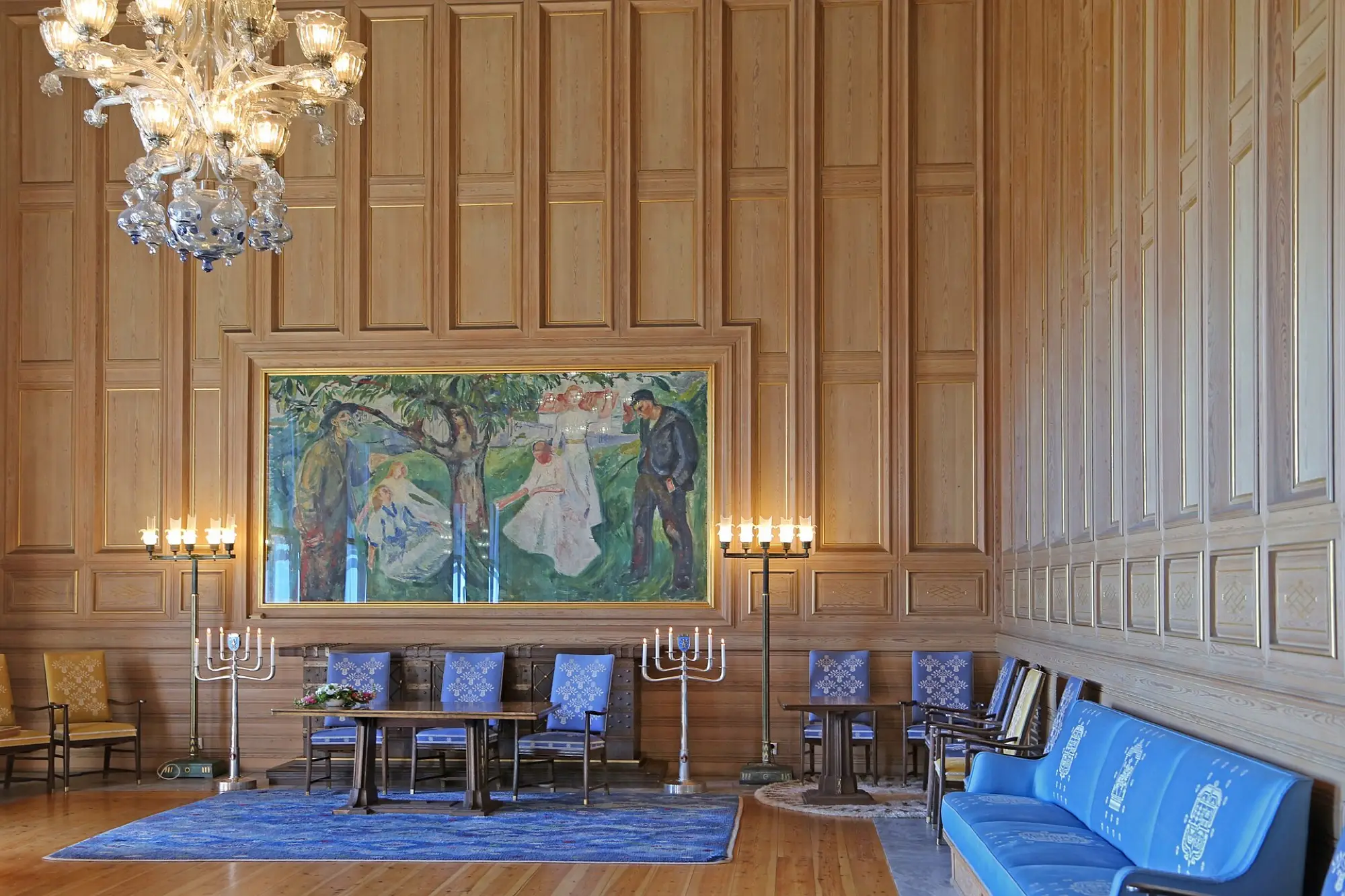
Oslo adjusts these prices every year, and points out that every municipality offers its own residents a civil wedding free of charge. Ceremonies usually take place in the Munch room, last about 10 to 15 minutes, and have room for 30 people, including the couple, children, and a photographer. The ceremony is spoken in Norwegian or English. If either partner speaks neither language, the city provides a written translation of the text or books and pays for an authorised interpreter.
After the wedding
The officiant must send a formal marriage notification to the Tax Administration within three days of the wedding. After an Oslo wedding, you leave with a certified copy of the marriage register as a temporary certificate, but your final document comes from the Tax Administration.
Registering a marriage made under Norwegian law takes about 2 weeks from the date the Tax Administration receives the officiant's notification. Once the marriage is recorded in the National Population Register (Folkeregisteret), both partners receive a confirmation, after which you can order an official marriage certificate. If your marital status is recorded incorrectly in the National Population Register after getting a permit, you must contact the Tax Administration rather than UDI.
If you married abroad
If you marry under another country's law, that country's authorities decide what paperwork you need. Norway recognises a foreign marriage only if both partners were present at the ceremony, both were at least 18, neither was already married, and you are not closely related. If you only hold a D-number, you cannot get a Norwegian certificate of no impediment for a wedding abroad; a foreign citizen residing in Norway usually obtains this document from their home country's authorities. A wedding held at a Norwegian embassy or foreign mission, or usually at a Norwegian Church Abroad (sjømannskirken), takes place under Norwegian law and follows the standard certificate process.
To register a marriage concluded under foreign law in the National Population Register, you must send the form "Declaration concerning my marriage" along with the original marriage certificate. The certificate must be an original with a physical stamp and signature, submitted by post, in English or a Nordic language (or accompanied by a certified translation). The certificate usually requires an apostille or legalisation. The Tax Administration returns original documents by registered mail. Registering a marriage made under foreign law takes up to 10 weeks, which includes the authenticity check and document return.
You must be registered with a Norwegian national identity number before your marriage can be registered. A foreign spouse with no connection to Norway does not need to send the declaration form.
Documents from a listed group of countries, among them India, Pakistan, the Philippines, Nigeria, Kenya, Vietnam and Kosovo, are rarely considered sufficient to register a marriage, even with an apostille. Exceptions can be made if UDI has already accepted the marriage in a family immigration case. UDI states that for some countries, the Tax Administration will not register the marriage until UDI has granted the family immigration application.
The residence permit to live together in Norway
Marrying someone who lives in Norway or who is a Norwegian citizen does not give you a residence permit automatically. To live together in Norway, you must apply for family immigration to Norway with your spouse.
For a spouse of a Norwegian citizen, the marriage must be validly entered into, recognisable in Norway if performed abroad, and you must plan to live together in Norway. Key immigration requirements include:
- Income: The Norwegian spouse must have an income of at least NOK 436,957 a year before tax. UDI adjusts this amount in May each year, and the income level must hold for the first year the applicant holds the permit.
- Age requirement: In some spouse cases, both of you must be at least 24 years old when the application is processed. This applies if you married after the partner in Norway (the reference person) moved to Norway or if the reference person has always lived in Norway. The age rule does not apply if you were married, had children together, or lived together for more than two years before either of you moved to Norway.
- Location of application: Even if you marry inside Norway, the main rule is that you cannot hand in the application while in Norway. You must apply from a country where you are a citizen or where you have held a valid residence permit for the past six months. If you submit an application inside Norway when you are not permitted to do so, it will be rejected and the application fee will not be refunded.
- In-country application exceptions: A citizen of a visa-free country who is staying legally in Norway can apply from within the country to join a spouse in certain cases. However, if applying to join a fiance, you must also hold skilled worker status to apply from inside Norway.
The UDI application fee for a first-time adult family immigration permit is NOK 11,900. The waiting time for spouses of Norwegian citizens is long. UDI's waiting-time guide says that from 1 September 2026 to 1 February 2027, the agency is processing applications submitted up to 1 September 2025. Applicants who applied later than 1 September 2025 will wait longer, and UDI cannot yet provide processing dates for those cases.
The fiance permit, if you want to marry after you arrive
You can apply for a residence permit to come to Norway to marry someone who lives there, commonly called a fiance permit. This permit is strictly for getting married; you cannot use it to decide whether you want to marry or to get to know a partner better. UDI stresses that you do not need this permit to marry in Norway, as any legal stay is sufficient.
To qualify for a fiance permit, both partners must be at least 24 years old, the engagement must be genuine, neither partner may be married to anyone else, and it must be likely that you will return home if the marriage does not take place. The partner living in Norway must meet the income requirement of NOK 436,957 a year before tax and must have a home.
The fiance permit is valid for at most six months. You must marry in Norway within that period and apply for a family immigration permit as a spouse at least one month before the fiance permit expires. This leaves less than five months to marry. The permit cannot be extended if you postpone the ceremony. While you can work on a fiance permit, you have no right to free language training, and the time spent on it does not count towards permanent residence or citizenship.
What the spouse permit leads to
Once granted a spouse permit, you can work in Norway and you gain the right to learn Norwegian through free Norwegian and social studies courses. You and your spouse must live together in Norway. The permit has an expiry date and must be renewed.
Time spent on a spouse permit counts towards the qualifying periods for permanent residence in Norway and Norwegian citizenship. A person who is married to and living with a Norwegian citizen can apply for citizenship after at least five years of residence in Norway during the last ten years, on residence permits valid for at least one year each. In addition, the total time living in Norway and the total time married to the Norwegian citizen while living together must add up to at least seven years. These two time periods can run at the same time.