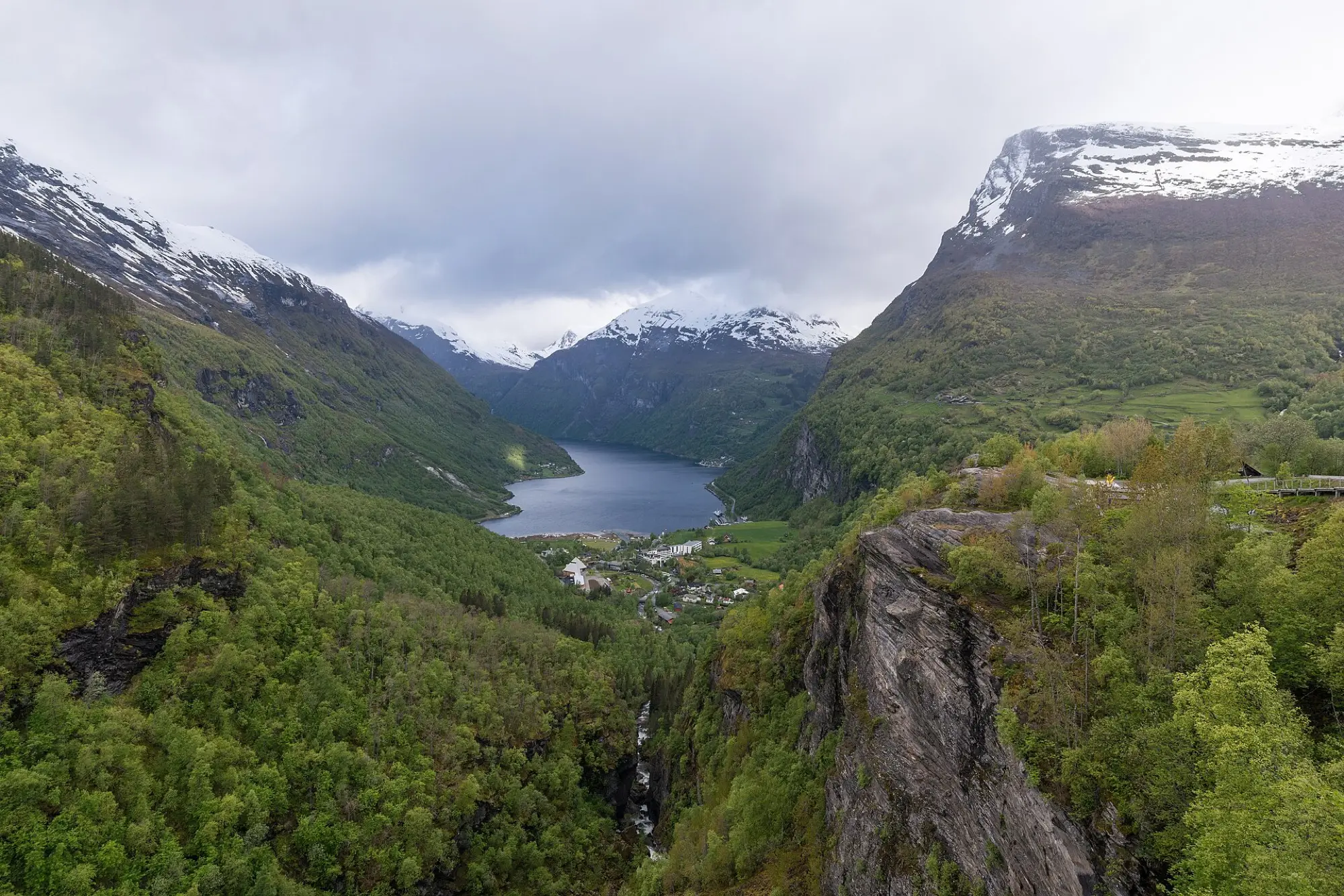

Geirangerfjord sits in Sunnmøre and is reached by road, public bus, or boat from Ålesund and Hellesylt. Planning requires checking mountain road closures, seasonal ferry timetables and visitor centre opening dates in advance.
Geirangerfjord in one answer
The Geirangerfjord is a 15-kilometre side arm of the Sunnylvsfjorden between Hellesylt and Geiranger, inscribed on the UNESCO World Heritage List in 2005 alongside the Nærøyfjord. Key sights include cruises past the Seven Sisters and the Suitor, Geiranger Skywalk on Dalsnibba, Flydalsjuvet, Ørnesvingen, the Norwegian Fjord Centre, kayaking from Homlong, the steep Skageflå hike, and walking from Vesterås to Storseterfossen.
Getting there without a car
The nearest airport is Ålesund Airport Vigra, about two and a half hours from Geiranger by car. From Skutvika at Nedre Strandgate 53 in central Ålesund, Geiranger Fjordservice runs a boat to Geiranger that takes 3 hours one way and sails past the Seven Sisters and the Suitor; the round-trip day tour takes 9 hours. You must arrive at Skutvika 15 minutes before departure. On the 2026 summer timetable, from 1 April, an adult paid NOK 2139 return or NOK 1070 one way, with children aged 5-15 paying 50%. The operator's booking page now lists one-way adult fares from NOK 1,124. The summer cruise runs from April to October. From November to March, the boat from Ålesund operates as a winter experience that includes food, guiding, a bus and entry to the fjord centre, from NOK 1,539.
Coastal ships provide direct seasonal access. From 1 April to 31 August, Havila's northbound coastal ship sails from Ålesund into Geiranger and back during its port call, leaving Ålesund at 10:00 and returning at 19:00. The Hurtigruten coastal express calls at Ålesund all year, and sails into the Geirangerfjord in spring, summer and autumn.
Public transport connects via Hellesylt and Åndalsnes:
- Buses 110 and 250 depart from Korsegata bus stop in central Ålesund to Hellesylt at the mouth of the fjord. Tickets are sold on board by debit or credit card, as well as in the Fram and Entur apps.
- From Hellesylt, Cruise Service sells one-way passenger tickets on its white catamaran Keiser Wilhelm, which docks at the quay next to the ferry pier and sails to Geiranger with stops at the waterfalls along the route.
- In the summer season, a public bus runs between Ålesund, Åndalsnes and Geiranger via Trollstigen; booking ahead is recommended.
- Fjord Tours operates a bus between Åndalsnes and Geiranger from 1 June to 30 September. It takes 3 hours 30 minutes, costs from 750 NOK, stops at Gudbrandsjuvet and the Trollstigen viewpoint, and must be booked in advance.
- By rail from Oslo or Trondheim, take the Dovre Railway (Dovrebanen) to Dombås and transfer to the Rauma Railway (Raumabanen) to Åndalsnes. Fjord1 notes that summer bus connections run to Geiranger from Bergen or Oslo via Stryn or Otta, or you can take the train to Otta or Åndalsnes and continue by bus.
- Fjord Tours sells a Geirangerfjord package starting in Oslo or Bergen from June to September from 5968 NOK, alongside a winter version from November to March from 4996 NOK.
Getting there by car
Driving times depend on seasonal mountain road passes and ferries. Statens vegvesen's route planner records the following road distances and driving times:
- Ålesund to Geiranger via the E39, Stordal and Eidsdal: 108,657 metres (about one hundred and nine kilometres), taking 118 minutes including the Linge-Eidsdal ferry.
- Oslo to Geiranger in summer via the E6 and Rv15: 446,781 metres (about four hundred and forty-seven kilometres), taking 352 minutes (just under six hours).
- Loen to Geiranger via Rv15 and Geirangervegen: 86,675 metres (about eighty-seven kilometres), taking 98 minutes.
- Lom to Geiranger via Rv15 and Geirangervegen: 96,559 metres (about ninety-seven kilometres), taking 91 minutes.
- Geiranger to Åndalsnes: 87,032 metres (about eighty-seven kilometres), taking 104 minutes including the Eidsdal-Linge ferry.
Read our guides to driving in Norway and planning a Norway road trip before setting off. Ørnevegen (the Eagle Road), which climbs from Geiranger to Eidsdal, opened in 1955 and gave the village a road connection all year. It negotiates eleven hairpin bends from the fjord to 620 metres above sea level at Korsmyra and remains open all year.
In contrast, Geirangervegen (Fv63) climbs past Flydalsjuvet towards Stryn and Dalsnibba; it closes in winter and is normally open from May to October. For Langvatnet to Geiranger, Norwegian Scenic Routes records past closing dates of 18 November and 9 January, and past opening dates of 27 April and 17 June. For Trollstigen, past closings have occurred between 5 October and 7 December, with past openings between 29 April and 12 June. After reopening, high-mountain passes may close temporarily at night and during severe weather.
The Geiranger-Trollstigen scenic route covers 104 km, reaches 1038 metres above sea level, and includes the Eidsdal-Linge ferry crossing. For road conditions, consult the Norwegian Public Roads Administration's "Vegvesen trafikk" app or telephone +47 22 175 175.
Note that Fjord1's Geiranger-Hellesylt car ferry is suspended until further notice; check our guide to car ferries in Norway for wider ferry rules. Fjord1 halted the service from Friday 4 September after Oslo District Court lifted an earlier injunction; Fjord1 is appealing and states it will provide information regarding the 2027 season later. All parking in Geiranger is paid parking.
The eight things at a glance
| Thing to do | Distance from the village | Season | Adult price |
|---|---|---|---|
| 1. Fjord cruise | in the village | check locally | NOK 641 (75 min) / NOK 695 (2 hr) |
| 2. Geiranger Skywalk Dalsnibba | 21 km | mid-May to September or October | check locally |
| 3. Flydalsjuvet | about four kilometres | May to October | check locally |
| 4. Ørnesvingen | about seven kilometres | open all year | check locally |
| 5. Norwegian Fjord Centre | in the village | check locally | NOK 160 |
| 6. Kayaking from Homlong | 5 minutes by car or a 20-minute walk | end of May to late September | from NOK 1,218 |
| 7. Skageflå hike | check locally | check locally | pick-up alone NOK 300 cash; drop-off adds NOK 50 fee |
| 8. Westerås walk to Storseterfossen | check locally | check locally | check locally |
1. A fjord cruise past the Seven Sisters and the Suitor
Geiranger Fjordservice operates two sightseeing cruises directly from behind the tourist information and ticket office in the village centre, running in all weathers. You must arrive 15 minutes prior to departure. The 75-minute cruise on a traditional boat costs NOK 641 for adults, while the two-hour cruise on a larger hybrid-electric boat costs NOK 695. Children pay 50%. A free downloadable audio guide app provides commentary in 12 languages. The two-hour cruise uses a new electric catamaran built in 2026, which the operator says is the first to meet the fjord's strict new environmental rules. Departures run multiple times daily in summer, and booking in advance is recommended from June to August as sailings sell out. For 1 April 2027, Fjord Norway lists departures for the 75-minute cruise at 10:00, 12:15 and 14:30.
According to Store norske leksikon, the Seven Sisters (De syv søstre) fall 250 metres on average by the ledge of the abandoned Knivsflå farm, which was deserted in 1898 because of rockslide risks. On the opposite bank sits the bottle-shaped Suitor (Friaren) waterfall, where legend tells that he failed to woo the sisters. Just west of the sisters, the Bridal Veil (Brudesløret) plunges 300 metres, though its spray appears only for a couple of weeks each year during peak snowmelt. Cruise Service also operates a one-hour trip and a 2.5-hour tour with a one-hour stop in Hellesylt, both including a stop to taste water from the Suitor. Fjord Norway lists Cruise Service's Geiranger-Hellesylt return trip on MS Keiser Wilhelm at NOK 550 for adults and NOK 225 for children.
2. Geiranger Skywalk on Dalsnibba: 1,500 metres up
Geiranger Skywalk sits 1,500 metres above sea level, providing what the operator calls Europe's highest fjord view from a road. The viewpoint is located 21 km from Geiranger, roughly a 30-minute drive. The journey follows county road 63 for 16 km before turning onto Nibbevegen, a toll road that climbs 438 metres across 11 hairpin bends over its 5 km length.
Geiranger Skywalk Dalsnibba is closed for the season and plans to open in mid-May 2027. It typically opens in the middle of May and operates until September or October, though snow or ice can force short-notice closures. The road opened on 15 May and closed on 24 September in 2024, and opened on 12 May and closed on 3 October in 2025. During the season, the road remains open around the clock. Tickets can be bought online in advance or at the entry barrier, where they are valid for the whole day. The barrier is staffed from 9.00 to 17.00 (extended to 18.00 between 15 June and 15 August); an automated card payment terminal handles entries outside these hours. On-site facilities including the shop, café and toilets open 09.30-17.00 from May to 14 June, 09.30-19.00 from 15 June to 15 August, and 09.30-17.00 from 16 August through September.
Temperatures at the top can be 10 to 15 degrees colder than in the village, accompanied by strong winds, and snow is often still there in June and July. Travellers without a car can take Geiranger Fjordservice's 2-hour panorama bus to both Dalsnibba and Flydalsjuvet from NOK 750.
3. Flydalsjuvet: the classic view down to the village
Flydalsjuvet is a designated rest stop on the scenic route, situated on the mountainside at the inner end of the fjord at 330 metres above sea level. Driving from Geiranger along Geirangervegen takes 8 minutes over 4,127 metres (about four kilometres). The platform features an upper and a lower viewing area linked by a walkway, and the site is partly wheelchair accessible. The viewpoint overlooks the valley, fjord, and the summits of Laushornet (1,502 metres) and Eidshornet (1,629 metres). On-site toilets open from mid-May to mid-October. Geirangervegen past Flydalsjuvet towards Stryn closes in winter. Geiranger Fjordservice offers a 1.5-hour panorama bus covering Flydalsjuvet and Ørnesvingen from NOK 580.
4. Ørnesvingen: the top of the eagle road
Ørnesvingen is the viewing platform at the top of Ørnevegen, situated 7,227 metres (about seven kilometres) from Geiranger, an ascent taking 12 minutes by car. The road climbs eleven bends up to Korsmyra at 620 metres above sea level and is open all year. The viewpoint incorporates its own waterfall and offers an unobstructed view across the fjord towards Geiranger, the Seven Sisters, and Knivsflå farm; the platform is partly wheelchair accessible. The site is a popular vantage point for observing passenger cruise liners sailing the waterway. Geiranger Fjordservice's 1.5-hour bus tour serves this viewpoint from NOK 580.
5. The Norwegian Fjord Centre and the waterfall walk
The Norwegian Fjord Centre serves as the visitor and educational hub for the West Norwegian Fjords World Heritage area. The exhibition halls house interactive displays covering local geology, ecosystems, flora and fauna, alongside a shop and café. The centre is situated 1 km from the village centre, up 327 steps and 85 metres higher. Admission costs NOK 160 for adults (16 and older) and NOK 85 for children aged 5-15; children under 5 enter free of charge. Fosseråsa, by the river and its waterfalls, was the first certified national hiking trail in Norway. A waterfall walk from the Fjord Centre takes you back down to the fjord. Visitors can walk the riverside path independently, or book Geiranger Fjordservice's guided waterfall walk accompanied by a fjord ranger from NOK 725.
6. Kayaking from Homlong
Geiranger Fjordservice's kayak base is located at Homlong on the sheltered side of the harbour, providing the shortest paddle distance across to the Seven Sisters waterfall. The base includes free parking and is reached via a 5-minute drive or a 20-minute flat walk from the village centre. The centre opens 9:00-17:00 from the end of May until late September. Guided tours require no previous experience, though independent kayak rental requires prior paddling experience; all paddlers should feel confident in water and be able to swim. Lifejackets are supplied.
Prices and age limits:
- 2.5-hour guided beginners' tour: from NOK 1,218 (minimum age 10; maximum 10 participants per guide).
- 4-hour guided Seven Sisters tour: from NOK 1,628 (minimum age 13; maximum 8 participants per guide).
- Rental is permitted from age 8 upwards, but each child must paddle a double kayak with an adult.
7. Skageflå: a farm 250 metres above the fjord
Skageflå is a historic mountain farm positioned on a rocky shelf 250 metres directly above the fjord, looking out at the Seven Sisters. In 1993, King Harald and Queen Sonja held their silver wedding anniversary celebrations at the farm. To reach the trail, the traditional excursion vessel MS Geirangerfjord drops hikers at Skagehola jetty at the conclusion of its fjord tour. You buy a drop-off and pick-up ticket; the drop-off adds a landowners' fee of NOK 50.
From Skagehola, a very steep path climbs for approximately 45 minutes to reach Skageflå. From the farm buildings, hikers can either return down to Skagehola to board the scheduled boat, or continue on a hike back to Geiranger village that takes about 4 hours, fitting among other routes in our famous hikes in Norway guide. Pre-booked ticket holders do not need reservations for the boat collection; single pick-up tickets cost NOK 300 in cash per person on board, subject to available capacity. All walking is undertaken at your own risk; wear firm hiking boots and bring warm waterproof clothing, food and drink.
8. Westerås and Storseterfossen: walk behind a waterfall
The excursion to Storseterfossen provides the opportunity to walk directly behind a torrent of falling water. The route begins from Vesterås farm at 320 metres above sea level, reached by a narrow gravel road. Public parking is available at the Norwegian Fjord Centre or along the main road at Hole; as parking at Hole is limited, riding an electric bike from the village provides an alternative approach.
The trail climbs from Vesterås up to an open mountain shelf at 540 metres elevation, taking 45-60 minutes each way. A section of the track consists of stone steps constructed by Sherpas from Nepal, finished in 2014. From the upper plateau, a railed path descends behind the curtain of the waterfall. Surface rocks can be wet and slippery, requiring care underfoot.
Cruise ships and the zero-emission rule
Since 1 January 2026, passenger ships under 10,000 gross tonnage entering the World Heritage fjords must run on energy that produces zero direct emissions of carbon dioxide or methane. Larger vessels of 10,000 gross tonnage and above must meet identical zero-emission rules starting 1 January 2032. Under Norwegian Maritime Authority regulations, ships may utilize biogas as an approved alternative fuel, and connection to shore power is compulsory wherever port facilities exist. Furthermore, all vessels of 400 gross tonnage or more, or certified for more than 15 people, are banned from discharging sewage into the World Heritage fjords.
Traffic levels have historically been high; Store norske leksikon notes that 178 cruise ships entered the Geirangerfjord in 2022. Commercial tour operators have started updating equipment: the operator states that its new 2026 electric catamaran running the two-hour cruise is the first to meet the fjord's strict new environmental rules. Shore-side hop-on hop-off buses operate only when cruise liners are moored between May and September, charging NOK 495 for adults.
The regulatory transition has caused transport disputes. On 8 May 2026, the Norwegian Maritime Authority issued Fjord1 an interim exemption allowing the ferries MF Veøy and MF Bolsøy to continue sailing. Following a complaint from a competitor, the ministry overturned the waiver. Fjord1 withdrew the Geiranger-Hellesylt car ferry from Friday 4 September after the Oslo District Court vacated the stay that had permitted operations since July. Fjord1 is appealing the verdict.
When to go, and what is shut in winter
Fjord Norway states that Geiranger is accessible throughout the year, noting that summer attracts the most tourists, whereas winter conditions provide dramatic scenery. During peak summer, vehicle volumes along the Geiranger-Trollstigen scenic route become congested, leading the route authority to recommend trips in early June or September. Review our guide to the best time to visit Norway to coordinate seasonal travel.
Winter brings substantial closures across the region:
- Geiranger Skywalk Dalsnibba is closed for the winter season, planning to reopen in mid-May 2027.
- Geirangervegen (Fv63) past Flydalsjuvet towards Stryn and Dalsnibba closes for the winter season, usually remaining open only from May to October.
- The Geiranger-Trollstigen scenic route closes every winter, reopening around mid-May until snow returns in October or November. Trollstigen's bends opened on schedule in 2026 following rockfall prevention engineering, though mountain passes close on short notice during severe weather.
- The Homlong kayak base operates from late May to late September and is closed throughout winter.
- Geiranger Fjordservice operates a winter package by boat from Ålesund between November and March (from NOK 1,539), shifting to regular cruises from April to October.
For more fjord alternatives, consult our overview of Norway's fjords without a car.