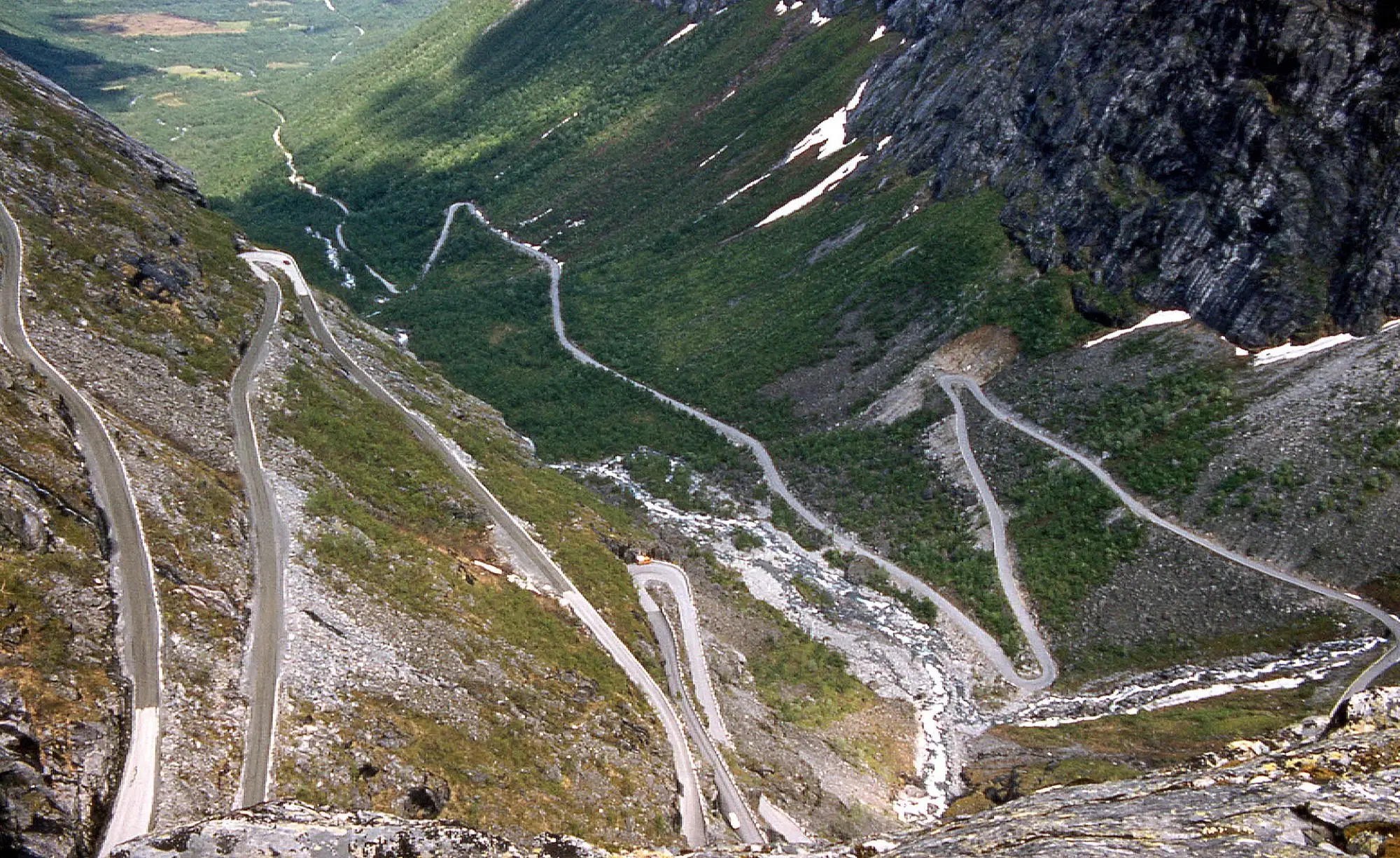

This guide gives four road routes: Oslo to Bergen over Hardangervidda and along the Hardangerfjord in 7 days; the western fjords from Bergen to Ålesund by Flåm, Loen, Geiranger and Trollstigen in 8 to 10 days; the scenic routes from Bergen to Trondheim over Aurlandsfjellet, Sognefjellet, Trollstigen and the Atlantic Road in 10 days; and Senja, Andøya and Lofoten in the north in 8 days. The mountain roads on the second and third routes close for winter.
Norway road trip in short, four routes
The Norwegian Scenic Routes (Nasjonale turistveger) are 18 selected roads through landscapes along coasts and fjords, mountains and waterfalls, meant as alternatives to the main roads. Each itinerary links several of these scenic stretches.
The first route takes 7 days, with 4 driving days and 3 days without a long drive (a Trolltunga day from Odda and two days in Bergen). The second route takes 8 days, with 5 driving days and 3 days based in Flåm, Loen and Ålesund; with 2 spare days, one in Geiranger and one at the end, it takes 10. The third route takes 10 days, with 8 driving days and 2 days without a long drive, one in Geiranger and one in Trondheim at the end. The fourth route takes 8 days, with 6 driving days and 2 days without a long drive, one on Senja and one in Reine.
Seasonal closures limit when you can drive these routes. The Geiranger-Trollstigen scenic route is always closed in winter and is normally open from mid-May to October or November, depending on when winter returns. On the E16, the Lærdal tunnel is being upgraded: from Monday 16 November 2026 the tunnel is closed every night from 18:00 to 06:00, except the night to Sunday; if you arrive too late, the next chance to drive through is 06:00 the next morning. In the north, the ferry from Gryllefjord on Senja to Andenes in Vesterålen runs only in the summer season, and the crossing takes about 1 hour and 40 minutes; check the timetable for the season's dates.
The four routes compared
| Route | Days | Driving time in planner | Ferries | When to go |
|---|---|---|---|---|
| 1. Oslo to Bergen via Hardanger | 7 | 489 minutes | Jondal to Tørvikbygd | Open all year, but winter brings convoys |
| 2. Western fjords: Bergen to Ålesund | 8 to 10 | 620 minutes | Fodnes to Mannheller, Eidsdal to Linge | Summer (Trollstigen and Langvatnet to Geiranger close in winter) |
| 3. Scenic routes: Bergen to Trondheim | 10 | 1,029 minutes | Tørvikbygd to Jondal, Utne to Kvanndal, Fodnes to Mannheller, Eidsdal to Linge, Åfarnes to Sølsnes, Halsa to Kanestraum | Summer only (passes close in winter) |
| 4. Senja, Andøya and Lofoten | 8 | 512 minutes plus ferries | Brensholmen to Botnhamn, Gryllefjord to Andenes (optional Moskenes to Bodø out) | Summer for the Gryllefjord to Andenes ferry |
Total planned road distances run to about five hundred and fifteen kilometres (513,988 metres) for route 1, about six hundred and fifty kilometres (647,736 metres) for route 2, about nine hundred and ninety kilometres (989,662 metres) for route 3, and about five hundred and five kilometres (504,057 metres) across the five road legs of route 4.
1. Oslo to Bergen via Hardanger in 7 days
Visit Bergen puts the drive from Oslo to Bergen via Gol, Geilo, Eidfjord and Voss over Hardangervidda at around seven hours, one of Norway's most popular tourist routes. The leg times listed below are the route planner's driving times; stops, ferry queues and summer traffic add to them. The Hardangervidda scenic-route page notes heavy summer traffic on the route, with both light and heavy vehicles.
- Day 1: Oslo to Geilo. Drive about two hundred and twenty kilometres along the E16 and Rv7 (191 minutes).
- Day 2: Geilo to Eidfjord. Drive about ninety-one kilometres on the Rv7 across the Hardangervidda plateau (84 minutes). This is part of the Hardangervidda scenic route, which runs 67 km on the Rv7 between Eidfjord and Haugastøl, climbs to 1250 metres above sea level, and is open all year. Vøringsfossen in Eidfjord has a free fall of 182 metres. In winter the road over the Hardangervidda plateau can close for short periods in bad weather, often runs as a convoy behind snowploughs, and Vøringsfossen is closed.
- Day 3: Eidfjord to Odda. Drive about seventy kilometres along the Rv13 (64 minutes). This leg is on part of the Hardanger scenic route, which covers 158 km in four sections and is open all year. The road along the Hardangerfjord passes Odda, close to the starting point of the Trolltunga hike.
- Day 4: Odda. Day without a long drive. At Trolltunga the summer season runs from 1 June to 30 September and the winter season from 1 October to 31 May. In the winter season Trolltunga's own site strongly recommends hiking there only with an experienced, professional guide.
- Day 5: Odda to Bergen. Drive about one hundred and thirty-five kilometres along the Fv49, Samnangervegen and E16 (150 minutes). This leg includes the Jondal to Tørvikbygd ferry operated by Fjord1, which takes about 20 minutes and costs 88 kr for a car up to 6 metres long, on part of the Hardanger scenic route. Steinsdalsfossen waterfall in Kvam, two kilometres west of Norheimsund, has a path that goes behind the waterfall.
- Day 6: Bergen. Day without a long drive in Bergen.
- Day 7: Bergen. Second day in Bergen. If you are comparing this with public transport options, see our Norway itinerary for the same trip without a car, or take the Oslo to Bergen train for the return journey.
2. The western fjords from Bergen to Ålesund in 8 to 10 days
This route covers the western fjord landscape. To learn more about the fjords along the route, read about the best fjords in Norway.
- Day 1: Bergen to Flåm. Drive about one hundred and sixty-five kilometres on the E16 (144 minutes).
- Day 2: Flåm. Base day in Flåm. The Nærøyfjord and the Geirangerfjord were inscribed together on UNESCO's World Heritage List in 2005 as the West Norwegian Fjords. The Nærøyfjord cruise from Flåm sails the Aurlandsfjord, then the narrow Nærøyfjord to Gudvangen, and takes around two hours one way. The Nærøyfjord is only 250 metres wide in places. Above the fjord, the Stegastein viewpoint near Flåm is at an altitude of 650 metres, with views across the Aurlandsfjord; the stretch from Aurlandsvangen up to the Stegastein viewpoint is open all year.
- Day 3: Flåm to Loen. Drive about two hundred kilometres via the E16, Rv5 and Fjordvegen (185 minutes), including the Fodnes to Mannheller ferry. This leg uses the 24.5 km Lærdal tunnel (Lærdalstunnelen), which opened in November 2000, is the world's longest road tunnel, and is now being upgraded. From Monday 16 November 2026 the Lærdal tunnel on the E16 is closed every night from 18:00 to 06:00, except the night to Sunday; if you arrive too late, the next chance to drive through is 06:00 the next morning. In the daytime the tunnel stays open but is narrowed to one lane on short stretches with traffic lights, and the trip through can take up to 15 minutes longer.
- Day 4: Loen. Base day in Loen. Loen Skylift is one of the steepest cable cars in the world and lifts you about a thousand metres, almost straight up, to the restaurant on the edge of Mount Hoven.
- Day 5: Loen to Geiranger. Drive about eighty-seven kilometres via the Rv15 and Geirangervegen (98 minutes), on part of the Geiranger-Trollstigen scenic route. In summer, Gamle Strynefjellsvegen, the old road between Grotli and Videsæter and a historic alternative to the main road across Strynefjellet, can replace part of the Rv15; it is a 27 km scenic route, partly gravel, built by hand at the end of the 19th century. Fjord1's Geiranger to Hellesylt ferry, which normally sails from April to October, is suspended until further notice, and Fjord1 says it will give information about the 2027 season later, so this route reaches Geiranger by road. In Geiranger itself, sightseeing cruises on the fjord last either 75 minutes or two hours; they leave several times a day in summer, and the operator recommends booking ahead in the high season from June to August, when some departures sell out.
- Day 6: Geiranger to Åndalsnes. Drive about eighty-seven kilometres along road 63 (104 minutes), including Fjord1's Eidsdal to Linge ferry, on part of the Geiranger-Trollstigen scenic route. The route climbs to 1038 metres, passes the view from Ørnesvingen down to the Geirangerfjord, and descends through the eleven hairpin bends of Trollstigen. Fjord1's Eidsdal-Linge crossing takes about 13 minutes, and a car up to 6 metres long pays 81 kr. Fjord Norway advises starting early in the morning or late in the afternoon for a quieter trip over Trollstigen. The road is narrow and winding, and drivers of large campervans or caravans should plan for meeting oncoming traffic.
- Day 7: Åndalsnes to Ålesund. Drive about one hundred and ten kilometres along the E136 and E39 (89 minutes).
- Day 8: Ålesund. Base day in Ålesund. From Ålesund you can explore the Art Nouveau town itself, the World Heritage Geirangerfjord, the Runde bird cliff and the Geiranger-Trollstigen scenic route. With 2 spare days, one in Geiranger and one at the end, the route takes 10 days.
3. The scenic routes from Bergen to Trondheim in 10 days
- Day 1: Bergen to Utne. Drive about one hundred and thirty kilometres via Norheimsund (159 minutes), including the Tørvikbygd-Jondal ferry, on part of the Hardanger scenic route.
- Day 2: Utne to Flåm. Drive about one hundred and five kilometres by Rv13 and E16 (110 minutes), including the Utne-Kvanndal ferry, on part of the Hardanger scenic route.
- Day 3: Flåm to Sogndal. In summer, drive over Aurlandsfjellet by the Stegastein viewpoint. This leg covers about eighty-six kilometres (93 minutes), including the Fodnes-Mannheller ferry, on part of the Aurlandsfjellet scenic route. The Aurlandsfjellet scenic route runs 47 km between Lærdalsøyri and Aurlandsvangen and climbs to 1308 metres. When Aurlandsfjellet is closed in winter, the alternative is the E16 through the Lærdal tunnel, with the night closures from 18:00 to 06:00 described in route 2.
- Day 4: Sogndal to Lom. Drive about one hundred and thirty-five kilometres (136 minutes) on part of the Sognefjellet scenic route. The Sognefjellet scenic route runs 108 km on road 55 between Lom and Gaupne; its summit at 1434 metres above sea level makes it the highest mountain pass in Northern Europe.
- Day 5: Lom to Geiranger. Drive about ninety-seven kilometres by Rv15 and Geirangervegen (91 minutes), on part of the Geiranger-Trollstigen scenic route down from Langvatnet.
- Day 6: Geiranger. Day without a long drive in Geiranger.
- Day 7: Geiranger to Åndalsnes. Drive about eighty-seven kilometres (104 minutes), including the Eidsdal-Linge ferry, on part of the Geiranger-Trollstigen scenic route across Trollstigen.
- Day 8: Åndalsnes to Kristiansund. Drive about one hundred and fifty-five kilometres via Bud and the Atlantic Road (157 minutes), including the Åfarnes-Sølsnes ferry, on part of the Atlanterhavsvegen scenic route. Fjord1's Åfarnes-Sølsnes crossing takes about 15 minutes, and a car up to 6 metres long pays 88 kr. The Atlantic Road (Atlanterhavsvegen) curves from islet to islet over seven bridges along the open Hustadvika bay, and the scenic route runs 36 km from Kårvåg to Bud.
- Day 9: Kristiansund to Trondheim. From Kristiansund a boat takes about an hour to the islands of Grip, 14 km northwest of the town. The drive to Trondheim by the E39 covers about one hundred and ninety-five kilometres (179 minutes), including the Kanestraum-Halsa ferry. Fjord1's Halsa-Kanestraum crossing takes about 20 minutes, and a car up to 6 metres long pays 81 kr.
- Day 10: Trondheim. Day without a long drive in Trondheim at the end.
4. Senja, Andøya and Lofoten in 8 days
This northern route connects three archipelagos. To review all the travel options for getting from Tromsø to Lofoten, note that the ferry from Brensholmen on Kvaløya to Botnhamn on Senja runs all year, but the ferry from Gryllefjord to Andenes runs only in the summer season; consult our Lofoten guide for reaching Lofoten another way outside summer.
- Day 1: Tromsø to Gryllefjord. Drive about one hundred and forty-five kilometres (196 minutes), including the Brensholmen-Botnhamn ferry, on part of the Senja scenic route. The ferry from Brensholmen on Kvaløya to Botnhamn on Senja runs all year, the crossing takes about 35 minutes, and you cannot reserve a place. The Senja scenic route runs 102 km along the west coast between Botnhamn and Gryllefjord, with detours to Husøy and Mefjordvær. Tungeneset, looking out to the Okshornan cliffs, is the most photographed spot on Senja.
- Day 2: Senja. Day without a long drive on Senja.
- Day 3: Gryllefjord to Sortland. Take the summer ferry from Gryllefjord on Senja to Andenes in Vesterålen (about 1 hour and 40 minutes; you cannot reserve a place). Drive about one hundred kilometres by Fv82, Buksnesveien and Reinsnesveien (92 minutes), on part of the Andøya scenic route. The Andøya scenic route runs 58 km along the outer edge of Andøya between Andenes and Bjørnskinn; on Andøya you can walk on the Bleikstrand beach, and the bird rock on the island of Bleiksøya is worth seeing. At Børvågen, by Andøya Spaceport, the road can be closed for up to 8 hours during operations.
- Day 4: Sortland to Svolvær. Drive about one hundred and fifteen kilometres by Rv85 and E10 (91 minutes), on part of the Lofoten scenic route. The Lofoten scenic route is 230 km, from Raftsundet to Å on the E10, with detours to Henningsvær, Eggum, Unstad, Uttakleiv, Vikten, Nusfjord and Grunnfør; you can avoid ferries by driving the E10.
- Day 5: Svolvær to Leknes. Drive about eighty-six kilometres via Henningsvær (83 minutes), on part of the Lofoten scenic route.
- Day 6: Leknes to Reine. Drive about fifty-seven kilometres by the E10 (50 minutes), on part of the Lofoten scenic route. Most of the Lofoten islands are joined by bridges and tunnels, and it is 163 km on the E10 from Fiskebøl to Å; driving within Lofoten needs no car ferry between Moskenes in the south and Fiskebøl in the north.
- Day 7: Reine. Day without a long drive in Reine.
- Day 8: Departure. Two ways out exist from Reine. You can drive about two hundred and ninety-five kilometres on the E10 back to Evenes airport (253 minutes; the drive from Evenes airport to Svolvær takes around two and a half hours, longer during conditions described in our guide to Lofoten in winter). Alternatively, take the ferry from Moskenes to Bodø. The direct crossing between Moskenes and Bodø takes about 3.5 hours and you can bring a vehicle or travel on foot. On Torghatten's Bodø-Moskenes route the full fare for a petrol, diesel or hybrid vehicle up to 6 metres is NOK 605. Booking ahead is not mandatory on the Bodø-Moskenes route; reserved journeys are paid when booked on Torghatten's website, and reserving a spot costs extra on top of the ticket, NOK 130 for a vehicle up to 6 metres. The route is very busy in peak season, and travellers to Røst and Værøy are given priority.
When the mountain roads are open
Even after a mountain road opens for the season, it may be closed for periods at night and in bad weather.
On the Geiranger-Trollstigen scenic route, the road is always closed in winter and is normally open from mid-May to October or November, depending on when winter returns. The hairpin bends on Trollstigen opened as normal in 2026 after maintenance and rockfall protection work, and the road can close at short notice because of bad weather or maintenance. For Trollstigen the scenic-route page gives past closing dates of 5 October and 7 December and past opening dates of 29 April and 12 June; for Langvatnet to Geiranger, past closing dates of 18 November and 9 January and past opening dates of 27 April and 17 June.
Aurlandsfjellet is closed over the mountain in winter, with past closing dates of 7 October and 6 November and past opening dates of 7 May and 3 June. Sognefjellet is closed in winter between Rustasætre/Vegaskjelet and Turtagrø; past closures fell between 17 November and 17 December and past openings between 12 April and 1 May, and in 2026 it opened on 2 April. Gamle Strynefjellsvegen is closed in winter, with past closing dates of 15 September and 11 October and past opening dates of 15 May and 29 June.
The Rv7 across the Hardangervidda plateau is open all year, but in winter it can close for short periods in bad weather, often runs as a convoy behind snowploughs, and Vøringsfossen is closed. The plateau road may occasionally also be closed in winter to let the reindeer graze in peace. When the Hardangervidda road is closed by bad weather in winter, the Lærdal tunnel is to be kept open. Visit Bergen does not recommend driving Oslo to Bergen in winter; roads close often, some stretches can only be driven in convoy behind an escort vehicle, and it suggests the train instead.
Ferries on the way, what they cost and how you pay
All ferries in Vestland follow the AutoPASS rules; you pay only for the vehicle and the driver, passengers travel free, and the registration number or AutoPASS tag is read when you board. An AutoPASS-approved toll tag in the vehicle gives an automatic 10% discount. The ferry price is set by the length of your vehicle, including any load. Kinsarvik-Utne is one of the ferry routes in Vestland that are free of charge. For more details on tags and crossings, see our guide to car ferries in Norway.
Fjord1's fares for a car up to 6 metres long include:
- Jondal to Tørvikbygd: 88 kr (takes about 20 minutes)
- Eidsdal to Linge: 81 kr (takes about 13 minutes)
- Åfarnes to Sølsnes: 88 kr (takes about 15 minutes)
- Halsa to Kanestraum: 81 kr (takes about 20 minutes)
Fjord1's Geiranger to Hellesylt ferry, which normally sails from April to October, is suspended until further notice; Fjord1 says it will give information about the 2027 season later. In the north, the full fare on Torghatten's Bodø-Moskenes route for a petrol, diesel or hybrid vehicle up to 6 metres is NOK 605, booking ahead is not mandatory, and reserving a spot costs an extra NOK 130 on top of the ticket. You cannot reserve a place on the Brensholmen-Botnhamn or Gryllefjord-Andenes ferries.
Driving rules, fuel and charging
Statens vegvesen says to check road and traffic information and the weather forecast before you set off. Winter tyres should have a tread depth of at least 3 mm. Fill up with fuel or make sure you have enough charge, especially before a mountain pass. Visit Bergen says to fill up or charge fully before crossing the mountain passes, because there are no petrol or charging stations on the mountain. In a convoy, cars drive together behind a lead vehicle, often because of bad weather on mountain passes; there is always an escort vehicle at the front, and you must not overtake or turn around. Road and traffic information is available by phone on +47 815 48 991. To report a dangerous traffic situation, call the Traffic Control Centre on +47 22 175 175. For full regulations and toll systems, see our guide to driving in Norway.