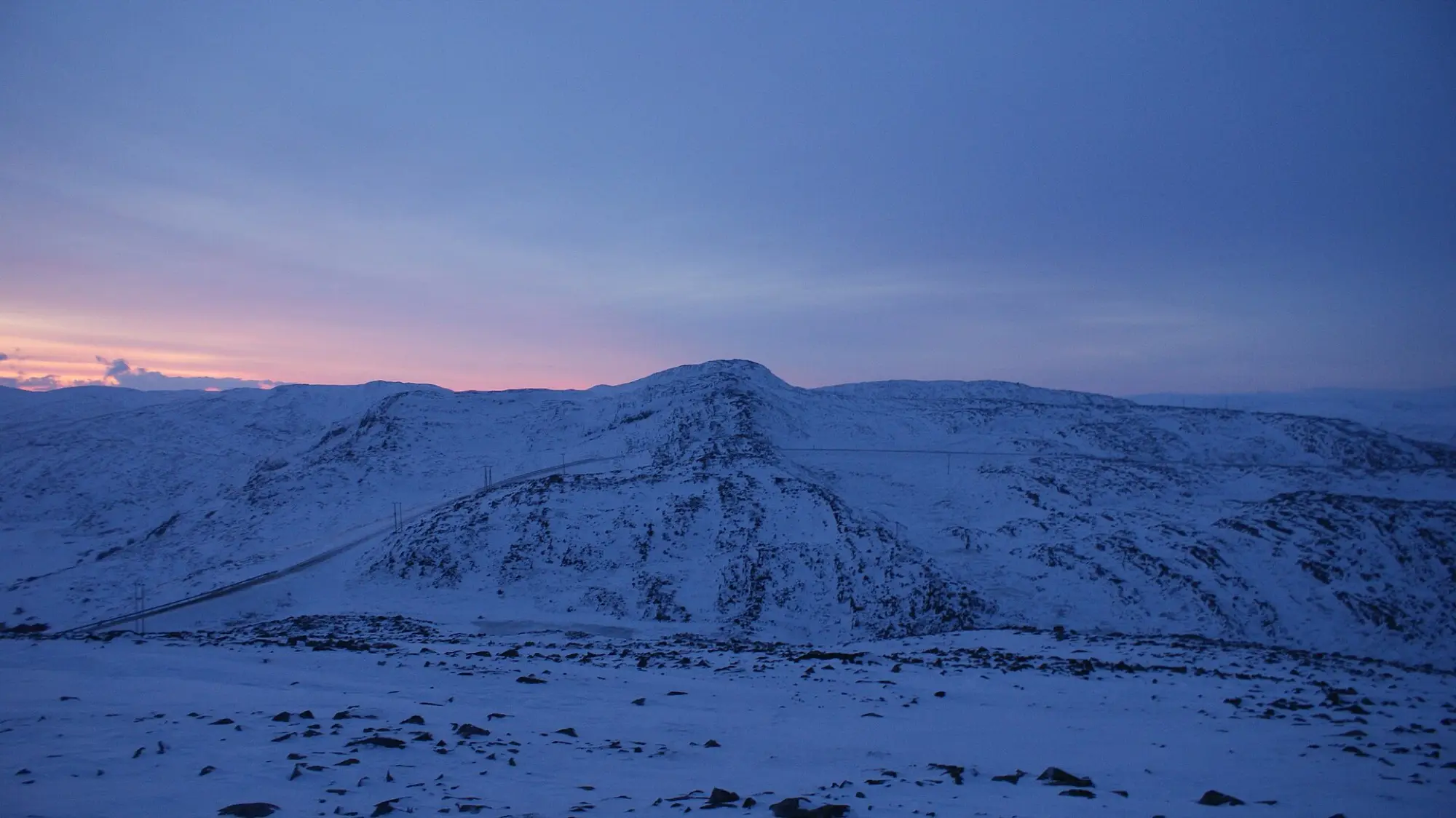

In December the south keeps a short day, with Oslo seeing 5h 52m of daylight on 21 December, while the north from Tromsø upwards experiences polar night. Bergen's coast is mild and wet, Oslo and Tromsø sit a little below freezing on the normals, and Svalbard is far colder. Coastal express ships and the Flåm Railway operate all month, but most shops close on 25 and 26 December.
How much daylight December has, from Oslo to Tromsø
Around the winter solstice the days in southern Norway are simply short; there is no polar night in Oslo or Bergen. From Bodø southwards, the sun does appear even in deepest midwinter, lighting the landscape briefly around midday.
Computed on this site, daylight and darkness on the winter solstice, 21 December, vary considerably depending on latitude:
- In Oslo, the sun rises at 09:18 and sets at 15:11, giving 5h 52m of daylight. The sky is fully dark (dark enough for the aurora) for 12h 36m. See Oslo daylight across the year for monthly comparisons.
- In Bergen, sunrise is at 09:45 and sunset is at 15:29, yielding 5h 44m of daylight and 12h 36m of full darkness. Check Bergen daylight figures for other seasons.
- In Tromsø, the sun does not rise at all. The sky is astronomically dark for 13h 32m, while the middle of the day brings roughly four hours of blue civil twilight. More details are available on Tromsø daylight and polar night.
Polar night in Tromsø, Lofoten, the North Cape and Svalbard
Computed on this site, Tromsø's polar night lasts 48 days, beginning with the first day without a sunrise on 27 November and ending on 13 January. The sun climbs above the horizon again from mid-January, but the surrounding mountains mean it is usually not seen from the town centre until later in the month.
In Lofoten the polar night, which locals call mørketiden, lasts from around 7 December to 5 January, during which the sun does not rise above the horizon. At the North Cape, Visit Nordkapp notes that the polar night period runs from late November to January, when darkness prevails for most of the day. Further north in Svalbard, the sun disappears completely for almost four months in Longyearbyen, from late October to mid-February, and it is fully dark even at midday for several weeks around Christmas.
Even when the sun stays below the horizon, northern Norway is not completely blacked out, and Lofoten is not pitch black. On clear days, sunset colours appear in the south while the sky to the north turns deep blue. Around 1-2 in the afternoon, the remaining light reflects off the sea and the snow during the "blue hour", turning the landscape deep blue. Outdoor activities continue during these dark months; even small resorts in northern Norway operate floodlit ski slopes, and local operators run dog-sledding and snowmobile outings with head torches.
December weather in Oslo, Bergen, Tromsø and the far north
Met Norway station normals provided on yr show the following baseline conditions:
| Weather station | Normal December mean temperature | Normal December precipitation |
|---|---|---|
| Oslo (Blindern) | -1.4 °C | 54 mm |
| Bergen (Florida) | 3.1 °C | 290 mm |
| Tromsø (Vervarslinga) | -1.7 °C | 110 mm |
| Svolvær airport (Lofoten) | 1.5 °C | no normal on yr |
| Honningsvåg airport (North Cape) | -0.8 °C | no normal on yr |
| Svalbard airport | -9.2 °C | 25 mm |
Visit Bergen notes that winter in Bergen hovers around zero, often bringing snow to the seven mountains around the city while the city centre is usually too mild for snow to settle. More on western Norway's winter conditions can be found in our guide to Bergen in December.
For northern areas, Visit Tromsø advises anyone doing Arctic activities or chasing the aurora to prepare for temperatures between -25 °C and 5 °C, and to dress in layers so garments can be added or removed. Paths and streets can be slippery in winter, including in towns; wearing ice grips or spikes helps prevent falls.
Northern lights in December
Northern Norway sits under the auroral oval, the zone with the highest northern lights activity. From mid-September to the first days of April, darkness falls across the region by about 6-7pm or earlier, meaning the hours of peak aurora activity all take place in the dark.
Around Tromsø, the lights can appear at any time during the night, though they are often most active between roughly 20:00 and 02:00. Organised northern lights tours from Tromsø generally run from September to early April. Guides monitor the weather, cloud cover and aurora data before choosing a route, as cloud is the usual obstacle. Computed on this site, Tromsø is dark enough for the aurora from 16:56 to 06:26 (13h 30m) on 15 December, while Lofoten is dark enough from 17:18 to 06:38 (13h 20m) on the same date. See our Tromsø northern lights tonight page or check Lofoten northern lights for daily viewing details.
At the North Cape, polar night darkness means the lights can sometimes be seen from early afternoon. Svalbard is more or less the only accessible place on the planet where you can see the rare daytime aurora during the polar night alongside normal night-time displays, with local details on Svalbard northern lights. Because of polar bears, Visit Svalbard strongly recommends joining an organised group when going out to look for the lights.
For coastal voyages, Hurtigruten offers a Northern Lights Promise on new bookings of 11 days or more along the Norwegian coast between 20 September and 31 March; if no aurora is officially sighted during the sailing, they provide a free 6- or 7-day Coastal Express voyage. More advice on locations is in our guide to the northern lights in Norway.
What runs in December - coastal ships, the Flåm Railway and Norway in a Nutshell
Hurtigruten's Coastal Express ships call at 34 ports between Bergen and Kirkenes all year round, carrying cargo and local passengers alongside travellers; the full round trip takes 12 days. Both Hurtigruten and Havila sail the Bergen–Kirkenes route year-round and call at Tromsø twice per day.
The self-guided Norway in a Nutshell itinerary, which links the Bergen Railway, the Flåm Railway and a Nærøyfjord cruise, operates year-round. Fjord Tours offers 2-day winter packages to Flåm timed for winter daylight between November and March, priced from 5626 NOK one way from Oslo or 4983 NOK for a round trip from Bergen.
The Flåm Railway runs all year. In winter, the steep line is demanding to run, but the entire route is likely to be under snow, the waterfall frozen, and the carriage ride calmer and quieter than during peak summer.
In the north, daily flights connect Tromsø and Oslo with Svalbard. Around Tromsø, whale watching tours usually operate from early November to the end of January (varying year to year), and dog sledding on snow is typically available from November to April, depending on snow conditions. Learn more about regional travel in our overview of Tromsø in winter.
Christmas markets and the Nobel Peace Prize in December
The main city markets:
- Oslo: Jul i Vinterland, located at Spikersuppa in central Oslo, runs from 7 November 2026 to 3 January 2027. It is closed on Christmas Eve. Our guide to Oslo in December 2026 covers the capital's timetable.
- Bergen: The Bergen Christmas Market on Festplassen opens from 20 November to 22 December 2026. Pepperkakebyen, the city's gingerbread town, runs from 14 November 2026 to 10 January 2027.
- Trondheim: The Christmas market on Torvet (the city square) runs from 3 to 21 December 2026, open every day from 11 to 19.
In Oslo, the Nobel Peace Prize is awarded on 10 December, the date Alfred Nobel died, continuing a tradition established in 1901. The formal ceremony takes place inside Oslo City Hall, followed by the Nobel banquet at the Grand Hotel in central Oslo that evening.
How Norway celebrates Christmas, briefly
In Norway the main festive celebration takes place on Christmas Eve, 24 December. Families gather for a big meal and open presents together after dinner.
In Bergen, Christmas dinner is usually mutton ribs (pinnekjøtt), fish, or pork ribs, served with sauerkraut, swede, gravy and boiled potatoes. Read about Christmas traditions in Norway for the traditions in full.
What closes on 24, 25 and 26 December
Under Norway's Public Holidays Act, Christmas Day (25 December) and Boxing Day (26 December) are public holidays. The statute requires standard shops to stay closed on public holidays and mandates early closing on Christmas Eve. Small shops selling mainly groceries or convenience goods with a sales floor of no more than 100 square metres are exempt, as are petrol stations with a sales floor of up to 150 square metres. Shops may also open on the last three Sundays before Christmas Eve, but only for limited hours specified by law.
- Oslo: VisitOSLO states that general shops close at 16:00 on 24 December and remain shut on 25 and 26 December. Open sights on Christmas Eve are few, including Munch (10-14), the Fram Museum (10-17), and the Vigeland sculpture park (open 24/7).
- Bergen: Shops close by 13:00 on Christmas Eve, Thursday 24 December, and remain closed on Christmas Day and Boxing Day, though exceptions may occur.
- Tromsø: Shops shut early on Christmas Eve and stay closed on 25 and 26 December. While general shopping, dining and nightlife are more limited over the Christmas period, a wide range of activities and accommodation providers remain available.
Driving in December - winter tyres, convoys and closed roads
Winter conditions mean Norwegian roads are colder, wetter, darker and more slippery, with significantly longer vehicle braking distances on icy stretches. Statens vegvesen advises drivers to check weather forecasts and traffic updates before every trip. If using a hire car, get to know the controls before departing onto winter roads.
Tyre rules are legally enforced based on geography and dates:
- Tyre tread depth: A minimum tread depth of 3 mm is mandatory from 1 November to the first Sunday after Easter Monday. In Nordland, Troms and Finnmark, the 3 mm minimum applies from 16 October to 30 April.
- Studded tyres: Permitted from 1 November to the first Sunday after Easter Monday elsewhere in Norway, and from 16 October to 30 April in Nordland, Troms and Finnmark.
- Summer tyres: Summer tyres cannot be used on winter roads, as they cannot grip ice and snow. When driving conditions demand it, vehicles must use winter tyres, chains or equivalent equipment, even outside the standard seasonal dates.
For longer journeys, pack a shovel, extra warm clothing, food, a reflective vest, and a warning triangle. Drivers should charge electric vehicles or fill petrol tanks fully before tackling any mountain pass.
During severe weather, some mountain passes are driven in convoy behind a designated lead vehicle. When participating in a convoy, never overtake, never turn around, and do not leave the vehicle if the line comes to a halt. On the E69, the final section from the Skarsvåg junction to the North Cape operates under fixed convoy times; from 1 January to 15 April there is no independent driving permitted on this stretch, only fixed convoys, unless bad weather shuts the road entirely. Some scenic mountain roads close for the whole winter: the Geiranger-Trollstigen mountain road is always closed in winter and normally reopens from mid-May.
To report a hazardous traffic situation, call the traffic control centre on +47 22 175 175. For emergencies, dial 112 for police, 113 for ambulance, and 110 for fire.