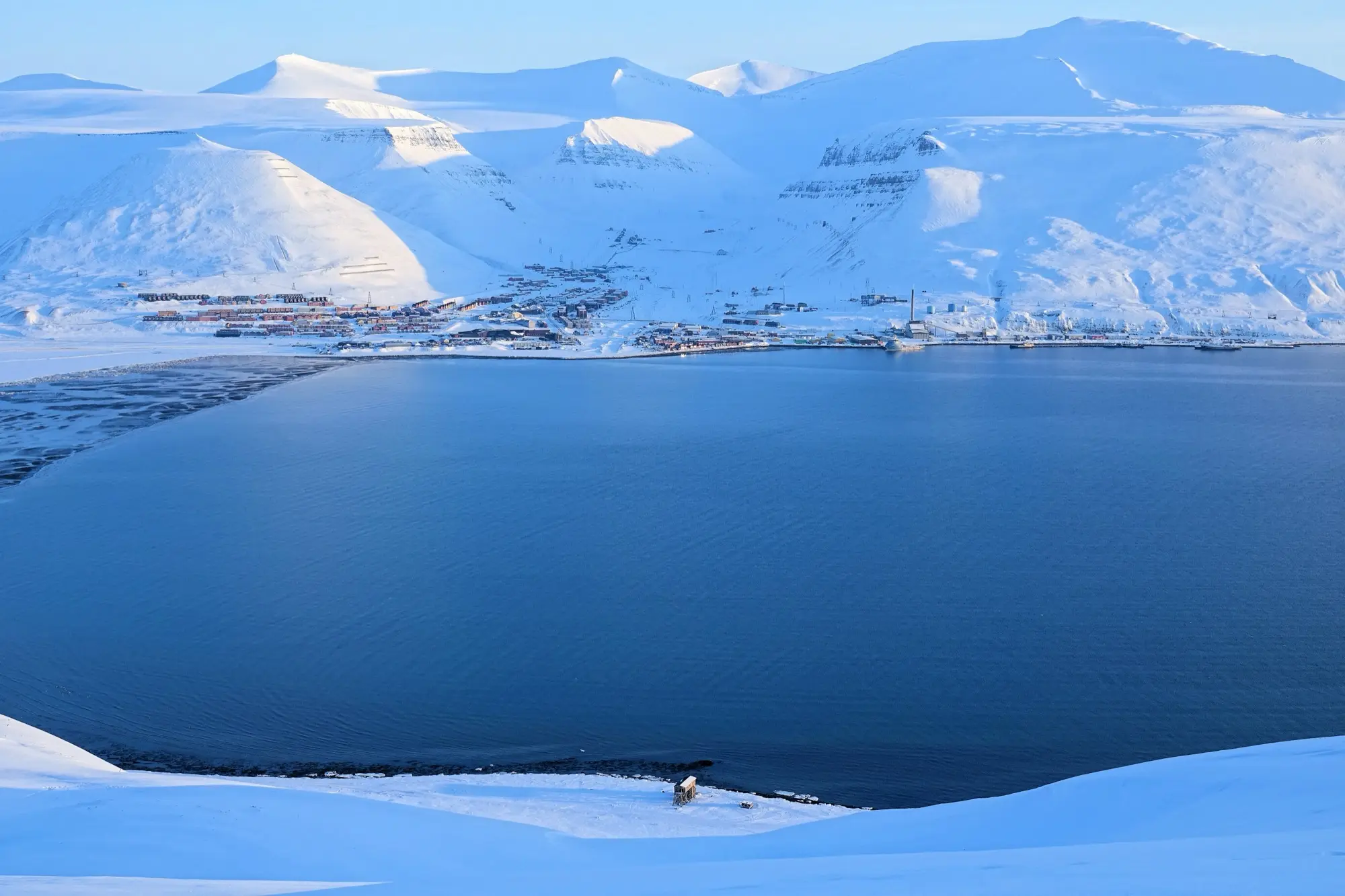

Longyearbyen is your base on Svalbard. Inside the town limits you can walk on your own, but anyone who goes outside the settlements must carry a means of scaring off polar bears, and Visit Svalbard says not to leave them without a professional local guide. Svalbard needs no visa of its own, but a visitor who needs a Schengen visa needs one, with two entries, to travel through mainland Norway.
1. Svalbard Museum: the place to start, open every day in Longyearbyen
Svalbard Museum is the cultural and natural history museum of Svalbard, located in Longyearbyen. It provides context on the archipelago's mining past, trappers, and Arctic wildlife before you head into the field.
The museum is open every day from 10 am to 5 pm. Over Christmas 2026 it is closed from 24 to 26 December and from 31 December to 2 January, and open 10 am to 4 pm from 27 to 30 December. Admission is NOK 160 for adults, NOK 110 for students, NOK 60 for locals, and free (NOK 0) for children. A guided tour runs Monday to Friday from 10.30 to 11.30 am and costs NOK 400 including admission.
Longyearbyen also has the North Pole Expedition Museum, formerly the Spitsbergen Airship Museum, which covers the three historic polar airships America, Norge, and Italia.
2. The town circuit: Longyearbyen on foot, inside the polar bear signs
Longyearbyen, the administrative centre of Svalbard, has 2,400 residents from almost 53 countries. Virtually everything inside the town limits is within a 20 to 30 minute walk, all year round, and the only ordinary public transport is the airport shuttle. The zone in Longyearbyen where no polar bear protection is needed is marked in red on a map you can get free at the tourist information office.
If you stay within the Longyearbyen town limits and do not pass the polar bear warning signs, you can walk on your own without polar bear protection. The warning signs stand on the roads out of town: by the port in the west, Svalbard Villmarkssenter in the east, in Nybyen, and by Huset to the south.
The town circuit is about 8 km long, passes some of Longyearbyen's best-known buildings, and has sign stations explaining the sights and heritage sites along the way. The old cableway central station is within walking distance of the centre, and the elevated reservoir to the east gives a view of the Adventdalen valley. Svalbard reindeer (Svalbardrein, the native small subspecies) are a common sight between the houses and along the streets; keep your distance from wild animals.
3. Global Seed Vault: the entrance only, because the vault is closed to visitors
Only authorised personnel have access to the Svalbard Global Seed Vault. The vault is not open to visitors, but organised guided tours stop outside it so you can see the entrance. Dyveke Sanne, a Norwegian artist, decorated the entrance portal with an illuminated art installation, which is where many visitors go to take photos.
The seed storage area is more than 100 metres inside the mountain, where seeds are kept at minus 18 °C. Instead of physical access, the facility offers everyone a virtual tour of the inside.
4. Snowmobile trips: the way most of Svalbard travels in winter
Visit Svalbard says everyone in Svalbard drives snowmobiles when the landscape is under snow. Motor traffic regulations limit where snowmobiles may be driven, drawing the line differently for permanent residents and for visitors. Since 2025, motorised traffic on the sea ice of selected fjords is banned after 1 March.
To drive a snowmobile you must hold a valid driving licence; a category B car licence is accepted. Drivers must carry the licence on organised tours too, while passengers need none.
Shorter trips suit first-timers. Longer full-day guided trips go to the east coast, past icebergs, old trappers' huts, and glacier fronts, and multi-day safaris are offered too. In the polar night you can chase the northern lights by snowmobile, and later in the season drive across the snow-covered plateau. When budgeting your activities, see our guide on is Norway expensive.
5. Dog sledding: huskies in winter, wheeled sleds in summer
Longyearbyen is home to around 1,000 polar dogs. In winter the dogs pull sleds over the snow; in summer they pull specially made wheeled sleds. Two people generally share each sled and swap the driving midway, accompanied by experienced guides.
Trips run as half days or full days, can include an ice cave or a cabin, and there are multi-day expeditions available.
6. Glacier ice caves: by sled, snowmobile or snowcat
Meltwater has carved passages into Svalbard's glaciers, and some of these ice caves can be visited safely on guided outings. You go in equipped with a headlamp, crampons, and a helmet.
You can reach the caves by dog sled, with the huskies waiting outside, by snowmobile directly to the entrance, or inside a tracked snowcat. An ice cave is within reach on a short snowmobile trip outside Longyearbyen.
7. Boat trips: glaciers, bird cliffs and walrus, until late autumn
Boat trips leave the quay in Longyearbyen from early spring until late November or early December. As November ends, sea conditions change and standard boat departures stop for the winter.
Options range from a short RIB (rigid inflatable boat) trip to the bird cliffs to an extended glacier safari. Visit Svalbard recommends a walrus and whale safari in the polar summer. In autumn, once the midnight sun season has ended, evening boat trips may show the northern lights.
For remote settlements, Isfjord Ekspressen sails daily both ways between Longyearbyen and Isfjord Radio from June to mid-September. Visitors can normally reach Ny-Ålesund only on summer day trips by boat.
8. Barentsburg and Pyramiden: seen from a distance, not visited
Visit Svalbard has removed from its platforms every tour or offer with any connection to the Russian state-owned companies in Svalbard, because of Russia's invasion of Ukraine. Instead, several local providers run guided tours on which you can see Barentsburg and Pyramiden from a distance.
Barentsburg, on Grønfjorden, lies 60 km west of Longyearbyen and is run by the Russian state-owned company Trust Arktikugol. Snowmobile trips west from Longyearbyen pass Barentsburg. Trust Arktikugol closed mining at Pyramiden in April 1998. Most of Pyramiden's buildings still stand as the residents left them, with a bust of Lenin in the centre looking towards the Nordenskiöldbreen glacier. Boat trips to Billefjorden and the Nordenskiöldbreen glacier pass Pyramiden. From around March and through the winter and spring, sea ice can prevent trips around Barentsburg and Pyramiden.
9. Mine 3: a guided walk into a coal mine just outside town
In Longyearbyen you can join a guided visit to Mine 3 (Gruve 3), located just outside town. The machines and equipment are still there from when the mine closed in 1996. The working height was no more than 60 to 90 cm, so the coal had to be dug out by old-fashioned methods.
10. Northern lights in the polar night: even at midday, with luck
At 78.2°N, Svalbard has polar night around the winter solstice, and a quiet geomagnetic night is often enough there to see the northern lights. Svalbard lies slightly north of the main auroral oval, so its aurora is often weaker and more diffuse than further south, such as around Tromsø. For mainland conditions, read our guide to the northern lights in Norway.
According to the calculated dark-hours figures on our Svalbard northern lights page, the sky is dark enough for the aurora in the 2026–27 season from between 1 and 15 October until between 1 and 15 March:
- 15 October: dark enough from 22:14 to 03:16 (5 hours 02 minutes).
- 1 December: dark enough from 16:40 to 06:58 (14 hours 18 minutes).
- 15 December: dark enough from 16:16 to 07:32 (15 hours 16 minutes).
- 1 March: the dark window shrinks to 22:28 to 01:50 (3 hours 22 minutes).
- 15 March: not dark enough for the aurora.
In the polar night it is dark even at noon, so daytime aurora can be seen with the naked eye in Svalbard. Visit Svalbard notes that the polar night makes it possible, with luck, to see the northern lights in the middle of the day. Earlier in autumn, once the midnight sun season has ended, evening boat trips may also show the northern lights.
Polar bears and firearms outside the settlements
Because of the polar bear threat, the Governor of Svalbard (Sysselmesteren) requires anyone travelling outside the settlements to carry suitable means of scaring off polar bears. The Governor also recommends, but does not require, carrying a firearm. Visit Svalbard says not to venture out of the settlements without a professional guide from a local activity provider; guides leading tours outside Longyearbyen always carry the required polar bear protection.
Visit Svalbard puts the Svalbard and Barents Sea polar bear population at around 3,000, of which about 300 stay on Svalbard all year. There are no organised tours that seek out polar bears in Svalbard, and a sighting cannot be predicted. The law forbids disturbing, attracting, or pursuing polar bears unnecessarily. Since 1 January 2025 you must keep at least 300 metres from a polar bear, and at least 500 metres from 1 March to 30 June. If you find a bear at close range you must retreat; this duty does not apply inside inhabited areas or at research stations, cabins, or tents.
Carrying a loaded firearm in the Longyearbyen settlement area is forbidden. In the settlement, a firearm must be carried so that everyone can see it is unloaded, and firearms may not be taken into shops or public buildings.
Private individuals over 18 with a valid Norwegian firearms licence or a European firearms pass can borrow a rifle for polar bear protection without applying. Others must apply to the Governor for a permit. Applicants must document sufficient firearms skills, and foreign citizens are asked to attach a police certificate no older than three months. The permit to borrow a firearm costs NOK 248. Because of high demand, the Governor's processing time for all weapons applications is up to eight weeks. Longyear78 and Sportscenteret in Longyearbyen rent out rifles and flare guns for polar bear protection.
The rules since 1 January 2025 on landing, boats, sea ice, camping and drones
Several changes to Svalbard's environmental regulations came into force on 1 January 2025, applying to everyone, individual travellers included, as outlined by the Governor of Svalbard:
- Landings: In all protected areas except the Nordre Isfjorden and Sassen-Bünsow Land national parks, landings for tourist activities may only take place at specific, mapped sites. Landing and time ashore must be with a guide who knows the natural and cultural environment. The rule also limits how many people may be ashore at the same time. This landing rule does not apply to individual travellers unless they take part in tourist activities.
- Boats and marine life: Boats calling at sea in national parks may carry no more than 200 passengers. At sea you must keep at least 150 metres from walrus haul-out sites. Within 300 metres of a haul-out you may not exceed 5 knots. The same 5-knot speed limit applies within 500 metres of listed bird cliffs from 1 April to 31 August.
- Ice: Breaking fast ice is banned. Since 2025, motorised traffic on the sea ice of selected fjords is banned after 1 March.
- Camping: All camping on tourist and field trips requires the Governor's permit. Individual travellers need a permit when camping in the same place for a week or more. Applications must reach the Governor at least four weeks before the trip. Any camp that requires a permit must maintain an alert, organised polar bear watch whenever people are in it.
- Drones and heritage: Drones are banned in protected areas. From 1 April to 31 August, drones may not fly closer than 500 metres to bird cliffs. All traces of human activity from before 1946 are automatically protected and must not be moved or taken, along with a protected 100-metre safety zone around each cultural monument.
New field operation safety regulations came into force on 1 January 2026. Under these safety rules, visitors must have insurance when travelling outside the travel area (formerly known as area 10). Local tour operators include search and rescue insurance in the price of booked activities, whereas standard travel insurance policies usually do not cover it. Furthermore, from 1 July 2027, tourist businesses that travel or stay outside inhabited areas must use guides approved by the Governor; this requirement is announced but not yet in force.
Getting there, the visa rule and the money
Norwegian and SAS fly to Svalbard. The flight takes about 3 hours from Oslo and about 1½ hours from Tromsø. If you are routing through the north, consider our guide on Tromsø in winter. Norwegian normally flies to Longyearbyen directly from Oslo all year, running more flights in the peak season from March to August. SAS normally has several flights a week all year, direct and via Tromsø, rising to several flights a day from March to August. The airport shuttle meets every scheduled flight arrival and departure and stops at all hotels and guesthouses.
Foreigners need no visa or work and residence permit from Norwegian authorities to travel to Svalbard. However, Svalbard is left out of the Schengen cooperation because of the access and entry rules in Article 3 of the Svalbard Treaty. Because Svalbard is outside Schengen, everyone clears customs and immigration between mainland Norway and Svalbard in both directions. Any foreign citizen who needs a visa for the Schengen area must have a Schengen visa to travel to and from Svalbard via the mainland. The Governor says to ensure that visa allows two or more entries. Every traveller must bring a valid travel document; a passport is valid, and Norwegian national ID cards and documents listed in the immigration regulations are accepted.
Every visitor pays an environmental fee of NOK 150, which is added automatically to air and cruise tickets. The local currency is the Norwegian krone. There is no bank, cash machine, or currency exchange office in Svalbard, so withdraw cash on the mainland if you want physical money. However, local businesses accept virtually all credit cards and prefer cards to cash.
Visit Svalbard recommends staying 5 to 10 days, and no fewer than five, since severe weather can cancel outdoor activities on any day of the year. At weekends and during peak periods, tours can be fully booked up to six months ahead, so book them at the same time as your flights. When planning the rest of your itinerary across the country, check the best time to visit Norway.
From October to May, temperatures can drop as low as −30 °C. Early in the winter the average usually stays around −12 °C, rising to around −5 °C towards the end of the season. In the dark season, wear a reflector or high-visibility vest in Longyearbyen, and bring spikes for your boots because roads are frequently icy. Note that the European Health Insurance Card does not apply in Svalbard, and Longyearbyen maintains only a small hospital for emergency care.