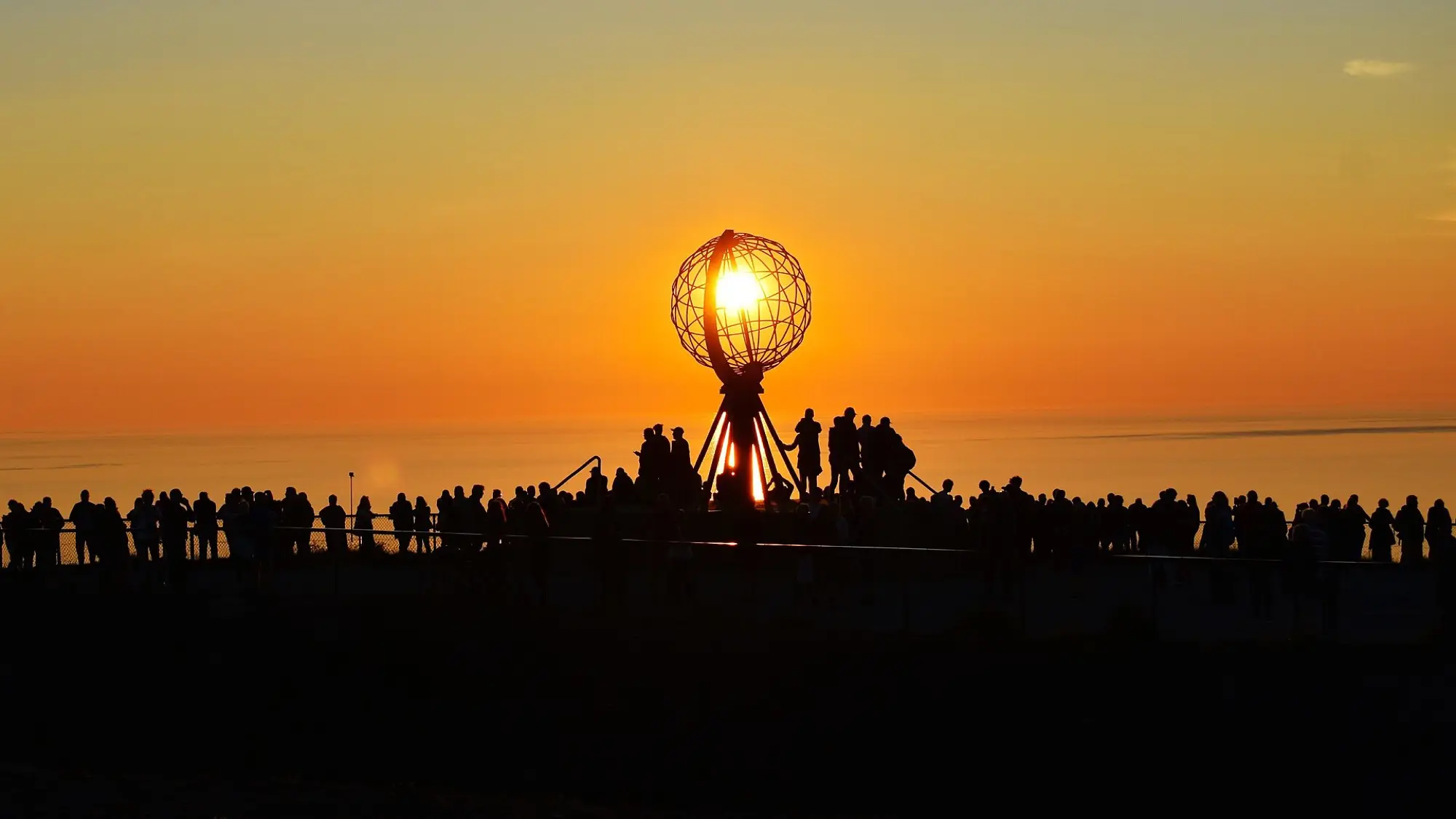

Reaching the North Cape (Nordkapp) involves travelling through Honningsvåg, which connects to the wider transport network by Widerøe flights via Tromsø, coastal ships or the road. Visit Nordkapp says the plateau and the globe cost nothing to visit, while entering the visitor centre carries a separate charge. At the cliff itself, the top of the sun stays above the horizon all night from 11 May to 31 July.
What and where the North Cape is
Northern Norway's tourist board says the North Cape lies at around 71 degrees north, approximately 2,000 km from the North Pole, on the island of Magerøya at the very end of the European landmass. The North Cape plateau sits on the edge of a 307-metre cliff above the Arctic Ocean and is home to the globe monument. Northern Norway's tourist board says the plateau rises 307 metres almost straight up from the Arctic sea but is flat at the top. Visit Nordkapp says Knivskjellodden, a low headland reached only on foot, stretches about 1.5 km further north than the North Cape cliff.
Northern Norway's tourist board says the English captain Richard Chancellor sailed round the cape in 1553 and named the 307-metre headland the North Cape. The tourist board says a road to the North Cape was completed in 1965, so visitors no longer had to climb up from the sea. Visit Nordkapp says the North Cape plateau can be visited all year, by car, motorhome or organised tour. The tourist board says more than 200,000 people visit the North Cape in a busy summer season.
Honningsvåg, on the south coast of Magerøya, is the largest town on the island and the starting point for almost every trip north on Magerøya. Statens vegvesen's route planner takes the drive from Honningsvåg to the North Cape plateau along the E69, a route of 33,771 metres, about thirty-four kilometres. The route planner gives 28.9 minutes of driving from Honningsvåg to the plateau, about half an hour, before any convoy wait.
What it costs to visit
Visit Nordkapp says it costs nothing to visit the globe monument and walk around the plateau; parking is free but limited to 6 hours, and overnight parking is not allowed. Entering the North Cape Hall, the visitor centre on the plateau, costs money. Visit Nordkapp sends visitors to the North Cape Hall's own website, nordkapphallen.no, for ticket prices and up-to-date opening hours; the prices are set by the Hall.
The North Cape Hall visitor centre is open all year and has exhibitions, a café and a souvenir shop. Hurtigruten describes a visit to the Hall as a 180° panoramic film about the region through the four seasons, exhibitions on the area's history in an underground tunnel, and what it calls the world's northernmost chapel. Havila says the North Cape Hall is built partly into the cliff, with a restaurant with panoramic views, a shop cut into the mountain and a chapel. Visit Nordkapp's practical guide says the North Cape visitor centre is fully wheelchair accessible, with step-free access inside the building. Tours to the plateau can be booked through local tour operators, and some of them include the North Cape Hall entrance fee.
When to go and the midnight sun
At the North Cape, the top of the sun stays above the horizon all night from 11 May to 31 July. Visit Nordkapp says the best time to see the midnight sun is around midnight, when the sun is low in the northern sky above the Arctic Ocean, and that the plateau faces straight north. How these dates fit into broader seasonal patterns across Scandinavia can be seen in our overview of the midnight sun in Norway, Sweden and Finland.
Northern Norway's tourist board says midnight sunshine at the North Cape is far from guaranteed, because cold and warm currents in the Arctic sea bring a good deal of fog. Visit Nordkapp says fog or cloud sometimes hides the sun, and that staying a few nights gives a better chance of clear skies. You can compare conditions with other regions in our guide to the best time to visit Norway.
Visit Nordkapp says Honningsvåg's summer season usually begins in mid-May and continues until late August, when cruise ships call from around the world. In 2024 the Port of North Cape had 174 cruise calls, the largest ship bringing more than 4,500 visitors in a single day. The tourist board says many travellers set aside only an evening for the North Cape, which can become too hectic and even a disappointment if the weather is poor, and suggests more time to explore Magerøya. Summer itineraries can be planned alongside our guide to Norway in summer.
Polar night and the northern lights
At the North Cape the polar night starts on 20 November and the sun returns on 22 January. Visit Nordkapp says the northern lights season in Nordkapp runs from about September to early April, when the nights are dark enough. Visit Nordkapp says that during the polar night, late November to January, it is dark for most of the day, so the aurora can be seen from early afternoon. Specific advice for seeing the lights at the cliff is covered in our dedicated North Cape northern lights guide.
Flying to Honningsvåg
Honningsvåg Airport (HVG) is served by Widerøe with daily flights via Tromsø, and is about 10 minutes from the town centre by car or taxi. Avinor, which runs the airport, lists Widerøe as the one airline at Honningsvåg. Parking at Honningsvåg Airport is free, at the owner's own risk.
Visit Nordkapp recommends booking the whole journey directly with Widerøe, which then helps rearrange the trip if a flight is delayed or cancelled. Northern Norway's tourist board says many people fly to Alta instead, which is further away but has a bigger selection of low-cost tickets. For winter, Visit Nordkapp advises arriving in Honningsvåg one or two days before the tours that matter most, and allowing at least one extra day before any long-haul flight.
Arriving by coastal ship and the North Cape excursions
The coastal ships dock in Honningsvåg twice a day, northbound and southbound, in the town centre. Havila's ships arrive in Honningsvåg northbound at 10:55 and leave at 14:30; southbound they arrive at 05:45 and leave at 06:00. Hurtigruten calls at Honningsvåg all year on the Coastal Express, docking mid-morning northbound with 3 hours 35 minutes in port, time for an excursion to the North Cape. For more details on schedules and services, consult our Hurtigruten Coastal Express guide.
On Hurtigruten's North Cape Line, Honningsvåg is the turning point of the round trip, with 12 hours in port. From May to September Hurtigruten's Svalbard Line spends the day in Honningsvåg on the northbound leg, 7 hours in port. Visit Nordkapp says a coastal-ship journey starting from Honningsvåg must be booked directly on the Hurtigruten website. Visit Nordkapp says most transport and tour options in Honningsvåg are coordinated with cruise arrivals and departures, and the bus meeting point is a short walk from the ship.
Hurtigruten's international excursions page lists its 3-hour bus excursion from Honningsvåg to the North Cape as year-round, from €179 per person. Havila's North Cape plateau excursion (booking reference HVGN1) runs northbound from 10:55 to 14:10, all year from 01.01 to 31.12, with the price on Havila's price list. Havila warns that the trip to the North Cape may at times be driven in convoy, which can shorten the time on the plateau. Havila says the road can close in strong wind, avalanche risk or severe weather, especially in autumn, winter and spring, and the excursion may then be cancelled at short notice with an alternative offered.
Driving and the bus from Alta
By road, the E6 runs north past Alta to Olderfjord, where you change to the E69; the old ferry to Magerøya has been replaced by a tunnel. For practical planning at the other end of the road and the bus, with its airport, see our guide to Alta. Statens vegvesen's route planner takes the drive from Alta to Honningsvåg along the E6 and E69, a route of 206,110 metres, just over two hundred kilometres. The route planner gives 163 minutes of driving from Alta to Honningsvåg, under three hours, before stops and winter delays. The route planner counts no toll points and no ferry between Alta and Honningsvåg. Practical rules for the road network are set out in our guide to driving in Norway.
Northern Norway's tourist board says bus 110 connects Alta with Honningsvåg via Olderfjord, a journey of around 3.5 hours. Visit Nordkapp says the bus route continues to Alta Airport (ALF), useful for connecting flights. Visit Nordkapp warns that in strong wind, heavy snow or poor visibility the buses may be delayed or cancelled, especially over the mountain plateau between Olderfjord and Alta, and advises checking the schedule on the day.
There are no traditional petrol stations on Magerøya, but fuel can be bought in two places, one in Honningsvåg near the Rema 1000 supermarket and one near the airport. Fast chargers for electric cars are in Honningsvåg and Storbukt, with one more in Skarsvåg; Visit Nordkapp says to fill up or charge before driving to the plateau. On the way north, the nearest alternatives on the mainland are in Olderfjord, 98 km from Honningsvåg. Cars can be rented in Honningsvåg; Visit Nordkapp recommends booking ahead, especially in summer. Visit Nordkapp says the local taxis mainly serve the town and essential local transport, so they cannot be relied on for trips to the North Cape.
The road to the plateau in summer
Visit Nordkapp says the road to the North Cape is normally open from late spring to early autumn, and summer driving conditions are generally good. For driving during the rest of the year, see the winter convoy section below. The road to the North Cape (E69) is well maintained but includes steep sections, wide open plateau and narrower coastal stretches, and fog, wind and poor visibility can occur even in summer. Patches of snow on the mountain plateau are not unusual until early June, but the road itself is generally kept clear and fully drivable.
From late spring to autumn Magerøya is summer pasture for reindeer owned by Sámi herders, which often walk along or stand on the road to the plateau; slow down, be ready to stop, and never stop on the road for photos. If you hit a reindeer you must report it to the police on 02800, even if the animal runs away.
The winter convoy on the E69
Visit Nordkapp says that in winter, usually November to April, the road between Skarsvåg and the North Cape plateau may only be driven in scheduled convoys (kolonnekjøring) led by a snowplough. Statens vegvesen, the Norwegian road authority, sets fixed convoy times for the E69 between the Skarsvåg junction and Nordkapp; from 1 January to 15 April this winter, as Statens vegvesen's timetable gives it (01.01.27-15.04.27), there is no free traffic on that stretch, only the fixed convoy times, unless the road is closed by bad weather. Check Statens vegvesen on the day, because times and road conditions can change.
In Statens vegvesen's fixed timetable, convoys leave the Skarsvåg junction at 08.30, 10.00, 12.00, 14.30 and 19.30, and leave Nordkapp at 09.30, 11.00, 12.30 (Fridays and Saturdays only), 13.45, 16.15 and 21.30. Statens vegvesen says the weather, not the calendar, decides when the winter convoy starts and ends, and the road over the mountain is still closed completely when the weather gets too bad. Statens vegvesen introduced the fixed convoy for safety, because a growing number of tourists come by rental car in winter and many have little or no experience of winter driving.
The convoys are free and need no booking; Visit Nordkapp advises arriving at the meeting point at least 15 minutes early and following the convoy leader without overtaking or stopping. Visit Nordkapp says a car driven in Northern Norway from late October to early May should have proper winter tyres, and that local rental cars already have them. Visit Nordkapp says guided tours to the North Cape run to the convoy times, and that with little winter-driving experience a guided tour is often safer and easier.
All winter a daily bus runs from Honningsvåg to the North Cape behind a snowplough; Northern Norway's tourist board says it is cancelled more often than other buses because the cape is so exposed. Visit Nordkapp advises not saving the North Cape plateau for your last day, so that if the convoy is cancelled you have another chance.
Hiking to Knivskjellodden
Visit Nordkapp's Knivskjellodden trail guide says a marked trail of about 9 km each way, roughly 18 km return, crosses open tundra past small lakes to a driftwood beach and the tip of Knivskjellodden. Most hikers spend 5-6 hours, with a total ascent of around 450 metres on the way back up from the sea. Visit Nordkapp gives the hiking season as about June to September, when the trail is free of snow, and warns that fog and bad weather can still come in summer.
The trail starts at a large parking area on the E69 about 6-7 km before the North Cape plateau, reached by car, motorhome or the bus to the North Cape. At the tip there is a stone cairn and a guestbook, and a view east across the bay to the North Cape cliff. Visit Nordkapp says the trail is stony and often wet, recommends hiking boots, and warns that the rock slabs near the tip can be very slippery. There are no toilets at the trailhead parking and no facilities along the trail, so bring food and water. Visit Nordkapp says hiking to Knivskjellodden is generally not recommended in winter, and should only be tried then with an experienced local guide.
Weather and safety at the cliff
On yr, the normal July mean temperature at Honningsvåg airport, 3.5 km from the town, is 10.2 °C. On yr, the normal January mean temperature at Honningsvåg airport is -2.5 °C. Visit Nordkapp says it can feel cold on the plateau even in summer, because it is open to the Arctic Ocean and often very windy, and that thick fog is especially common on the island.
The plateau sits on top of a steep cliff more than 300 metres above the sea. Visit Nordkapp says to stay inside the fences and marked areas and never climb over them to take photos. Strong gusts can come suddenly and are powerful enough to make you lose your balance, so take extra care near the edge in wind. Fog can quickly cut visibility to a few metres; stay on marked paths and near the buildings. Visit Nordkapp warns that in winter snow and ice make the ground slippery and snow overhangs can form at the cliff edge, so stay well away from it.
Skarsvåg and Gjesvær nearby
Skarsvåg, which Visit Nordkapp calls the world's northernmost fishing village, has about 60 people, is about 23 km from Honningsvåg on the road to the North Cape and 14 km from the cape. A hiking trail from Skarsvåg to Kirkeporten, a natural rock arch, takes about 2 hours return, with a view of the North Cape's horn. Visit Nordkapp says that on summer nights the sun shines right through the arch.
Gjesvær, a fishing village of around 100 people, is about 36 km from Honningsvåg, around 35-40 minutes by car. Gjesvær is best known for bird safaris to the Gjesværstappan nature reserve, home to puffins, gannets and other seabirds, more than 60,000 pairs in all; the boat season usually runs from May to August.