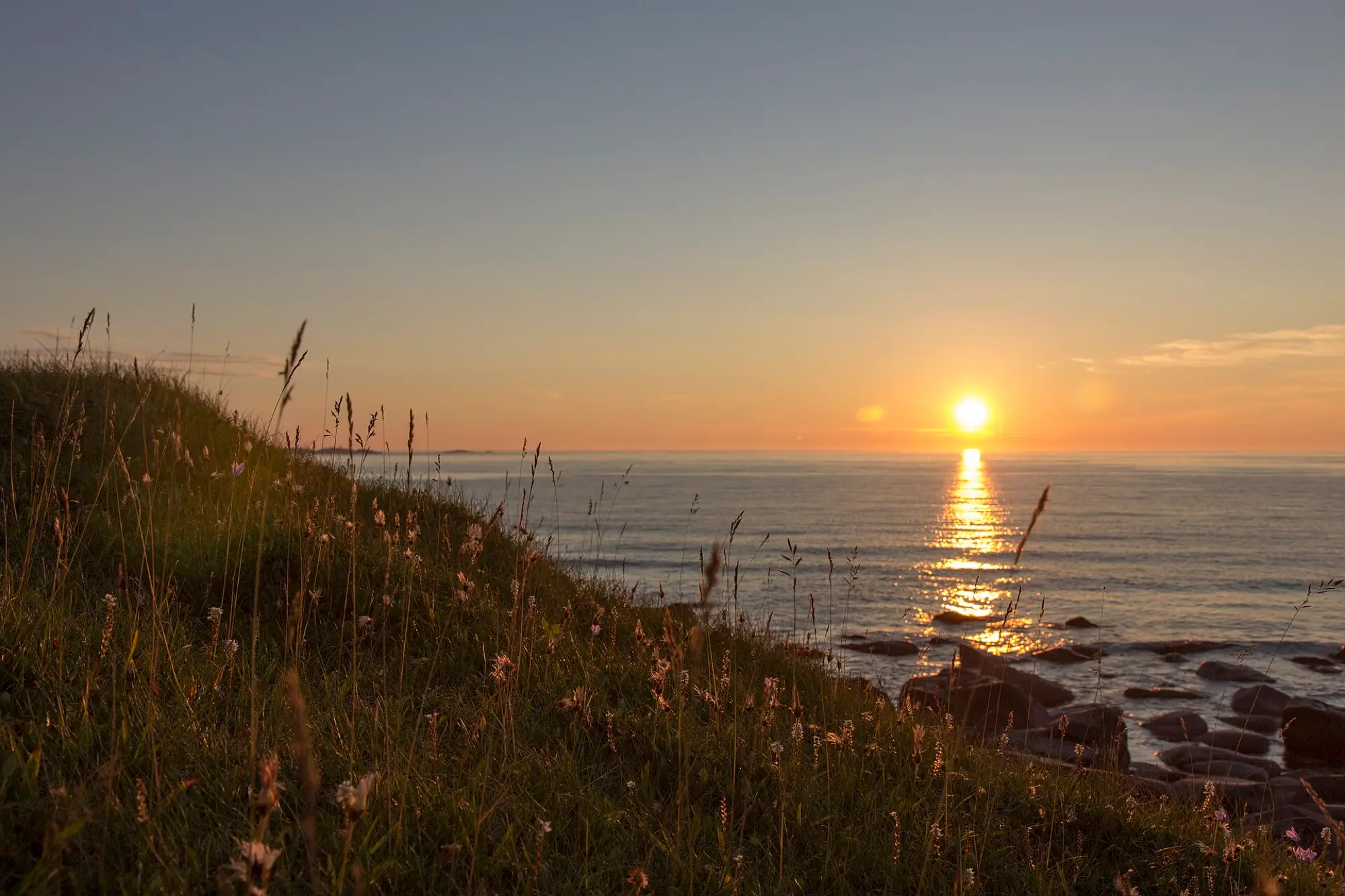

A summer visit to Norway spans 12 classic trips: Oslo island ferries, Norway in a Nutshell, Geiranger and Trollstigen, Preikestolen, the Atlantic Road, Hardanger cider routes, DNT mountain cabins, Lofoten, Tromsø, Senja, the North Cape, and Svalbard. North of the Arctic Circle the sun does not set at all in midsummer. Oslo and Bergen have no midnight sun, but 18h 50m and 19h 00m of daylight on 21 June.
The midnight sun: where the sun stays up all night, and when
North of the Arctic Circle, the sun remains above the horizon throughout the night during midsummer. In Tromsø the midnight sun stays above the horizon for 68 consecutive days, from 18 May to 24 July, as computed on this site. At the North Cape (Nordkapp) the top of the sun stays above the horizon all night from 11 May to 31 July, according to Yr.
Oslo has no midnight sun; on 21 June the sun rises at 03:53 and sets at 22:43, giving 18h 50m of daylight, and the sky is never dark enough for the aurora. Bergen has no midnight sun either; on 21 June the sun rises at 04:10 and sets at 23:11, giving 19h 00m of daylight, and the sky is never dark enough for the aurora.
For the midnight sun, choose an open spot with a clear view to the north or north-west, such as the coast of Kvaløya and Sommarøy or Storsteinen; clouds and mountains decide what you see. Arctic Norway warns that the midnight sun may be hidden behind a mountain, especially on Senja's rugged outer coast.
1. Oslo: island ferries and a sea bath in the city
In Oslo you can ride scheduled ferries across the harbour and swim in an outdoor sea bath. From Aker Brygge, Ruter's line B1 loops round Hovedøya, Lindøya, Gressholmen, Bleikøya and Nakholmen; the summer line B1X shuttles between Aker Brygge and Hovedøya; line B2 runs Hovedøya, Gressholmen, Langøyene. A regular public transport ticket or an Oslo Pass lets you get on and off any of the ferries between Aker Brygge and the islands. Hovedøya is the island closest to the city centre, and the boat from Aker Brygge takes only eight minutes. Sørenga is open 07:00-22:00 in the bathing season, 1 April to 14 October, and 07:00-16:00 in winter. For more details on the capital, see our guide to Oslo in summer.
2. Norway in a Nutshell: the Flåm Railway and the Nærøyfjord
Norway in a Nutshell is an itinerary connecting Oslo or Bergen with the western fjords by train and boat. The tour combines the Flåm Railway, the Bergen Railway and an electric fjord cruise on the narrow Nærøyfjord. You can start the tour in Oslo, Bergen, Flåm, Voss or Geilo. Fjord Tours prices Norway in a Nutshell from 2698 NOK. The Flåm Railway is busy in summer; with fixed dates, Fjord Tours recommends booking early, especially for July and August, when departures can sell out. You can find complete ticket logistics in our guide to Norway in a Nutshell.
3. Geiranger and Trollstigen: a UNESCO fjord and 11 hairpin bends
This trip pairs a boat cruise on Geirangerfjorden with a drive or hike up Trollstigen. The Geirangerfjord and the Nærøyfjord were inscribed together on UNESCO's World Heritage List in 2005 as the West Norwegian Fjords. At the abandoned farm Knivsflå seven waterfalls, the Seven Sisters (De syv søstre), drop into the fjord, falling 250 metres on average. In Geiranger itself, sightseeing cruises on the fjord last either 75 minutes or two hours. The sightseeing cruises leave several times a day in summer, and the operator recommends booking ahead in the high season from June to August, when some departures sell out. Geiranger Fjordservice also sails from Ålesund to Geiranger in 3 hours one way, past the Seven Sisters and the Suitor; a round-trip day tour from Ålesund takes 9 hours.
The Geiranger-Trollstigen scenic route is always closed in winter and is normally open from mid-May to October or November, depending on when winter returns. The hairpin bends on Trollstigen opened as normal in 2026 after maintenance and rockfall protection work, and the road can close at short notice because of bad weather or maintenance. According to Fjord Norway, Trollstigen climbs the steep mountainside through 11 hairpin bends. Fjord Norway advises starting early in the morning or late in the afternoon for a quieter trip. The road is narrow and winding, and drivers of large campervans or caravans should plan for meeting oncoming traffic. On foot, the Kløvstien path (858 metres above sea level) climbs to Trollstigen from Isterdalen; it is moderately challenging and takes about 3 hours.
4. Preikestolen: the rock 604 metres above the Lysefjord
Preikestolen is a mountain hike to a rock plateau that overlooks the Lysefjord. The plateau stands 604 metres above the Lysefjord. The Preikestolen hike is 8 km round trip with 500 metres of total elevation gain and takes about 4 hours; it is rated moderate. Peak season is June, July and August; to beat the crowds, start before 8 am or after 4 pm. Saturday and Sunday are the busiest days. Parking is paid after the hike, at the machine before leaving: free for under 15 minutes, NOK 40 for under 2 hours and NOK 275 for more than 2 hours. For details on trails across the country, check our guide to famous Norway hikes.
5. The Atlantic Road: 36 km over the islets
The Atlantic Road is a coastal drive crossing bridges and islets between Kårvåg and Bud. The Atlantic Road (Atlanterhavsvegen) curves from islet to islet over seven bridges along the open Hustadvika bay. The scenic route is 36 km long and runs from Kårvåg to Bud, as detailed by the Norwegian Scenic Routes administration. The authority suggests fishing from the Myrbærholm bridge, where it says a catch is almost guaranteed. On Eldhusøya an elevated hiking path makes a circular walk that is accessible to all. Cyclists should beware of strong winds on the bridges. The route may have quite a lot of traffic in the high season.
6. Hardanger: the fruit fjord in blossom and cider
In Hardanger you can visit fruit farms along the fjord and take a boat cruise between Norheimsund and Eidfjord. Visit Hardanger says the blossom season typically runs from mid-May through mid-June, and in a cold year may not peak until early June. Mid-May brings the Hardanger blossom, when hundreds of thousands of fruit trees on the fjord slopes turn white and pink; cherries and plums blossom first, then pears, then apple trees. The fruit harvest is in autumn; in spring the farms sell apple juice and cider from the previous year's harvest. Cider from Hardanger was the first alcoholic product in Norway to become a protected geographical indication. The Fruit and Cider Route in Ulvik links three farms, Ulvik Frukt & Cideri, Syse Gard and Hardanger Saft- og Siderfabrikk, all within walking distance of the centre, with festivals in May and October.
Norled's Hardangerfjord sightseeing cruise runs daily from May to September between Norheimsund and Eidfjord, and only in that season. It connects with bus 925 from Bergen bus station at 07:25 and bus 930 back from Norheimsund at 19:00, so it works as a day trip without a car.
7. A mountain hike and a night in a DNT cabin
This trip pairs walking in a national park with an overnight stay in a trekking cabin. Statistics Norway counts 41 national parks on the Norwegian mainland, covering 9.8 per cent of the land area (updated 8 April 2026). Gjendesheim, at the eastern end of Lake Gjende, can be reached by road all year and is the most common starting point for the Besseggen ridge walk. The Gjende boat runs daily between Gjendesheim, Memurubu and Gjendebu from June to October, connecting with the buses, and can carry your luggage ahead. For hikers visiting Trolltunga, Trolltunga AS states that experienced hikers can go on their own from 1 June to 30 September, while for the rest of the year the operator recommends a guided hike.
Local member associations of Den Norske Turistforening (DNT, the Norwegian Trekking Association) run about 600 cabins across the country. DNT cabins are open to everyone, members and non-members, but members get discounts, and you must be a member to get into the locked self-service cabins. Staffed lodges serve breakfast and dinner, many have showers and electricity, and they are open only in certain seasons; many offer self-service or no-service rooms outside the staffed season. Most self-service DNT cabins are open all year, but those in Jotunheimen, Skarvheimen, Hardangervidda and some other mountain areas close from 15 October until mid-February or early March; staffed lodges open in summer, and some in winter. DNT membership costs NOK 885 for an adult aged 26-66 and NOK 1,580 for a family of 2 adults and all children under 26. Learn how access keys and member pricing work in our guide to DNT cabins.
8. Lofoten: beaches, peaks and the ferry from Bodø
In Lofoten you can hike coastal mountain paths, visit sand beaches and take the ferry from Bodø. On Torghatten's Bodø to Moskenes ferry route, the full fare for a petrol, diesel or hybrid vehicle up to 6 metres is NOK 605. The route is very busy in peak season, travellers to Røst and Værøy are prioritised, and Torghatten recommends the direct sailings between Bodø and Moskenes to avoid being left at the dock. Read our full Lofoten travel guide to plan your time across the islands. If you are coming from Tromsø, see the options for getting from Tromsø to Lofoten.
On the islands, the Kvalvika and Ryten hike takes 3 to 5 hours, is moderate to challenging, and goes 3 km to the beach or 3.5 km to the top of Ryten at 543 metres; the season is spring to autumn, with snowshoes or skis in winter. Reinebringen, the Sherpa-step hike above Reine, is only accessible in the summer and autumn season. Bunes beach can only be reached by boat, with daily departures from Reine across the Reinefjord to Vindstad; tickets are in the Reis Nordland or Entur app, and you cannot take a car. Visit Lofoten gives the Bunes season as April to October.
9. Tromsø: the midnight sun from the cable car
In Tromsø you can ride the cable car up Storsteinen to see the midnight sun over the city. In Tromsø the midnight sun stays above the horizon for 68 consecutive days, from 18 May to 24 July. Fjellheisen is the Tromsø cable car, and it is open every day from 09:00 to 00:00, with the mountain café open from 09:00 to 23:30. A return ticket costs 645 NOK for an adult and 310 NOK for a child aged 3-15; one way is 415 NOK for an adult. Fjellheisen says you can watch the midnight sun from the top. For additional sights in town, read our complete guide to Tromsø in summer.
10. Senja: Norway's second biggest island
On Senja you can drive coastal scenic roads, take the detours to Husøy and Mefjordvær and hike up Mount Segla. Senja is Norway's second biggest island. The Senja scenic route runs 102 km along the west coast between Botnhamn and Gryllefjord, with detours to Husøy and Mefjordvær. You reach Senja by the bridge from the mainland via Finnsnes or by ferry; the Botnhamn-Brensholmen ferry can be your route between Senja and Tromsø. In summer a ferry runs between Andenes and Gryllefjord on Senja; it is not an option outside the summer tourist season. Tungeneset, looking out to the Okshornan cliffs, is the most photographed spot on Senja. Arctic Norway says Mount Segla is where everybody wants to hike on Senja.
11. The North Cape: a 307-metre cliff under the midnight sun
At the North Cape you can stand on the plateau at the edge of the cliff above the Arctic Ocean. The North Cape plateau sits on the edge of a 307-metre cliff above the Arctic Ocean, with the globe monument. Visiting the globe monument and the plateau costs nothing; parking is free but limited to 6 hours, and overnight parking is not allowed. Entry to the North Cape Hall, the visitor centre on the plateau, is paid, and some tours from Honningsvåg include it.
The road to the North Cape is normally open from late spring to early autumn; in early summer there may still be patches of snow on the plateau, but the road is kept clear. From late spring to autumn Magerøya is summer pasture for Sámi-owned reindeer, which often stand on the road to the plateau; slow down and be ready to stop. Honningsvåg airport is served by Widerøe with daily flights via Tromsø and is about 10 minutes from the town centre.
12. Svalbard: summer boat trips and the polar bear rules
On Svalbard you can take boat trips from Longyearbyen in the polar summer. Norwegian normally flies to Longyearbyen directly from Oslo all year, with more flights in the peak season from March to August. Every visitor pays an environmental fee of NOK 150, added automatically to air and cruise tickets. Isfjord Ekspressen sails daily both ways between Longyearbyen and Isfjord Radio from June to mid-September. Visit Svalbard recommends a walrus and whale safari in the polar summer.
Since 1 January 2025 you must keep at least 300 metres from a polar bear, and at least 500 metres from 1 March to 30 June. Statistics Norway counts 7 national parks on Svalbard, protected under the Svalbard Environmental Protection Act. Read our complete guide to Svalbard before planning activities outside Longyearbyen.
Summer weather: what the normals say
Weather stations show temperature and rainfall readings across the three summer months:
- At the Oslo (Blindern) weather station the normal monthly mean temperature is 15.3 °C in June, 17.7 °C in July and 16.5 °C in August, and normal rainfall is 80 mm, 87 mm and 103 mm, so August is the wettest of the three.
- On yr, the normal monthly mean temperature at the Tromsø (Vervarslinga) station is 9.4 °C in June, 12.3 °C in July and 11.3 °C in August.
Booking ahead in July and August
July and August bring busy travel periods on popular transport and hiking routes:
- The Flåm Railway is busy in summer; with fixed dates, Fjord Tours recommends booking early, especially for July and August, when departures can sell out.
- Sightseeing cruises in Geiranger leave several times a day in summer, and the operator recommends booking ahead in the high season from June to August, when some departures sell out.
- Preikestolen's peak season is June, July and August; to beat the crowds, start before 8 am or after 4 pm. Saturday and Sunday are the busiest days.
- The Bodø to Moskenes ferry route is very busy in peak season, travellers to Røst and Værøy are prioritised, and Torghatten recommends the direct sailings between Bodø and Moskenes to avoid being left at the dock.