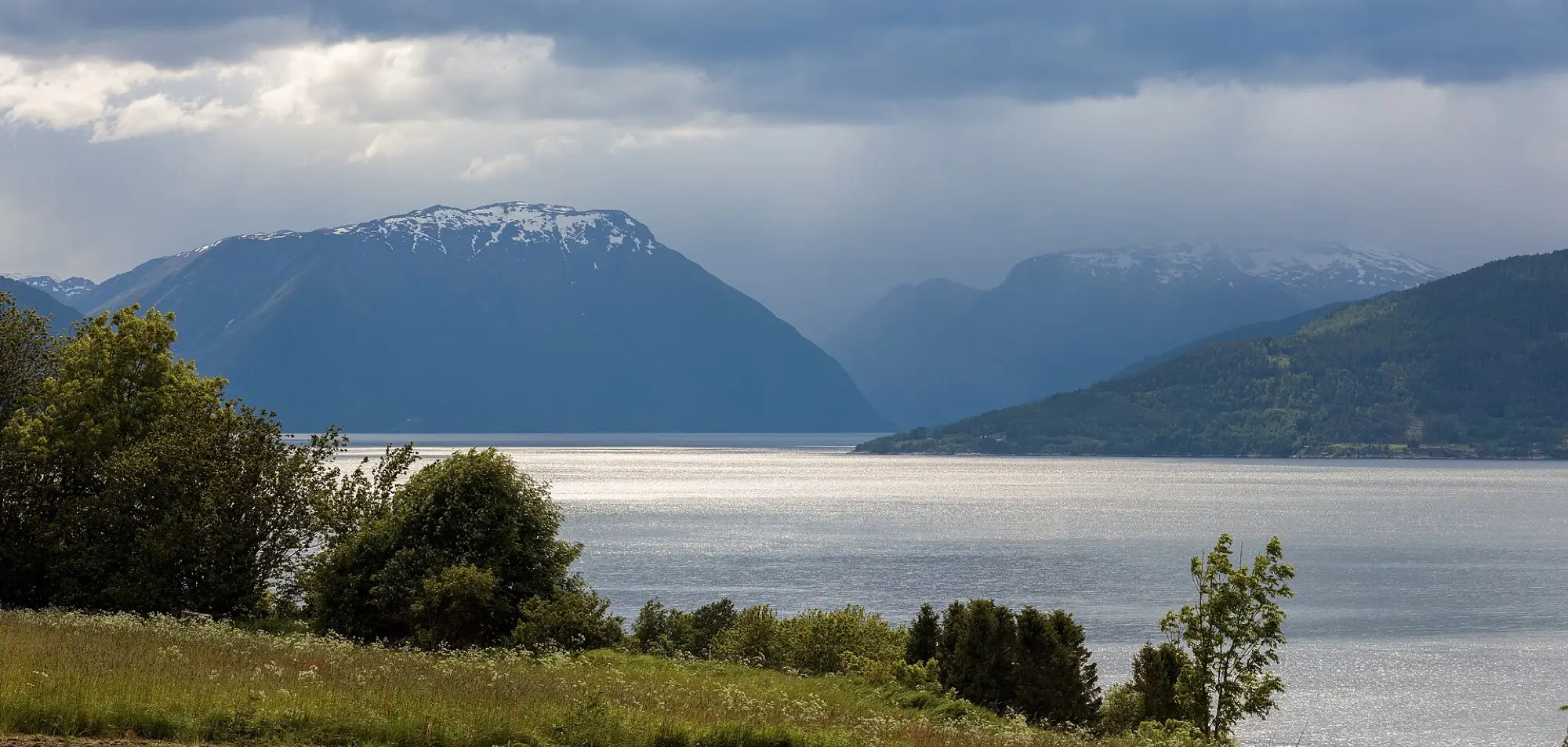

The Sognefjord reaches 205 kilometres inland from the coast to Skjolden and drops to 1,303 metres deep off the Vadheimsfjord. You can travel along Norway's longest and deepest fjord by daily express boats, local buses or scenic roads connecting its key villages. The ten places covered in this guide are Vik and Hopperstad, Balestrand, Fjærland, Solvorn and Urnes, Feigumfossen, Lærdal and Borgund, Aurland and Stegastein, Flåm, Undredal, and the Nærøyfjord.
Sognefjord in one answer
According to Store norske leksikon, the Sognefjord is Norway's longest and deepest fjord and the world's second-longest. It measures 205 kilometres long and reaches a depth of 1,303 metres off the Vadheimsfjord. Visit Bergen notes that the fjord stays more than 1,000 metres deep for roughly half its length, stretching inland from the open ocean all the way to the village of Skjolden.
Getting around without a car
Norled operates a daily express boat between Bergen and Flåm from 1 April to 31 October. The service leaves Strandkaiterminalen in Bergen at 08:00 and Flåm quay at 15:30, taking 5.5 hours one way. Along the route, the boat stops at Noreide, Vik, Balestrand, Leikanger and Aurland. This is an express boat for passengers only; no vehicles are carried. You can purchase tickets online, on board or at the tourist information office in Bergen. Norled's price list sets the standard adult fare at NOK 1295 for Bergen to Flåm. Children aged 6–17 and seniors over 67 pay NOK 648, students aged 18–29 pay NOK 777, and children under 6 travel free. If you plan to break the journey with an overnight stop in a village, buy separate tickets for each leg (such as Bergen to Balestrand, followed by Balestrand to Flåm) to secure your seats.
Fjord1 announces that it takes over the express boat routes from Strandkaiterminalen in Bergen to Sogn and Nordfjord on 1 December 2026. This handover includes the Bergen–Balestrand–Sogndal and Bergen–Flåm services. Fjord1 runs its passenger boat between Bergen, Balestrand and Sogndal every day of the year, calling at Lavik, Nordeide, Vik, Balestrand and Leikanger, though not every stop is served daily. Fjord1's seasonal boat to Balestrand, Aurland and Flåm operates from 1 April to 31 October, calling at Vik, Balestrand, Leikanger and Aurland before Flåm. Fjord1 gives a 50% discount for children, senior citizens and return tickets, and 40% off for students.
Tide operates the regional bus network around the Sognefjord on behalf of the public transport authority Skyss. In summer, the route extends to Lom and Ål on the same ticket. Skyss places the municipalities of Aurland, Lærdal, Årdal, Vik, Sogndal and Luster into zone J. Fjord Norway notes that Vik, Balestrand, Fjærland, Leikanger, Sogndal, Gaupne, Lærdal, Årdal, Aurland and Flåm are all within this single zone. Local journeys in zone J cost the same regardless of distance, and you can buy tickets on board or through the Skyss mobile app. Fjord Norway recommends a 24-hour ticket if you plan to explore the area by bus. From 1 November 2026, an adult Skyss single ticket for one zone costs NOK 51, and a 24-hour ticket for one zone costs NOK 136. In addition, Vy runs long-distance coaches connecting Oslo and Bergen to Sogndal and Flåm. You can find more connection ideas in our guide to day trips from Bergen or plan a route from the capital using our guide on fjords from Oslo.
Getting around by car
Drivers rely on several vehicle ferries to cross the water. Key crossings include Lavik–Oppedal on the E39, Vangsnes–Dragsvik/Hella on road 13, and Fodnes–Mannheller on road 5. On the Lavik–Oppedal ferry, the crossing takes about 20 minutes, costing 81 kr for a vehicle up to 6 metres and 33 kr for a motorcycle. Read our guide to car ferries in Norway for details on toll payment and ferry ticketing, and check driving in Norway for practical road rules. For a scenic water transfer, Lustrabaatane operates a 2.5-hour car ferry between Kaupanger and Gudvangen from 20 May to 16 September 2026, leaving Kaupanger at 09:15 and 15:45 in the shoulder months. It includes an audio guide and an on-board cafeteria, spending about a third of the trip inside the narrow Nærøyfjord.
Statens vegvesen's route planner calculates the drive from Bergen to Flåm along the E16 at 144 minutes. Flåm to Sogndal via the Stegastein viewpoint across Aurlandsfjellet takes 93 minutes, including the Fodnes–Mannheller ferry crossing. If you are building a broader itinerary, see our recommended Norway road trip.
The E16 passes through the Lærdal tunnel (Lærdalstunnelen), which opened in November 2000. At 24.5 kilometres, it is the longest road tunnel in the world. The structure is undergoing major upgrades: from Monday 16 November 2026, the tunnel closes every night from 18:00 to 06:00, except on the night leading into Sunday. Drivers who arrive after 18:00 cannot pass through until 06:00 the following morning. During daytime hours, traffic lights narrow short sections of the tunnel to a single lane, which can add up to 15 minutes to the crossing time.
Mountain passes provide seasonal alternatives. The Sognefjellet scenic route follows road 55 between Lom and Gaupne. Reaching 1,434 metres above sea level, it is Northern Europe's highest mountain pass. The pass closes in winter between Rustasætre/Vegaskjelet and Turtagrø; past closures have occurred between 17 November and 17 December, with reopenings between 12 April and 1 May. The Aurlandsfjellet scenic route runs 47 kilometres between Lærdalsøyri and Aurlandsvangen, climbing to 1,308 metres. While the high mountain section shuts during winter, the lower ascent from Aurlandsvangen up to the Stegastein viewpoint remains open all year.
The ten places at a glance
| Place | Without a car | Season | Adult price |
|---|---|---|---|
| Vik and Hopperstad | express boat to Vik | 18 May to 19 September 2026 | NOK 150 |
| Balestrand | express boat, all year | travel museum Thursday to Saturday, 18 October to 18 December | NOK 140 (museum) |
| Fjærland | boat from Balestrand, 20 May to 30 September 2026; bus on road 5 | museum closed until January 2027 | NOK 180 (museum) |
| Solvorn and Urnes | Solvorn-Ornes ferry, all year | 2 May to 30 September 2026 | NOK 150 |
| Feigumfossen | check Skyss | Feigesagi café in summer | check locally |
| Lærdal and Borgund | Fjord Tours tour from Flåm, 13 April to 12 October | 15 April to 14 October 2026 | NOK 150 |
| Aurland and Stegastein | Fjord Tours electric bus from Flåm, all year | all year | from 470 NOK (bus tour) |
| Flåm | express boat, 1 April to 31 October; Flåm Railway all year | all year | check locally |
| Undredal | Nærøyfjord cruise, book the stop ahead | every day | check locally |
| The Nærøyfjord | Nærøyfjord cruise from Flåm or Gudvangen | every day | check locally |
1. Vik and Hopperstad: a stave church from around 1130
Hopperstad stave church (Hopperstad stavkyrkje) stands in Vik and is regarded as one of the country's oldest stave churches, dating to around 1130. The building seen today is the outcome of extensive restoration during the 1880s and 1890s led by architect Peter Andreas Blix, who referenced Borgund stave church when original components were missing. Hopperstad retains its original chancel screen, making it the only preserved stave church where this feature remains intact. The church opens for visitors from 18 May to 19 September 2026, daily from 10:00 to 17:00. Admission costs NOK 150 for adults, NOK 100 for children and students, NOK 130 for seniors and NOK 350 for a family ticket.
The express boat calls at the quay in Vik. By road, Visit Bergen estimates a driving time of approximately 2 hours 45 minutes from Bergen and about 1.5 hours from Flåm. The fjord at Vik drops to a depth of 1,200 metres, framed by mountains rising around 1,000 metres. Fridtjovparken in Vik displays a 22-metre statue of Fridtjov the Bold, presented by Wilhelm II in 1913, with views over the Sognefjord. You can also visit Ostebaren, a cheese bar set inside the dairy where Tine previously produced gamalost, the Norwegian old cheese.
2. Balestrand: Kviknes Hotel, from 1877
Balestrand has been a known tourist village since the second half of the 1800s. Its landmark property, Kviknes Hotel, dates from 1877; Kaiser Wilhelm II received the news that the First World War had broken out there in 1914. Alongside Vik, Balestrand forms the western boundary of the traditional fruit-growing districts of Sogn.
The express boat calls at Balestrand. Drivers can reach the surrounding region using frequent car ferries connecting Dragsvik (just north-east of Balestrand) to Hella on road 55 and Vangsnes on road 13. In the village, the Norwegian Museum of Travel and Tourism outlines the development of leisure travel across Norway. From 18 October to 18 December, the exhibition opens Thursday to Saturday from 11:00 to 15:00. Tickets cost NOK 140 for adults (18+), NOK 110 for seniors and students, and free admission for children aged 0–17. Lustrabaatane's passenger boat between Fjærland and Balestrand leaves Fjærland at 3:15 pm every day from 20 May to 30 September 2026, takes about 1.5 hours and costs NOK 1200 for an adult and NOK 600 for a child in 2026.
3. Fjærland: a glacier museum at NOK 180
The Norwegian Glacier Museum (Norsk Bremuseum) sits in Fjærland at the head of the Fjærlandsfjord, functioning as a visitor centre for Jostedalsbreen National Park. Architect Sverre Fehn, who received the Pritzker award in 1997, designed the building. Queen Sonja officially opened the museum in 1991, and it has since welcomed over 1.7 million visitors. Standard admission is NOK 180 for adults, NOK 90 for children and students, and NOK 400 for a family pass (two adults with children under 16). The museum is open daily 10:00–16:00 across April, May, September and October, daily 09:00–19:00 throughout June, July and August, and 10:00–15:00 on Tuesdays and Thursdays from January to March. Visits during November and December are arranged by advance request. The museum's website states it is currently closed for the season until January 2027.
You can reach Fjærland by bus along road 5 directly from Bergen or Oslo, stopping right beside the museum entrance. Driving takes slightly over 30 minutes from Sogndal, 4 to 5 hours from Bergen, and 6 to 8 hours from Oslo. In summer, the dedicated glacier bus runs daily from 1 June to 30 September, timed to meet the tourist boat from Balestrand before continuing past the museum to the Bøyabreen glacier tongue. Down on the shore, Mundal in Fjærland has been the Norwegian book town since the mid-1990s, offering over 250,000 used books for sale in the summer half of the year.
4. Solvorn and Urnes: a World Heritage stave church since 1979
Urnes stave church joined the UNESCO World Heritage list in 1979. UNESCO says 28 of the roughly 1,300 medieval stave churches on record survive in Norway, and that Urnes is one of the oldest. Urnes dates to around 1130, and the National Trust of Norway (Fortidsminneforeningen) notes it is the most lavishly decorated of Norway's 28 surviving stave churches. Its northern doorway incorporates panels from an older church on the site dating to roughly 1070, carved in the Urnes style, the last of the Viking Age styles. For the 2026 season, Urnes opens daily from 2 May to 30 September between 10:30 and 17:45, closing on 17 May. Admission costs NOK 150 for adults, NOK 100 for children and students, NOK 130 for seniors and NOK 350 for families. Entry is capped at 25 individuals per tour and 50 visitors per hour, so allow sufficient time for possible queues.
Lustrabaatane operates a small ferry across the Lustrafjord between Solvorn and Ornes daily throughout the year, with a crossing time of about 20 minutes and capacity for 11 cars and 90 people. Ferries have crossed here since 1859. From Solvorn, departures on Monday, Tuesday, Wednesday and Friday run at 07:10, 10:00, and hourly until 16:50; weekend sailings begin at 10:00. The summer timetable runs 2 May to 30 September, switching to the winter schedule from 1 October to 30 April. A departure marked with a star must be booked in advance. Tickets are sold on the ferry and cannot be booked in advance. In 2026, single fares cost 75 kr for adults, 37 kr for children aged 4–16, and NOK 210 for a vehicle up to 6.00 m. After parking above the Ornes pier, walk uphill through the hills to the church. Alternatively, you can drive to Ornes without using the ferry by taking the road past Gaupne, Skjolden and Sørheim and on past Feigefossen. Statens vegvesen calculates about 18 minutes from Sogndal to Solvorn, where Walaker Hotel was founded in 1640 and is often called Norway's oldest hotel.
5. Feigumfossen: a 218-metre waterfall on the Lustrafjord
Feigumfossen drops 218 metres on the southern shore of the Lustrafjord, making it one of Norway's highest unregulated waterfalls. Fjord Norway uses both Feigumfossen and Feigefossen in its regional visitor information.
From Skjolden, follow Sørsidevegen along the fjord's southern edge; the driving route planner gives a journey time of 17 minutes. Park where the Feigeelva river meets the shoreline. Fjord Norway rates the walk up to the waterfall as easy, but the climb is short but steep and the path can be slippery, requiring good shoes and a drink. Feigesagi café, situated near the trailhead, serves waffles overlooking the Lustrafjord throughout the summer season. A RIB boat trip from Skjolden can be combined with the walk to the waterfall.
6. Lærdal and Borgund: a stave church built in 1180
Borgund stave church has stood on the same site since it was built in 1180. Widely considered Norway's best-preserved stave church, it features layered roofs adorned with dragon heads. The free-standing bell tower south of the church is the only free-standing stave bell tower in Norway. The visitor centre, opened in 2005, houses exhibitions alongside a shop and café; you must show an admission ticket to access the café and toilets. Church interiors are limited to 20 visitors at a time. Borgund opens from 15 April to 14 October 2026, daily from 09:30 to 17:00, closing on 17 May and 6–7 October. Admission is NOK 150 for adults, NOK 100 for children under 16 and students, NOK 130 for seniors, and NOK 350 for a family. Walks from the church follow Kongevegen, the old King's Road crossing Filefjell, including the round trip Vindhellavegen/Sverrestigen.
Driving from Flåm to Lærdalsøyri via the E16 takes 35 minutes, followed by about 24 minutes further up the valley from Lærdalsøyri to Borgund stave church. Alternatively, Fjord Tours operates a 4-hour excursion from Flåm covering both Borgund and the Stegastein lookout between 13 April and 12 October. In Lærdalsøyri, the Gamleøyri quarter preserves an intact urban cluster from the 1700s and 1800s, reflecting its past as a key trading depot linking the eastern mountain valleys to the western fjords. A severe fire on 19 January 2014 destroyed 40 properties between the historic quarter and the church, including six heritage-listed structures.
7. Aurland and Stegastein: a platform 650 metres above the fjord
The Aurlandsfjord branches from the main Sognefjord, cutting inland for 17 kilometres beneath mountain walls reaching 1,800 metres. At its outer mouth, the fjord reaches a depth of 962 metres. The Stegastein viewpoint cantilevers 30 metres out into open air, suspended 650 metres above the fjord surface.
The structure stays accessible year-round. While the road over Aurlandsfjellet is closed in winter, the stretch from Aurlandsvangen up to Stegastein is open all year. Fjord Tours runs an electric minibus tour from Flåm to Stegastein throughout the year. The 1.5-hour round trip includes roughly 25 minutes to take photographs at the viewing platform, with ticket prices starting from 470 NOK.
8. Flåm: 20 km of railway down from Myrdal
The Flåm Railway (Flåmsbana) connects the high-altitude station at Myrdal (867 metres above sea level) down to the fjord terminal in Flåm. Built between 1923 and 1940, the 20-kilometre line takes roughly one hour. It ranks among the world's steepest standard-gauge railways, running 80 per cent of its length on a steep 5.5 per cent incline. The track threads through 20 tunnels, 18 of which were excavated entirely by hand.
The railway operates all year. From 1 November 2026 to 31 March 2027, trains leave Flåm daily at 9:00, 11:45, 14:30 and 16:50, returning from Myrdal at 10:15, 13:15, 15:39 and 18:05, with reduced schedules on 24, 25 and 31 December. Passenger seating is unreserved; you select an open seat upon boarding. Departures can sell out during July and August, so book early if you have fixed itinerary dates. You can connect to Myrdal using the mainline Oslo to Bergen train or book the combined journey via the Norway in a Nutshell package.
9. Undredal: Norway's smallest stave church and goat cheese
Undredal lies along the western shore of the inner Aurlandsfjord and contains the smallest stave church in Norway, whose exact founding date remains unknown. The village economy centres on summer mountain agriculture and the production of traditional goat's cheese, yielding both standard white goat cheeses and sweet brunost.
Undredal got its road connection in 1988, bringing tourism with it. From Langhus up the valley, tunnels run to Flåm (5 km) and to Gudvangen (11.4 km) on the year-round main road between Oslo and Bergen. Passenger boats operating the Nærøyfjord cruise call at Undredal pier daily, but intermediate quays must be booked before the vessel departs Flåm or Gudvangen; otherwise, the boat sails past without stopping.
10. Nærøyfjord: 250 metres wide and on the World Heritage list
Branching off the Aurlandsfjord inside Aurland municipality, the Nærøyfjord extends for 19 kilometres. At its narrowest constriction, the waterway measures just 250 metres across, with steep mountainsides rising 1,800 metres above the water. In 2005, UNESCO placed the Nærøyfjord alongside the Geirangerfjord on the World Heritage List under the joint heading of the West Norwegian Fjords. Read our overview of the best fjords in Norway to compare it with other arms of the coastline.
The passenger cruise runs every day between Flåm and Gudvangen, taking around 2 hours. Two boats on the route, Vision of the Fjords and Future of the Fjords, run on battery power alone at speeds below 10 knots through the narrowest parts. From 16 October 2026 to 31 March 2027, winter departures sail from Flåm daily at 9:30 and 14:45, calling at Aurland and Undredal before docking in Gudvangen at 11:30 and 16:45. Intermediate calls at Aurland, Undredal, Dyrdal and Styvi require pre-booking before departure. A shuttle bus runs year-round to bring passengers back to Flåm, creating an easy circular loop. In severe winter conditions, the cruise operator may alter the sailing to an out-and-back voyage from Flåm, with bus transfers linking Gudvangen. The bus from Gudvangen to Voss runs through the Nærøydalen valley, takes 1 hour 5 minutes, runs all year and costs from 200 NOK; tickets must be bought in advance.
When to go, and what is shut in winter
Visitor traffic on the Sognefjord peaks in summer, with large numbers arriving aboard ocean cruise ships calling at Flåm, Gudvangen, Skjolden and Gulen. Summer travellers can refer to our guide on Norway in summer to coordinate broader regional trips, or consider a visit to the Hardangerfjord further south.
Seasonal transport and cultural sights operate along distinct timetables across the year:
- Vik and Hopperstad: Hopperstad stave church welcomes visitors daily from 18 May to 19 September 2026.
- Balestrand: The travel museum opens Thursday through Saturday between 18 October and 18 December.
- Fjærland: The passenger ferry from Balestrand runs from 20 May to 30 September 2026, while the Glacier Museum's website says it is closed for the year until January 2027 and that November and December are by request.
- Solvorn and Urnes: Urnes stave church opens for tours between 2 May and 30 September 2026, alongside the year-round Solvorn ferry.
- Feigumfossen: The Feigesagi trailside café serves guests only during the summer season.
- Lærdal and Borgund: Borgund stave church opens its doors from 15 April to 14 October 2026.
- Aurland and Stegastein: The viewing deck and the electric minibus tour from Flåm operate right through the year.
- Flåm: The Flåm Railway maintains passenger services across all twelve months.
- Undredal: The cruise calls every day when the stop is booked ahead.
- The Nærøyfjord: Electric fjord cruise vessels operate daily throughout every season.