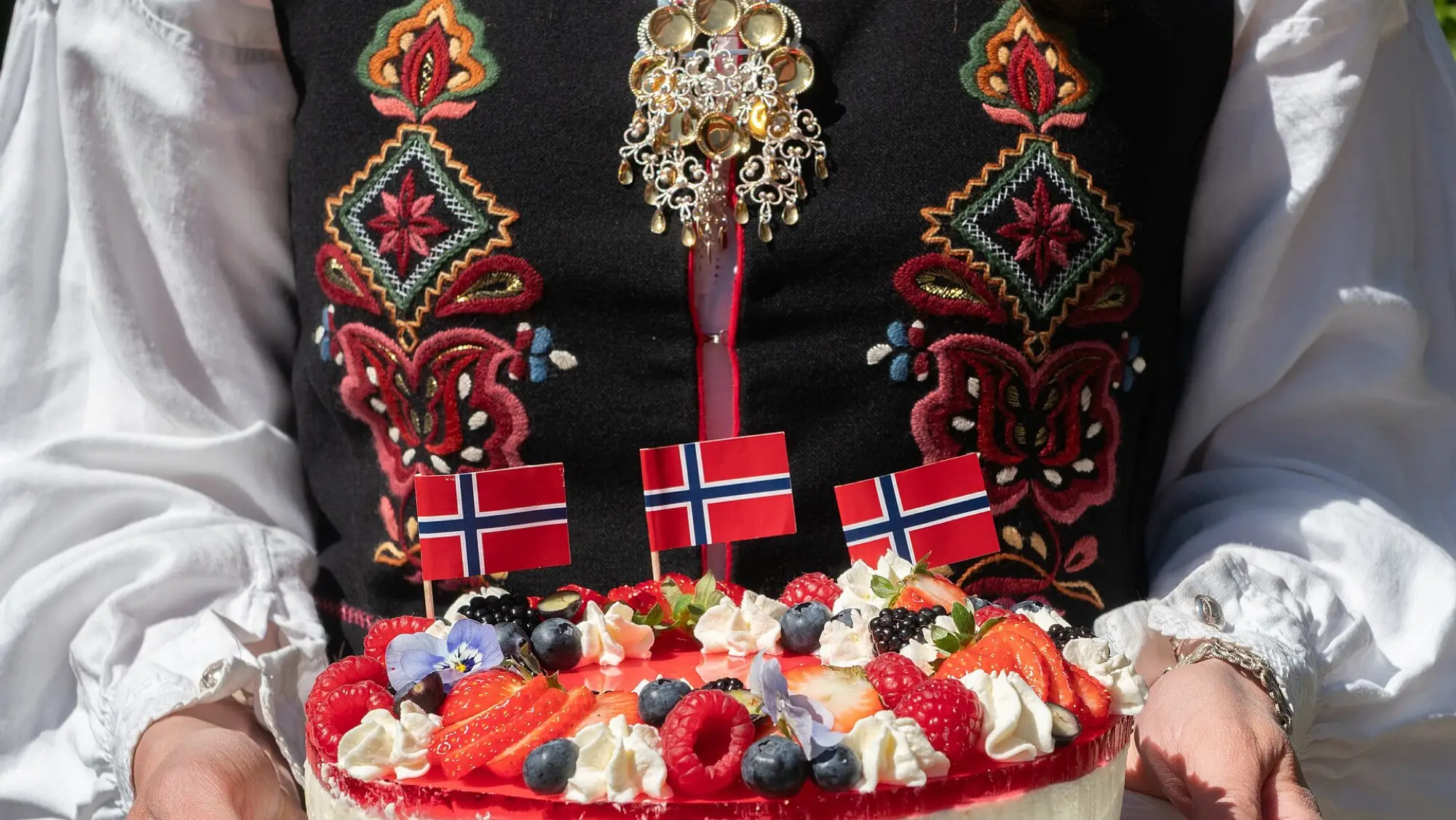

Ten traditions explain most of what a visitor notices in Norway: 17 May and the barnetog (children's parade), the bunad (festive dress), friluftsliv (outdoor recreation) and the right to roam, the hytte (cabin), skiing, dugnad (community work), the matpakke (packed lunch), quiet Sundays, Easter crime novels (påskekrim) and Sámi National Day on 6 February. The guide ends with two words you will hear, koselig and janteloven.
1. 17 May, Constitution Day and the barnetog
Norway's national day falls on 17 May, celebrated because Norway got its own constitution on 17 May 1814; it is also called Constitution Day (grunnlovsdagen). The constitution was adopted unanimously at Eidsvoll on 16 May 1814 and dated and signed the next day, 17 May. Store norske leksikon says 17 May is an official high day and flag day, and that the national day is marked more in Norway than is usual in many other countries, among other things with children's parades (barnetog).
The barnetog is a parade of children in their best clothes, usually organised by school, with banners, school bands and large Norwegian flags at the front; the children carry hand flags, sing and shout hurra. The first barnetog came about in 1870, on the initiative of the writer Bjørnstjerne Bjørnson. Girls first joined in 1889. 17 May parades are now held in every Norwegian municipality, and in many places abroad where Norwegians live. Since 1906 the royal family has greeted the people and the barnetog from the balcony of the palace in Oslo every year, except during the occupation of 1940 to 1945 and the pandemic years 2020 and 2021.
According to the City of Oslo's published plan, the Oslo barnetog starts at 10:00 from the main gate of Akershus Fortress and ends at Rådhusplassen, the City Hall square, at around 13:30; each school takes around 50 to 60 minutes from start to finish. Check the City's page before the day. The parade stops only twice, first at the Storting (parliament) at 10:15 and then at the Royal Palace at about 10:30, where the 17 May committee's leader greets the King and the royal family. The area around the Karl Johan monument at the palace is kept for the public; standing places are drop-in and need no ticket, first come first served, and the area opens at 08:00. Seats must be booked in advance and are kept for older and disabled people. On 17 May, as on 1 May, Sundays and public holidays, shops may not sell beer and other drinks of up to 4.7% alcohol, under the Alcohol Act. For Norsk Folkemuseum, Holmenkollen and the rest of the city, see things to do in Oslo.
2. The bunad, Norway's festive dress
A bunad is an outfit worn for celebrations and high days; bunads differ in how closely they are tied to history and to one place. Today the bunad is worn at christenings, confirmations, weddings, graduations and on 17 May, and it can also be worn where the dress code is black tie, at dinners at the palace and at the opening of the Storting. In 2024 the use of the bunad in Norway was inscribed on UNESCO's Representative List of the Intangible Cultural Heritage. There are about 450 different bunads in Norway today. Store norske leksikon says around 70 percent of Norwegian women own a bunad, and just over 20 percent of men.
The first book on Norwegian bunads, Hulda Garborg's Norsk klædebunad, came out in 1903 and introduced the term bunad. Bunad wearing has had three big upswings, at the break-up of the union with Sweden in 1905, after the Second World War, and after the Lillehammer Olympics in 1994. Norway's knitwear has its own page: Norwegian sweaters.
Norsk Folkemuseum on Bygdøy, 5 km from the city centre, has a folk dress exhibition showing how the bunad is worn today, older local costumes and the Sámi gákti (traditional clothing). Adult tickets cost NOK 200 and children aged 0 to 17 go free. From 1 May to 4 October it is open every day, 10:00 to 17:00. From 5 October to 30 April the museum is open Tuesday to Sunday, 11:00 to 16:00, and closed on Mondays. The museum is closed on 1 January, 17 May and 24 and 25 December.
3. Friluftsliv and the right to roam
Store norske leksikon defines friluftsliv as non-motorised travel, stays and activities in nature for the sake of recreation. The word friluftsliv was probably first used by Henrik Ibsen, in 1859, in the poem På vidderne. Between 70 and 80 percent of the population said that in 2020 they went hiking in forest and field, went on short ski trips or swam outdoors; Store norske leksikon notes that self-reported figures usually run somewhat higher than the real ones.
The right to roam, allemannsretten, is set out in the Outdoor Recreation Act (friluftsloven) and covers the right to pass through, to stay and to harvest. The Norwegian Environment Agency says allemannsretten gives everyone the right to walk freely and stay where they like in nature, whoever owns the land. It also gives the right to harvest from nature, such as saltwater fish, berries, mushrooms and wild flowers. The right applies in uncultivated land (utmark); cultivated land and the land around homes (innmark) are excluded. Camping or sleeping out must be more than 150 metres from an inhabited house or cabin. To stay more than two nights in the same place you need the landowner's permission, unless you are far from settlement or in the high mountains. The right does not cover driving motor vehicles such as snowmobiles in uncultivated land, nor freshwater fishing, hunting or riding an e-bike. From 15 April to 15 September you may not light a fire in or near forest and other uncultivated land without the municipality's permission, unless it obviously cannot cause a fire. For places to walk, see Norway national parks.
4. The hytte, the family cabin
Hytte is a Norwegian term traditionally used for a small building, in the mountains, by the sea or in forest and field, meant for short stays with few or no modern comforts. Cabins became a mass phenomenon in Norway in the 1960s. Statistics Norway opens its fact page on cabins with the line that Norwegians love being at the cabin, and counts 452,150 cabins and other holiday buildings in Norway in 2026. Cabins are traditionally simply furnished and often have a cabin book (hyttebok) where guests write about their stay and the weather.
Between the world wars Oslo's working class took over the small islands in the Oslofjord and built several hundred tiny, colourful wooden cabins on Bleikøya, Nakholmen and Lindøya. Ruter's boat B1 from Aker brygge in central Oslo stops at the cabin islands of Lindøya and Bleikøya, among other islands. You can reach these on several day trips from Oslo. The largest owner of tourist cabins open to the public is the Norwegian Trekking Association, Den Norske Turistforening (DNT). DNT's local member associations run about 600 cabins across the country; read more on how to stay in DNT cabins.
5. Skiing, and Holmenkollen
Cross-country skiing is one of the most widespread outdoor leisure activities in Norway. Store norske leksikon says the saying "Norwegians are born with skis on their feet" (nordmenn er født med ski på beina) tells a lot about the tradition of cross-country skiing.
Holmenkollen is a hill about 9 kilometres north-west of central Oslo, best known for the Holmenkollen ski jump; the ski museum is at the jump. The Holmenkollen Ski Museum covers 5000 years of skiing history; it celebrated its 100th anniversary in 2023 and has been renovated. The ski museum and jump tower are open seven days a week all year; from January to April the hours are 10:00 to 16:00. In 2026 a ticket costs NOK 200 for adults and NOK 100 for children aged 6 to 17, and every ticket covers both the ski museum and the jump tower. Take metro line 1, the Frognerseteren line, to Holmenkollen station; the walk from there is 10 minutes, only a few hundred metres but steep.
Many forest roads and ski trails around Oslo are lit; the city's first lit trail opened in 1946, from Frognerseteren to Tryvann, and the lights stay on until 23:00 in the evening. In winter the City of Oslo's own crews groom about 350 kilometres of ski trails with grooming machines and about 100 kilometres with snowmobiles, in the city and in the Marka forest. For skiing, lit trails and Holmenkollen, see Oslo in winter.
6. Dugnad, the shared work day
Dugnad is voluntary, unpaid work done together as a community. It is a common way of working in housing co-operatives and jointly owned buildings, where everyone pitches in instead of hiring others to do the job, for example the spring dugnad. Clubs and associations also use dugnad to put on events such as flea markets (loppemarked) and concerts. The people who turn up are usually treated to food and drink.
The word comes from Old Norse dugnaðr, "help, support", and is not used for an organised form of work in the other Nordic languages. Dugnad was voted Norway's national word by the NRK programme Typisk norsk in 2004.
7. The matpakke, the packed lunch
A matpakke is a cold meal, usually open sandwiches, wrapped in paper or packed in a lunch box, meant to be eaten away from home. A typical Norwegian matpakke is 2 to 4 slices of wholemeal bread with toppings such as cheese, ham, liver pâté, caviar spread or mackerel in tomato, wrapped in paper with a sheet between the slices (mellomleggspapir). Only in the early 1900s did bread replace porridge as the midday meal. Surveys show that about four in ten adults eat a homemade matpakke at school or work three days a week or more. The matpakke is also common on hikes and other outdoor trips.
Brunost, brown cheese, is a traditional Norwegian sandwich topping made from boiled-down whey; it is cut with a cheese slicer and is common on bread, waffles and crispbread. The dairy TINE says most Norwegians eat brown cheese on their sandwiches, cut into thin slices with a cheese slicer, which it calls another Norwegian invention. For serving details, read about brunost.
8. Quiet Sundays
Under the Public Holidays Act (helligdagsfredloven), every ordinary Sunday counts as a public holiday (helligdag), as do New Year's Day, Christmas Day and Boxing Day and the Easter, Ascension and Whitsun holidays. On these days, from midnight to midnight, the law calls for holiday peace (helligdagsfred) that no one may disturb with improper noise. Shops selling to consumers must stay closed on these days, and close early on Christmas Eve, Easter Saturday and Whitsun Eve.
The exceptions include kiosks and grocery shops with no more than 100 square metres of sales space, petrol stations of up to 150 square metres, campsite shops in the camping season, shops in areas the county governor has named typical tourist places, and cafés and restaurants. Under the Alcohol Act, shops may sell beer no later than 20:00 on weekdays and 18:00 on the day before a Sunday or public holiday; the municipality sets the exact hours within those limits. On Sundays and public holidays shops sell no beer at all.
9. Påskekrim, crime stories at Easter
Maundy Thursday, Good Friday, Easter Sunday and Easter Monday are all public holidays under the Public Holidays Act. Store norske leksikon calls påskekrim a peculiarly Norwegian phenomenon in which crime stories of all kinds are tied closely to Easter; crime novels are published and marketed especially before Easter, and TV channels, radio and streaming services show crime series.
The tradition is usually traced back to the 1923 thriller Bergenstoget plyndret inat! (The Bergen train robbed tonight!), written by Nordahl Grieg and Nils Lie under the pen name Jonathan Jerv. The publisher marketed it with an advertisement that made it look as though the train really had been robbed. The habit of reading crime at the Easter cabin is why so many crime novels come out early in the year in Norway. In 1976 the broadcaster NRK first showed crime on Maundy Thursday and Good Friday, and it has been an unbroken tradition since. Crime mysteries are even solved in comic strips and on milk cartons. At Easter, Norsk Folkemuseum puts on an Easter crime mystery and family activities.
10. Sámi National Day, 6 February
Sámi National Day is 6 February, a shared celebration for Sámi in every country. The date marks the first large Sámi meeting, held in Tråante (Trondheim) from 6 to 9 February 1917, proposed by the activist Elsa Laula Renberg. The Sámi Conference chose 6 February unanimously in 1992. Since 2003, 6 February has been an official flag day in Norway. On the day people congratulate each other by saying lihkku beivviin in North Sámi. Celebrations range from flags, Sámi food and the national anthem to week-long festivals, and schools and kindergartens in particular mark the day. Learn more about traditions across the calendar in Sámi culture in Norway.
Sámi Week in Tromsø runs from 31 January to 7 February 2027, around Sámi National Day on 6 February. Sámi Week, run by the Midnight Sun Marathon foundation since 2004, has lectures, concerts, exhibitions and Sámi crafts; on 6 February the day starts with a communal breakfast in the city. The Norwegian reindeer racing championships are on Sunday 7 February 2027 on Storgata in Tromsø; the reindeer pull drivers on skis over a 201-metre sprint and can reach up to 60 km/h. Tickets for the reindeer racing cost NOK 250 for adults, free for children under 16, and are sold at Tromsø Kulturhus.
Two words you will hear, koselig and janteloven
The Norwegian Academy's dictionary says koselig describes something that creates or is marked by a snug, friendly atmosphere or well-being, such as a cosy living room. Said of a person, koselig means pleasant, likeable or friendly. The Bokmål dictionary defines koselig as "that comes with kos", with the examples a cosy home, a cosy gathering and a nice guy.
Janteloven, the Law of Jante, comes from the fictional small town of Jante in Aksel Sandemose's 1933 novel En flyktning krysser sitt spor; it has ten rules describing norms in small communities where individuality and success are often met with scepticism or envy. The first rule reads "Du skal ikke tro at du er noe", you are not to think you are anything special. Store norske leksikon says the law has been used to explain why there is often a reluctance to stand out or show off one's own achievements, and that it has parallels in other cultures, such as Britain's tall poppy syndrome. Sandemose was born and died in Denmark but lived in Norway from about the age of 30 and became a Norwegian writer. To compare koselig and janteloven next to their Finnish, Swedish and Danish cousins, see Nordic words explained.