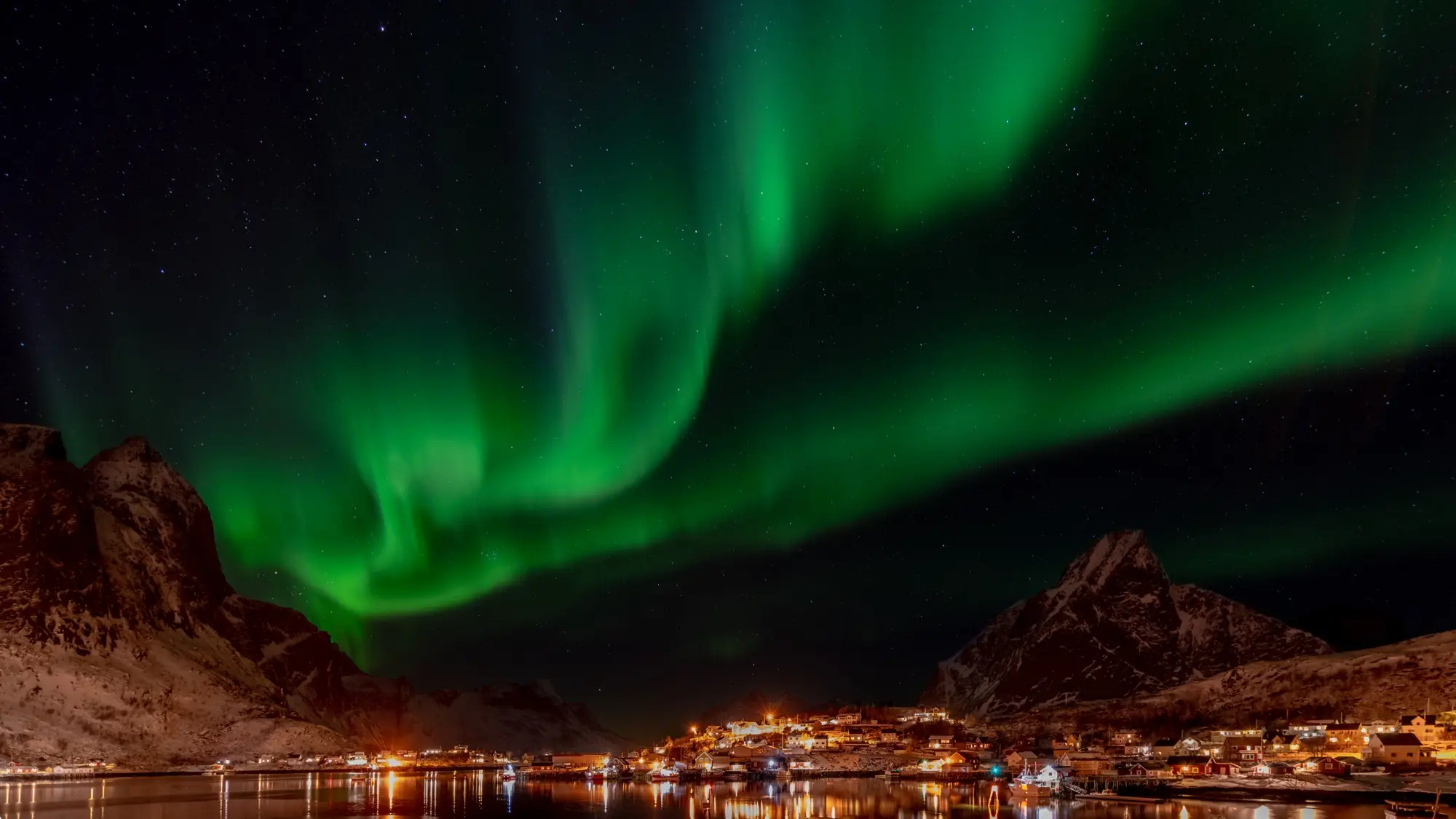

Northern Norway, northern Iceland, Swedish Lapland and northern Finland sit under or near the auroral oval, where under the oval the northern lights can be seen on more than half the nights of a year. Once you are under the oval, tonight's cloud cover matters more than which town you picked, and spending more nights gives you better odds than travelling to a better location. You can track tonight's aurora forecast for each place.
Where you can see the northern lights
According to the NOAA Space Weather Prediction Center, the best place to see the aurora is under the oval, between latitudes of about 60 and 75 degrees, where it can be seen on more than half the nights of a year. The Finnish Meteorological Institute states that the aurora forms an oval band around the geomagnetic poles, that about 2,500 km from the poles the probability of seeing it is almost 100%, and that the northern parts of Fennoscandia belong to the maximum auroral zone.
The Northern Norway tourist board describes the oval as stretching over northern Norway, northern Iceland, Canada, Alaska and northern Russia, and says parts of Sweden and Finland are close enough to see the same displays at a different angle.
Going further north does not keep improving the odds. The Finnish Meteorological Institute says the aurora is seen every night on the Arctic Ocean coast of northern Norway, that aurora nights become fewer again further north inside the oval, and that they fall off quickly to the south.
When to go for the northern lights
The sky has to be clear and dark, so in the summer months at auroral latitudes the midnight sun makes the aurora impossible to see. The Finnish Meteorological Institute gives the best months as February to March and September to October, and says the aurora cannot be seen in the summer months because the nights are light. You can see when the nights get dark enough at each place, computed for every date, in our guide to daylight through the year.
Around the spring and autumn equinoxes the Earth's position in the solar wind lets its energy into the magnetosphere most efficiently, so magnetic storms are on average more common in autumn and spring than in summer and winter. Late winter and early autumn are statistically the best times for the aurora, and because spring is also on average a less cloudy time, the Finnish Meteorological Institute recommends March for waiting for the northern lights. For a wider view of conditions across the year, see our guide to the best time to visit Finland.
The Finnish Meteorological Institute gives the best time to see the aurora as between 9 p.m. and 1 a.m. local time. In Lapland the chance of aurora passes 50% by nine in the evening (Finnish winter time), peaks around 23.30, the magnetic midnight, when the magnetic disturbances are strongest, and drops below 50% by four or five in the morning.
The Swedish Lapland visitors board counts light pollution of every kind, from streetlights to the full moon, as a factor in seeing the aurora. The moon and the aurora are independent of each other, northern Norwegian photographers are often out on full-moon nights, and the Northern Norway tourist board says a full moon should not stop you chasing the northern lights.
The best places in Finland
By the Finnish Meteorological Institute's statistics, three nights out of four have the northern lights in northern Lapland, the Kilpisjärvi–Utsjoki area, provided the sky is clear enough of cloud. In Finland the aurora is most frequent near the latitude of Kilpisjärvi, where it is seen on average on three clear dark nights in four (75%); in Utsjoki the figure is about 10 percentage points lower. For regional advice and camera settings, read our guide to the northern lights in Finland.
Moving south the aurora becomes less frequent; in Sodankylä every second night is an aurora night, in Helsinki once a month. The Finnish Meteorological Institute puts central Lapland (Ylläs, Levi, Sodankylä) at three or four nights a week, the Oulu–Kuusamo latitudes at one night in four and the south coast at once a month, and says this is how often the aurora could be seen if every night were dark and cloudless.
The Finnish statistics rest mainly on aurora observations from the 1990s; in the quiet years 2006 to 2009 the aurora was seen in Kilpisjärvi only about every second night.
Go to an open place as dark as possible, away from the light pollution of towns; in southern Finland especially the aurora is most often in the northern sky, so the best spot has a clear view at least to the northern horizon.
Visit Rovaniemi gives the northern lights season in Rovaniemi as late August to early April, on clear, dark nights away from city lights. Saariselkä is reached through Ivalo Airport, Finland's northernmost airport, which has daily flights from Helsinki and winter connections from several European cities. Lapland North says Inari lies under the auroral oval.
The coast of northern Norway
The Northern Norway tourist board says the region lies under the northern lights oval, is easy to travel to, has good infrastructure and has the mildest climate in the Arctic, and that the northern lights belt runs along its coast from Lofoten to the North Cape.
In northern Norway the first aurora is often seen around mid to late August; from around mid September to the end of March the chances are at their maximum; by late April daylight has completely outdone the northern lights. Visit Tromsø says the aurora may be seen in the Tromsø region from late August to early April whenever the sky is dark and clear enough, but most northern lights activities do not start until early September, and they and accommodation are often fully booked. Some people believe the aurora is stronger in periods of high solar activity because the oval expands; Visit Tromsø says research shows that this has little impact on the activity directly below the oval, such as in Tromsø.
Visit Lofoten says the aurora is potentially visible over Lofoten from late August until mid April. Visit Lofoten says Lofoten's coastal climate means temperatures remain quite mild compared with inland destinations; its example is photographing at -2 °C rather than -20 °C. Lofoten has airports at Leknes and Svolvær, and Visit Lofoten says the northern side of Lofoten, with most of the best aurora-watching places, is free from the interference of light pollution.
The Northern Norway tourist board says that thanks to Alta's dry and stable climate the northern lights were observed and measured there, with the world's first northern lights observatory built on Haldde mountain in 1899; guides there take visitors into the Altadalen valley, up onto the plateau or out along the coast, wherever they believe there is the best chance of clear skies.
The mountains of Swedish Lapland
The Swedish Lapland visitors board says Abisko lies inside the aurora oval and usually in a rain shadow, with one of the lowest rainfall climates in the Nordic area, which means more clear nights, sometimes more than two weeks of aurora nights in a row.
The Aurora Sky Station sits on Mount Njullá at 900 metres, in a spot with very few sources of light; the chairlift up from STF Abisko Turiststation takes about 20 minutes. Abisko National Park is about 100 km northwest of Kiruna; there are daily flights to Kiruna, and from there a train or bus.
Kiruna's tourist board gives the season as September to March, with the aurora often seen from the end of August and as late as April, and the strongest displays usually in September, October and March.
Iceland, from the city to the dark
Visit Iceland says Iceland's location close to the Arctic Circle puts it within the auroral zone, and that in the darker months the aurora can be seen across the country when skies are clear and solar activity is favourable. Iceland's northern lights season runs from September to April; the aurora is said to be most active around the equinoxes in September and March, while midwinter gives a longer window of darkness each day.
On a clear, active night the aurora is often visible from Reykjavík, but sightings are much better outside populated areas, away from the capital's light pollution. Within Reykjavík the aurora is rarely strong enough to outshine the city lights, but the city has parks and reserves without street lights; the coastal walk to Grótta takes about an hour from the centre, and the Heiðmörk reserve is quieter.
Visit Iceland describes the aurora belt as latitudes 60° to 75° north with Iceland roughly in the middle, and Reykjavík as a major hub of international flights, far easier to get to than the aurora destinations of northern Canada, Alaska and Scandinavia.
Cloud decides more than latitude
Weather does not affect whether the aurora occurs, but because its light is made above all the clouds it cannot be seen through thick cloud. The Swedish Lapland visitors board says that under the auroral oval, from Kiruna to Abisko, the question is not so much whether there are northern lights as whether the sky is clear, so an aurora chase is really a chase for clear skies.
In northern Norway the regions further inland, sheltered from the ocean by high mountains, generally have a more stable climate with more cloudless nights, but when cold easterly winds blow in winter the coast is clearest; the weather can vary within a few kilometres, so being mobile helps.
The Icelandic Met Office says the aurora needs dark and partly clear skies, and its aurora forecast combines aurora activity, cloud cover, sunlight and moonlight. Visit Iceland's advice is to check both the cloud cover and the aurora activity, to give yourself several nights, and to accept there are no guarantees.